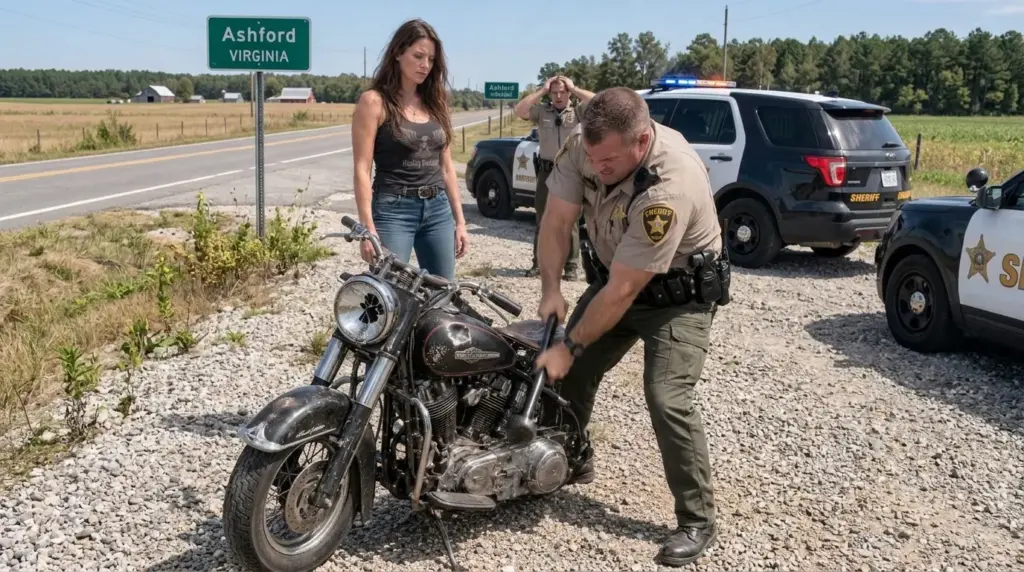
Boone pulled out a chair and sat down. “You need to understand where we are. A federal agent was stopped on your road. You damaged her motorcycle. You opened her saddlebag. You found her credentials. Those are your actions.”
“You knew what happened the minute I called you.”
“And I told you how to prevent it from becoming worse.”
Mercer gave a short laugh. “You told me not to bring her to the station because you had already created a problem. You built the seizure process.”
Boone leaned back. “Be careful.”
“I know how this works: find the right vehicle, create a reason to hold it, get the value down, then move it through Hensley.”
Boone’s voice became quiet. “Do not say another word.”
Mercer looked toward the hallway where Maya was being held. “She was right.”
Boone’s expression changed. “About what?”
“You are going to put this on me.”
“I am trying to keep both of us out of a federal case.”
“No. You are trying to keep your name off the paperwork.”
Boone stood. “You want advice? Stop talking, follow instructions, and let me manage this.”
Mercer picked up the draft report. “No.”
Boone stared at him.
“I want my own copy.”
“You do not need one.”
“That is exactly why I want one.”
Mercer folded the pages and put them inside his jacket before Boone could stop him.
At her home, Ruth Walker was reading a letter that had arrived by hand less than an hour earlier. The envelope carried the name of a local law office. The letter warned that public distribution of incomplete footage could interfere with an active investigation and expose her to legal claims if the material was presented without context.
Ruth read it twice. Then she called Laura Chen.
“I got something from a lawyer.”
“What does it say?”
Ruth read the main paragraph aloud.
Laura asked, “Does it order you to do anything?”
“No. It says I should preserve the video and avoid distributing it.”
“That part is reasonable. Anything else?”
“They keep using the word ‘misleading.'”
“Did they identify who hired them?”
Ruth checked the bottom of the page. “No.”
“Keep the letter. Keep the envelope. Do not respond yet.”
Ruth sat down at the kitchen table. “They know I have the video.”
“Yes.”
“They want me scared enough to stop talking.”
Laura paused. “Does the letter change what you saw?”
“No.”
“Then stay with what you know.”
Ruth looked at the notebook where she had written the sequence from the roadside. “I’m not changing anything.”
After the call, Laura added the letter to the growing timeline. Pressure on Ruth meant someone in Ashford was actively trying to control witnesses. That made Noah Alvarez more important.
At the sheriff’s office, Noah discovered the same thing in a different form. A new internal draft had appeared in the case folder. This version described him as the deputy responsible for confirming the vehicle identification and communicating the result to Mercer. That part was true. The next sentence was not: it said Noah had reported uncertainty about the database return.
He read it again. Then he kept going. The report stated that Mercer acted after receiving conflicting information from his junior deputy.
Noah stood up and went directly to Boone’s office. Boone was not there. He found another sergeant at the desk.
“Who added this?”
The sergeant looked at the page. “I don’t know.”
“It says I gave Mercer conflicting information.”
“Did you?”
“No.”
“Then talk to Boone.”
“I’m trying to.”
The sergeant shrugged. “That’s all I can tell you.”
Noah took a photo of the draft with his phone. He understood what Boone was doing: if investigators proved Mercer had damaged the engine case after a valid return, Boone could claim the confusion began with Noah; Mercer would say he relied on field information; Boone would say he relied on Mercer. Noah would become the easiest person to blame because he had the least power.
He left the building and sat in his car. For several minutes, he did nothing. Then he called the number Laura Chen had left with him through an intermediary earlier that night.
She answered quickly. “Noah Alvarez?”
“Yes.”
“Are you somewhere you can speak privately?”
“I’m in my car.”
“Go ahead.”
Noah looked through the windshield at the dark sheriff’s office. “Maya Williams is being held at a private tow yard.”
Laura’s voice remained controlled. “Name?”
“Hensley Recovery and Storage.”
“Address?”
He gave it.
“Are you certain she is still there?”
“She was when I left.”
“Is there an official booking?”
“No.”
“Arrest record?”
“No.”
“Was she free to leave?”
“No.”
Laura paused briefly. “What about the motorcycle?”
“Same place. At least it was.”
“Why are you telling me now?”
Noah looked down at the unsigned report on the passenger seat. “Because they are changing the record.”
“Who?”
“Boone. Mercer is involved, but Boone is controlling the paperwork.”
“What did you personally see?”
Noah answered carefully. “I ran the identification twice. It came back valid both times. Mercer struck the engine case after I told him that. Then he claimed the number had already been damaged. He broke the headlight and dented the tank. Maya never resisted.”
Laura did not interrupt.
Noah continued. “They took her to Hensley after Mercer cleared the stop through dispatch. Boone came later. He told them to keep her off the books.”
“Did you hear him say that?”
“Yes.”
Laura asked one final question. “Are you willing to put your name under that statement?”
Noah looked at the sheriff’s office again. “Yes.”
Laura ended the call and immediately moved the team toward Hensley.
The legal process took time: statements had to be confirmed; authority had to be established; location information had to be checked.
By the time federal investigators reached the industrial road leading to Hensley Recovery and Storage, the front gate was open. The yard was quiet. Laura entered with the team and went directly to the office.





