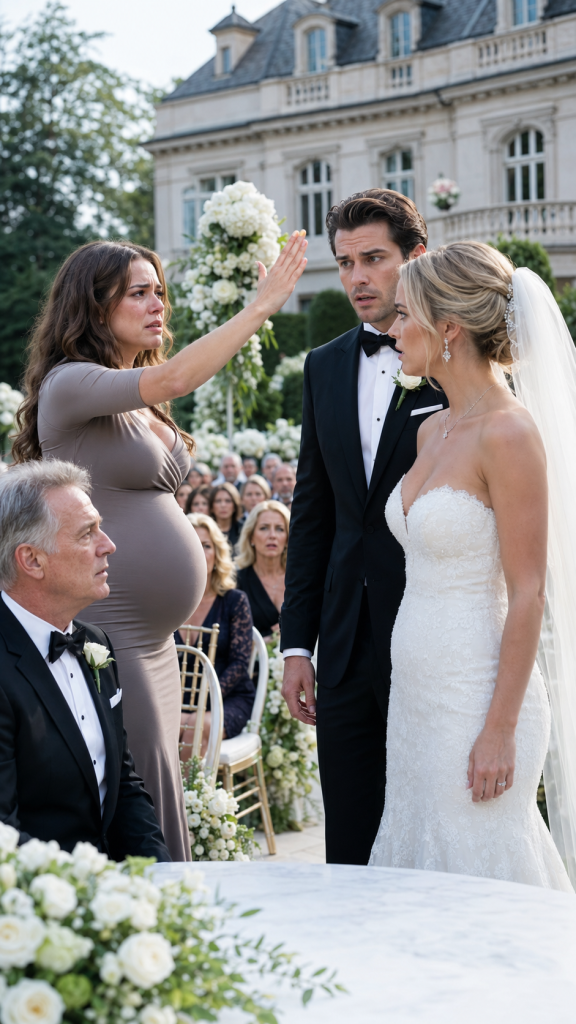
The hydrangea blooms on the manicured clifftops of Bellevue Avenue had been cultivated to a pale, porcelain perfection, matching precisely the faille silk of Clara Montgomery’s hem. Three hundred guests sat upon whitewashed Chiavari chairs, sheltered beneath a cathedral of woven white wisteria that fluttered in the saline draft climbing the bluffs of Rhode Island Sound. It was the sort of light that money commanded: golden, filtered, unyielding.
At the center of that light stood Julian Sterling, impeccably tailored in midnight Barathea wool, his cuff links bearing the discreet Roman coin crest of a family whose grand Manhattan townhomes had quietly dissolved into trusts and quiet mortgages twenty years before anyone had the poor taste to notice.
Clara had chosen him because he listened with an intensity that felt ancient, almost reverent. When she spoke of restoring her late mother’s foundation or the exhausting weight of being Arthur Montgomery’s only surviving heir, Julian’s gaze never drifted. He had held her trembling hands during the endless galas of the winter season; he had memorized the cadence of her laughter. He had made himself indispensable, an elegant buttress against the cold, echoing hallways of the family estate.
The presiding bishop cleared his throat, lifting a calfskin book. “If any person can show just cause why they may not be lawfully joined together, let them speak now, or else hereafter forever hold their peace.”
The customary, polite pause hung in the salt air. A shutter clicked somewhere near the hedge.
Then came the rustle of gravel—brisk, heavy, and utterly devoid of hesitation.
A woman walked up the central flagstone aisle. She wore no hat, no pastel linen, no pearls. Her coat was navy wool, unbuttoned despite the coastal wind, hanging wide over the unmistakable, rounding swell of an advanced pregnancy. Her dark hair was wind-bitten, pulled into an unadorned knot, and her leather boots made an ungodly, hollow scuff against the runner of white linen that Clara had spent three months sourcing from Lyon.
A private security officer at the perimeter moved forward, his hand drifting toward his radio, but before his fingers could close on the clip, the woman accelerated her pace. She did not yell. She did not shout Julian’s name.
She bypassed the groomsmen, climbed the two limestone steps of the chancel, and stopped directly in front of Clara Montgomery.
The slap cracked like a rifle shot over the water.
The sound tore through the wisteria. Clara’s head snapped sideways; her bouquet of gardenias and stephanotis tipped, spilling two crushed white heads onto the stone. Her left hand rose instinctively, fingers splaying over the heat blooming across her cheekbone. A single pearl earring trembled violently against her pale jaw.
Around the altar, the silence was immediate and suffocating. Three hundred socialites froze in their seats, champagne flutes halfway to lips, silk wraps slipping from sun-warmed shoulders.
Clara gasped, the breath catching in her throat like a splinter. Her gaze, wide and bewildered, shifted from the navy wool of the intruder’s coat up to her face. The woman had green eyes—vivid, bloodshot, and rimmed with a cold, terrifying stillness. There was no theatrical hysteria in her posture; her jaw was locked, her chest rising and falling in deep, measured strokes.
Julian didn’t speak. He didn’t drop into the posture of a protective fiancé. Instead, the color drained from his face with the speed of an open drain, leaving his tailored features gray and slack.
“You’re marrying the father of my baby,” the woman said.
Her voice was neither shrill nor loud, but in the deadened air beneath the canopy, every syllable carried cleanly to the tenth row.
Clara turned toward Julian. The movement was slow, mechanical, the desperate reflex of a woman seeking the harbor she had been promised. She waited for the laughter, the incredulous scoff, the swift gesture of a gentleman defending his honor against a madwoman. She waited for him to look at her.
Julian looked down at the runner. His gaze traced the seam of the linen, darting toward the sea, toward the hedges—anywhere except the eyes of the woman he was five minutes from binding to his name.
That was the first confession.
“Elena,” Julian hissed. The veneer shattered instantly, replaced by a low, guttural panic. He lunged forward, catching her right wrist in his fist. It was not a gesture of restraint meant to protect; it was a rough, dragging jerk designed to haul her off the dais, behind the boxwoods, into the shadows where inconvenient things could be silenced with money or threats. “Get off the lawn. Now.”
Elena did not flinch. She set her boots firmly into the turf, dropping her center of gravity against his pull. Her green eyes drilled into his face with an absolute, terrifying absence of fear.
“Let go of me, Julian,” she said.
“I told you not to come here,” Julian snarled, the words escaping through his teeth before his frantic mind could filter them.
The sentence landed in the pavilion with the finality of a dropped stone.
Clara went utterly motionless. The burning on her cheek was suddenly distant, replaced by an icy clarity that rushed from her scalp to her slippers. I told you not to come here. Not who are you. Not you have the wrong man.
He had known. He had managed the perimeter. He had calibrated the risk.
Elena wrenched her arm backward with a sharp, violent snap of her elbow. Julian’s hand broke free, his arm dropping limp against his trousers.
She did not look at him again. Turning deliberately back to the altar table—a mahogany console draped in antique Belgian lace where the register and gold signing pen lay waiting—she reached into the pocket of her navy coat. She pulled out a small, folded slip of glossy paper, flattened it with the heel of her hand, and placed it directly over the open Montgomery family Bible.





