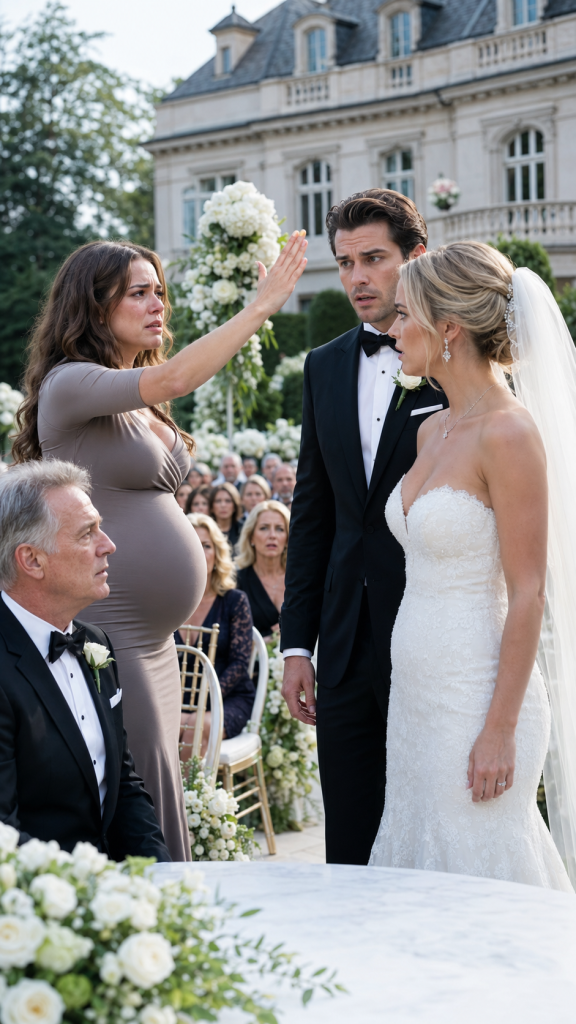
For six months, she had seen a prince. She had seen an intellectual equal, a man of refined tastes who preferred quiet dinners overlooking the cove to the garish parties of Southampton. She had seen a partner who dried her tears when she woke from nightmares about the hospital room where her mother had faded away.
Now, she looked at the hollow in his throat, the sheen of panic on his upper lip, the slight, involuntary twitching of his fingers against his tailored knee. The mask hadn’t slipped; it had dissolved entirely, exposing the frantic, predatory creature underneath.
“The foundation,” Clara said. Her voice was remarkably steady, though it lacked any trace of warmth. “Did you ever intend to open the wing for the pediatric hospice?”
Julian swallowed hard. “Clara—”
“Did you?”
Elena spoke from beside the Bible. “He already signed the preliminary sale agreement for the Hudson Valley land your mother left you. He sent the broker’s letter to my inbox by mistake two months ago, trying to prove how much capital he was about to control. He was going to flip it to a commercial resort developer forty-eight hours after the wedding.”
Julian lunged to his feet, lunging toward Elena with an arm raised. “You vindictive little—”
Before he could bridge the two feet between them, two state troopers and Arthur’s head of security tackled him to the limestone floor. The collision of bodies was loud, wet, and undignified. The antique signing table shook; the crystal vase holding white peonies toppled, water spilling across the Montgomery family Bible and soaking the edges of the ultrasound scan.
Julian thrashed, his face pressed against the flagstones, his midnight-blue jacket tearing at the shoulder seam. “Arthur! Arthur, let’s talk in the study! We can settle this! Clara! Look at me!”
Clara did not look down.
She reached up with both hands, took hold of the antique lace veil that had belonged to three generations of Montgomery brides, and pulled the pearl-topped pins from her hair. She did not rip it; she simply slid it free, letting the delicate, hundred-year-old fabric pool onto the stone aisle.
She turned to Elena Vance.
The woman in the navy coat stood with her arms wrapped around her stomach, breathing hard, the color slowly returning to her hollow cheeks. The anger that had sustained her walk down the aisle had receded, leaving behind an exhaustion so deep it seemed etched into her bones.
Clara took three steps forward. The guests held their breath, perhaps expecting a second strike, an aristocratic explosion of pride and fury.
Instead, Clara extended her right hand.
Elena hesitated. Her gaze dropped to Clara’s open palm, then rose to the red welt still marking the bride’s cheekbone. Slowly, hesitantly, she placed her hand into Clara’s. Her skin was rough, cold, and calloused from work that Julian Sterling had never had to do.
“Thank you,” Clara said softly.
Elena swallowed, a single tear finally escaping her left eye and cutting a path through the dust on her cheek. “I’m sorry about your wedding.”
“Don’t be,” Clara replied, her voice ringing clear over the lawn, reaching the farthest rows of the stunned audience. “You didn’t ruin a marriage. You prevented a theft.”
Arthur stepped to his daughter’s side, wrapping a heavy arm around her shoulders. He looked down at the troopers who were hauling Julian to his feet, cuffed behind his back, his face smeared with crushed flower petals and damp stone dust.
“Take him through the service gate,” Arthur said to the troopers. “His luggage is already packed and sitting on the curb outside the service entrance. If he ever steps onto this peninsula again, I will ensure every creditor from Boston to Zurich files their claims simultaneously before sundown.”
Julian tried to speak, but the trooper’s hand on the back of his neck forced his head down, steering him away from the sunlit lawn and down the gravel path that led toward the holding cells of the Newport barracks.
The silence that followed his departure was vast and heavy. The breeze picked up, rustling the thousands of white wisteria blooms overhead, sending a drift of white petals across the chancel like unseasonal snow.
Clara turned to the bishop, who stood frozen with the calfskin book still clasped against his vestments.
“Bishop,” Clara said, her voice carrying an authority she had never known she possessed. “You may close the book.”
She turned to face the three hundred guests—the elite of New York, Boston, and Newport, sitting in their bespoke finery, waiting for the scandal to consume her. Clara lifted her chin. She did not run down the aisle; she did not hide her face behind a bouquet.
“The bar is open on the south terrace,” Clara announced evenly to the crowd. “The string quartet will continue to play. Please enjoy the afternoon. My family and I have private business to conclude.”
Without waiting for their reaction, she took Elena by the elbow. “Come inside,” Clara said gently. “You’ve been on your feet too long, and we need to call an obstetrician to make sure the baby is well.”
Elena looked at her, stunned by the calm grace in the other woman’s eyes. “You don’t hate me?”
Clara glanced back one last time at the chancel—at the crushed flowers, the overturned water, and the dark blue coat standing beside her.
“You saved my life,” Clara said, leading her toward the French doors of the great stone house. “The least I can do is make sure he pays for yours.”
Behind them, the string quartet hesitantly picked up their bows, striking the first, uncertain notes of a Bach prelude, while out on the cliffs, the ocean continued its ancient, uncaring rhythm against the rocks, washing away the remnants of a day that was supposed to be a gilded cage, and had instead become an open door.





