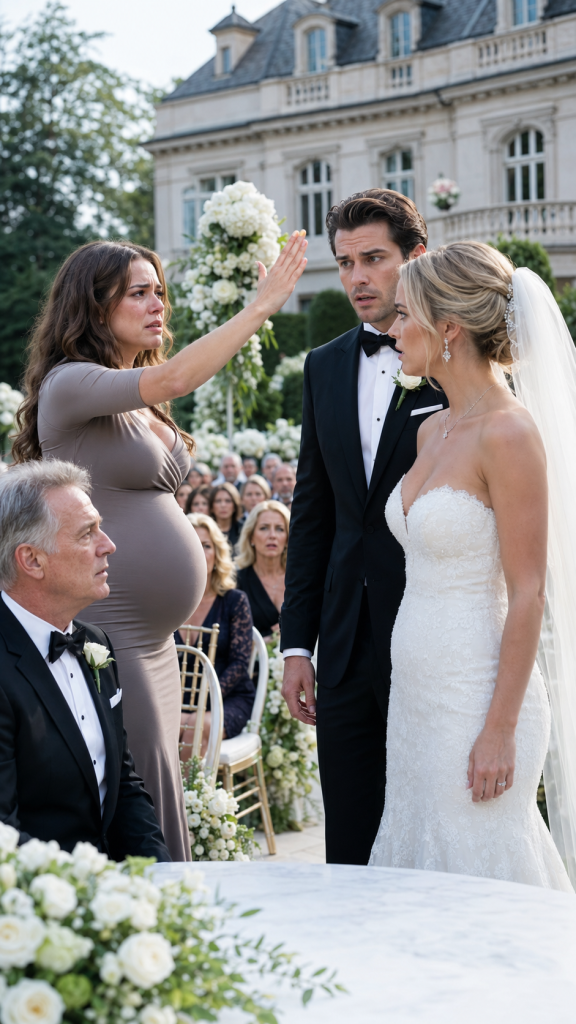
She took a shaky breath, her gaze falling to Clara’s reddened cheek.
“I needed you to hate me for three seconds,” Elena said, “so you would look at him long enough to see what he really was.”
Clara stood motionless. A cool gust of wind whipped across the terrace, lifting the wisteria petals and scattering them across the hem of her wedding dress.
Slowly, deliberately, Clara reached out and took Elena’s right hand—the hand that had struck her. Elena flinched, but Clara didn’t pull away. She wrapped her fingers around the cold, work-roughened knuckles and held them tight.
“You saved my life,” Clara said.
Elena’s jaw trembled. A single, ragged sob broke from her chest, followed by another, until she was weeping silently, her forehead dropping toward Clara’s shoulder. Clara did not hesitate; she pulled the woman in the navy coat against her chest, letting the salt water of another woman’s grief soak into the seed pearls of her mother’s gown.
Behind them, Arthur Montgomery stepped forward. He did not look at the guests. He looked at the two women standing at the altar.
“Miller,” Arthur called out to the remaining state trooper standing near the steps. “Have the staff car brought around to the east portico. Take Ms. Vance to the guest cottage at Ocean House. Call Dr. Henderson from Newport Hospital. Have him examine her and ensure she has everything she needs.”
“Yes, Mr. Montgomery.”
Arthur walked over to his daughter. He looked down at the veil lying on the communion table, then at Clara’s bruised face.
“Are you all right?” he asked.
Clara released Elena gently, handing her over to the care of Beatrice, who had stepped forward with a wool shawl from the dressing room. Clara looked at her father.
“You knew about the debt three weeks ago,” Clara said, her voice dropping into an icy register that made the old industrialist blink. “You let him walk me all the way to this altar.”
Arthur did not flinch. “I had the fraud indictment secured on Thursday. I could have stopped it at the rehearsal dinner. But Julian had a power of attorney filed in Delaware that would have taken eighteen months to litigate in civil court. I needed him to execute the pre-marital affidavit on site. I needed him to commit the felony in the presence of a federal magistrate.”
He pointed to the second row, where a quiet man with silver hair and a gray suit sat watching with an open leather portfolio.
“Judge Vance was sitting there, Clara. Not as a guest. As a presiding official.”
Clara looked at her father for a long, terrible moment. She saw the calculations, the ledgers, the cold, geometric architecture of a man who had spent fifty years viewing the world as an endless series of balance sheets.
“You used my wedding as a sting operation,” she said.
“I used your wedding to keep you out of a federal courtroom for the next ten years,” Arthur replied without hesitation. “Julian didn’t just want your money, Clara. He was four days away from assigning the Eleanor Montgomery Foundation’s maritime conservation land to a real estate syndicate that would have strip-mined the bluffs. I saved your mother’s work. And I saved you.”
“No,” Clara said softly, turning her back on him. “Elena saved me. You just managed the assets.”
She walked to the edge of the limestone terrace, looking out over the three hundred guests who still sat paralyzed in their chairs.
The socialites, the bankers, the cousins who had whispered behind their linen napkins about Clara Montgomery’s late marriage, about whether she had finally found someone worthy of her bloodline.
Clara did not run down the aisle. She did not cover her face.
“The wedding is concluded,” Clara said, her voice ringing out across the lawn with the power of a ship’s bell in the fog. “There will be no reception. However, the champagne is paid for, the kitchen has prepared three hundred portions of salmon, and the string quartet has been booked until five. I invite you all to drink my health, and then leave my father’s property.”
A stunned murmur rose from the crowd, but Clara was already walking.
She descended the limestone steps, not down the center aisle of crushed white linen, but across the open turf toward the cliff walk. She kicked off her satin slippers, leaving them lying like discarded shells in the tall sea grass, and walked barefoot through the damp clover until she reached the granite ledge overlooking the ocean.
Behind her, she heard the low, hesitant murmur of conversation starting up on the terrace—the collective exhale of a society that had just witnessed an execution and was now deciding how to talk about it over caviar.
The wind off the Atlantic hit her face, cold and clean and smelling of deep water. The red mark on her cheek throbbed with a rhythmic, pulsing heat, but the hollow beneath her ribs was gone.
Clara drew a deep, unhindered breath—the first real breath she had taken in six months—and looked out at the gray, horizonless sea. She was alone on the rocks, her dress trailing in the salt grass, her hair wild and unbound in the rising gale, and for the first time in her life, she was not afraid of the weather.





