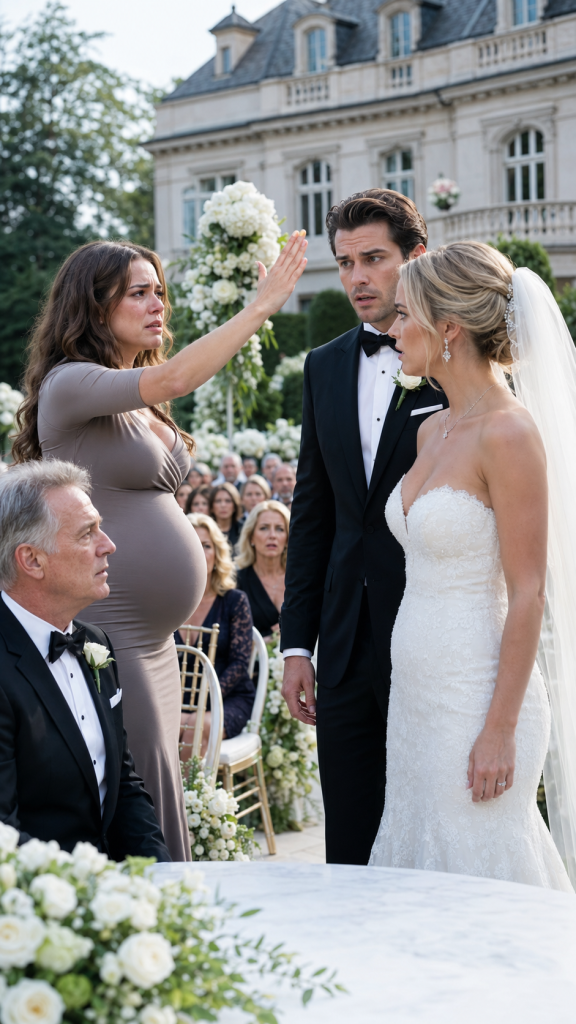
“Dearly beloved,” began the Right Reverend Thomas Hallowell, his voice resonant and buttery from four decades of burying and wedding the Newport registry. “We are gathered together here in the sight of God, and in the face of this company, to join together this Man and this Woman in holy Matrimony…”
Clara handed her bouquet of stephanotis to Beatrice. Her fingers were numb. Across the short expanse of Belgian lace that draped the communion table, Julian looked at her. His eyes were wide, dark, and feverish. He leaned forward an inch, his lips forming a silent word: Breathe.
It was meant to be their private joke. Instead, it struck her like an icy draft.
“…an honorable estate, instituted of God in the time of man’s innocency,” Hallowell intoned, adjusting his gold spectacles. He cleared his throat, pausing for the ritual clause that generations of celebrants treated as a mere theatrical breath. “Therefore if any man can show any just cause, why they may not lawfully be joined together, let him now speak, or else hereafter for ever hold his peace.”
The pause was meant to last three seconds. It was the space where guests smiled indulgently, where bridesmaids smoothed their skirts, where the ocean could be heard sighing against the granite cliffs below.
The sound that broke the silence did not come from the bluffs.
It was the crunch of heavy leather on gravel. Rapid, uneven, and utterly indifferent to the majesty of the surroundings.
From behind the boxwood hedges lining the service driveway, a woman stepped onto the lawn.
She was not running, but she moved with a terrifying, locomotive momentum. Her wool coat was dark navy, worn and unbuttoned, swinging wide with every stride to reveal a knit dress that clung tightly to a belly that was seven, perhaps eight months along. Her boots were scuffed brown leather, stained with road salt and dust, gouging deep divots into the manicured turf. Her dark hair was half-pulled from a utilitarian clip, whipped across her cheeks by the rising sea wind.
A gasp skittered across the back rows like dry leaves before a storm. Two private security guards stationed near the garden gate stepped forward, but the woman didn’t swerve. She didn’t shout. She didn’t wave her arms. She walked straight down the center aisle, her eyes locked onto the altar like crosshairs.
“Stop her,” Julian whispered. The word didn’t come from his chest; it was a dry rattle in his throat. He turned toward the Montgomery security chief standing near the pavilion post. “Security! Remove her immediately! She’s trespassing!”
No one moved.
Clara looked at her father. Arthur Montgomery stood with his hands tucked into his trouser pockets, his chin lifted, his eyes resting upon the approaching woman with an icy, terrifying neutrality.
The woman ascended the limestone steps before the groomsmen could even process the breach. She smelled of damp wool, gasoline, and the bitter cold of a long bus ride. Her face was hollowed out by sleeplessness, the skin beneath her cheekbones drawn tight, but her green eyes burned with a clear, lucid, incandescent fury.
Clara opened her mouth. “Can I help—”
The slap tore through the morning air like a birch branch snapping under heavy snow.
The impact whipped Clara’s head to the right. Her pearls bit into her skin; her veil tore slightly at the crown, the lace fluttering down across her shoulder. Her bouquet-less hands came up automatically to shield her face, her left palm pressing against a cheek that felt instantly on fire.
The garden fell into a silence so absolute that the hum of a single bumblebee in the wisteria sounded like an engine.
“You’re marrying the father of my baby,” the woman said.
Her voice was not shrill. It was pitched low, trembling only with the vibration of a body that had reached the outer limits of its physical endurance.
Clara stood frozen. Her ears were ringing with the shock of the blow, but the physical pain was instantly eclipsed by a strange, dreadful clarity. She did not look at the woman. She looked slowly, deliberately, at Julian.
Julian had backed away until the small of his back hit the altar table. The communion linen bunched beneath his palms. His face was no longer pale; it had assumed the grayish, translucent quality of lard.
“Clara,” Julian gasped, his hands coming up in a desperate, warding gesture. “Clara, she’s—she’s completely deranged. I swear to you, I don’t know who this is. She’s an extortionist. Call the police! Arthur, for God’s sake, call the police!”
The woman didn’t strike him. She looked at him with an expression that was worse than anger: it was disgust.
“You don’t know me, Julian?” she said. She reached out and caught the lapel of his Barathea tuxedo. Julian flinched, attempting to jerk his shoulder away, but her grip was like an iron clamp. “Look at me. Look at my face and tell your bride you don’t know Elena Vance.”
Julian’s breath came in ragged, wheezing gasps. “Get off me! Get your hands off me!” He seized her wrist, his knuckles turning white as he twisted her arm, trying to force her down the steps. It was a vicious, unpracticed movement—the flailing violence of an animal realizing the snare has tightened around its neck. “I told you to stay in Providence! I told you if you came near this place—”
He stopped.
The sentence hung in the frozen salt air, naked and unretractable.
Clara felt the blood drain from her extremities. The wind off the bay suddenly seemed deafening. I told you to stay in Providence.
Elena tore her wrist from his grip with a sudden, sharp twist, leaving Julian stumbling backward into the communion table. The silver chalice on the lace cloth wobbled and fell, rolling off the mahogany and clattering down the stone steps.





