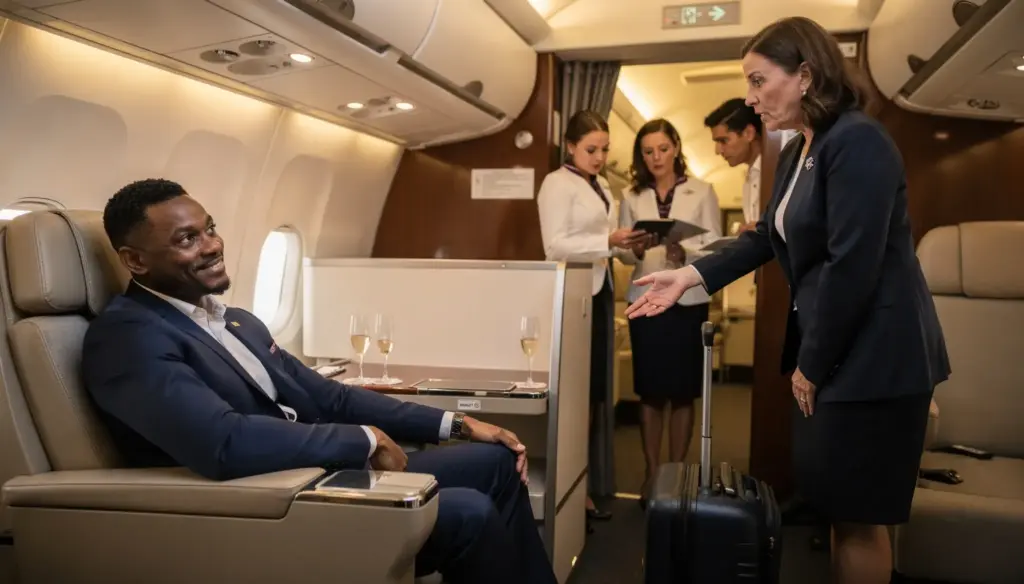
Two rows back, a Black man in a dark blue crewneck sweater and white trousers settled into a window seat. Short haircut. Neat beard. Calm face. He opened a tablet and began reading as if the airplane were an office that happened to have wings.
Gretchen felt something tighten under her ribs—an old, ugly reflex she would later insist was only about procedure. First class was not a lottery. First class was not a kindness. First class was a purchased category, and categories existed so that mornings like hers could still contain one clean win.
She waited. She watched him. He did not look around for confirmation. He did not fidget like a person who feared being asked to move. He simply sat, and the sitting itself began to irritate her, the way a wrongly placed picture frame irritated her in other people’s houses.
She told herself a story that felt, in the moment, like diligence. Maybe the gate had scanned wrong. Maybe he had walked past his row. Maybe someone needed to say the quiet part so the system could correct itself. The story did not mention race. Stories like hers rarely did out loud. They dressed themselves in words like process and fairness and I’ve flown enough to know.
The flight attendant with the water came back through. Gretchen almost said something then and didn’t. She told herself she was being fair. She told herself she was protecting the product. She told herself a lot of things that sounded like principles if you didn’t look at the color of the man in 3A.
When the aisle cleared for a moment, she stood. Her legs felt strangely light, as if the decision had already been made somewhere behind her eyes and her body was only catching up.
***
Grant heard the footsteps before he saw the face. Heels, controlled. Then a beige trench coat filled his peripheral vision, and a woman leaned into his row with a nearness that violated the polite geometry of airplanes. Her perfume arrived a half-second before her voice. Shoulder-length blonde hair. Patterned handbag hanging from one forearm like a verdict.
“This is first class, right?” she asked. Stern first. Testing the air.
Grant looked up. He had been asked versions of this question before—not always aloud, sometimes only with eyes. In a crew hotel once, a man had asked if he was in the right meeting while Grant sat at the head of the table with the agenda. At a charity dinner, a donor had handed him a coat-check ticket without looking at his face. The world had a deep talent for sorting Black men into roles that made other people comfortable.
He had learned, over years of being the only Black man in rooms full of decision-makers who still sometimes checked his badge twice, that the cheapest response was often the true one.
“Yes,” he said.
Her mouth did a small, smug thing. “Then somebody at the gate clearly made a mistake.”
The cabin around them stayed quiet in that particular airplane way: people hearing and pretending not to, the soft conspiracy of not wanting a scene. A woman in 1C froze mid-scroll. The man in the navy blazer across the aisle stared hard at his phone as if the screen might invent an exit. Grant felt the heat of her face too close to his. He felt the old temptation to explain—boarding pass, employee travel, the ridiculousness of the premise. He also felt the heavier thing, the exhaustion that had nothing to do with race and everything to do with a morning of weather models and a deferred APU and a son who needed picking up and a wife who was already pointed.
There was a version of himself, younger, who would have stood and produced documents like a defendant. There was another version who would have matched her tone until the cabin became a courtroom. He had been both men. Both had cost him sleep and, once, a promotion he later decided he was glad he hadn’t gotten under those terms.
He did not take the bait. He did not smile. He did not apologize for existing in a seat he had every right to occupy. He looked at her for one measured second, then returned his eyes to the tablet as if she were weather he had already filed.
Gretchen waited for the flinch she had expected—some scramble for a boarding pass, some nervous laugh, some admission that would restore the order she wanted. It did not come. The man’s stillness made her feel suddenly, uncomfortably visible, as if she had leaned too far into a mirror.
She opened her mouth to escalate. She had a second line ready—something about speaking to the gate, something about how these things happened—and then footsteps came fast up the aisle.
***
Felicia Brooks had been flying the line for nineteen years, which meant she could smell a cabin problem forming the way some people smelled rain. She was in her forties, dark blue uniform pressed, purple and red neck scarf tied the way the manuals preferred and the way her own hands preferred a little tighter. She had just come forward from checking a seatbelt when the ops channel in her earpiece chirped.
“Brooks—confirm Mr. Cole is onboard 3A. Operations needs his approval before door close. APU MEL and diversion contingency. Do not close without him.”





