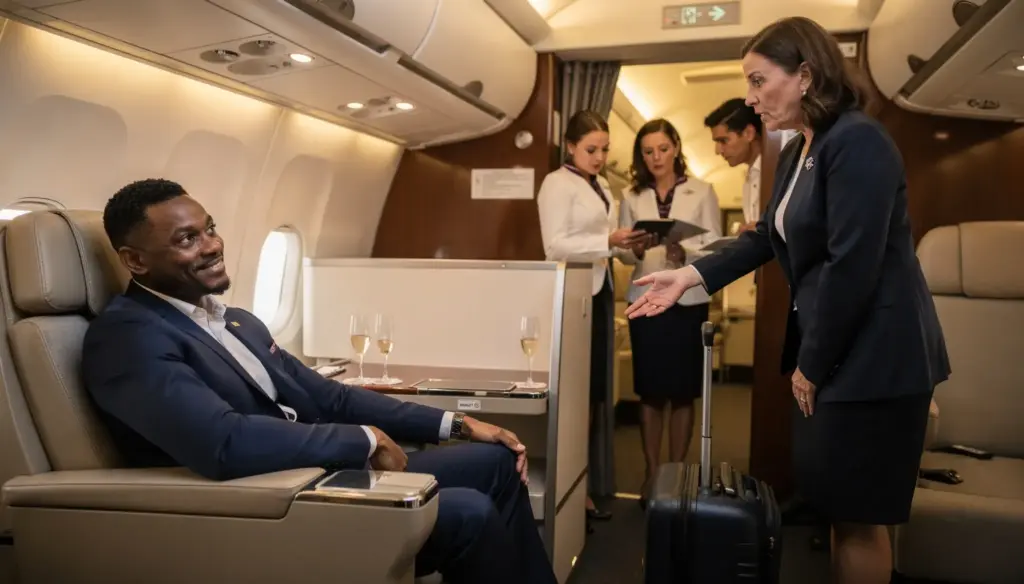
He nodded once. “Don’t do that to people.”
It was not absolution. It was not a TED Talk. It was instruction, the way he gave instruction on the ops floor when someone had cut a corner and nearly made weather into an incident.
She swallowed. “I won’t.”
He did not say good or I believe you or thank you for saying that. Belief was not a gift he owed her on demand. He stepped past her into the aisle and walked toward the door.
Felicia was at the forward galley, collecting the last cups. She caught Grant’s eye and tilted her head toward Gretchen in a silent question. Grant gave the smallest shake of his head: not now, not a scene, not a trophy.
On the jet bridge, the air tasted like jet fuel and rain that had not yet decided to stop. Grant walked with his bag and his phone and the particular relief of being off an airplane that had not diverted. Behind him, first class emptied in the usual shuffle of coats and egos and people pretending they had not witnessed anything worth remembering.
***
Gretchen remained in her seat until most of first class had emptied, then deplaned with the stiffness of a person leaving a courtroom. At the gate podium she paused, then asked the agent for a customer comment form. The agent, young and tired, handed her a card with a QR code and said, “You can do it on your phone,” as if confessing were now an app feature.
In the terminal, under a departure board that flickered, Gretchen filled out the digital form on her phone. She wrote that she had spoken inappropriately to another passenger and that the airline should know. She did not write Mr. Cole’s name because she was not sure of his first name and because using his name felt like dragging him into her paperwork. She wrote her own name clearly. In the comments box she typed, then deleted, then typed again: I questioned a Black passenger’s right to sit in first class. I was wrong. She submitted it before she could edit the sentence into something softer.
Then she stood there holding her patterned handbag and wondering what she had expected: a cleansing, a score reset, a story she could tell later about growth. None of that arrived. What arrived was the ordinary noise of Charlotte—rolling bags, gate changes, a child crying in a stroller, a gate agent calling a name into a microphone. She walked toward baggage claim because that was where her body knew to go.
At the carousel she watched other people’s bags go around and around, bright tags spinning like little flags of lives that had not, that morning, publicly humiliated a stranger. When her suitcase finally appeared, she pulled it off with both hands and felt no victory in the catch.
Grant called Vanessa from the curb while waiting for the rideshare that would take him to the station managers’ meeting first and, if the meeting ran short, to Eli’s school.
“You’re on the ground,” Vanessa said. Not a question.
“I’m on the ground.”
“Eli’s fine. He’s at aftercare until four if you need it. How was the flight?”
He watched a line of taxis. He thought about saying fine. He thought about saying a woman decided I was a gate error. He thought about the way Vanessa’s face would change, the way she would carry it for him even when he asked her not to. Marriage was full of loads you tried not to hand over and handed over anyway.
“There was a passenger who thought I was in the wrong cabin,” he said. “Crew handled the door. Weather held. I’m okay.”
Silence on the line, the listening kind. “Did you report her?”
“She may report herself. Felicia offered. I didn’t ask for a spectacle.”
Vanessa exhaled. “You don’t have to be the bigger person every time, Grant.”
“I’m not being the bigger person,” he said, and heard the weariness in his own voice. “I’m being a man who still has a meeting and a kid to pick up. If I spend the afternoon turning her into a project, she gets to live in my head rent-free. I’d rather she live in her own.”
Vanessa was quiet again. Then: “Eli wants pizza. He also wants you to watch him launch the rocket in the backyard if it isn’t raining.”
“Tell him I’m coming,” Grant said, and realized he had said the same words to Felicia on the airplane. Tell them I’m coming. Different doors. Same need to move toward the thing that required him.
Months later, Grant boarded another first-class cabin on another weekday, sweater swapped for a blazer because the meeting at the other end was with the FAA. A white woman across the aisle glanced at him, then at his boarding pass stub, then away. The glance was nothing—or it was something. He could not always tell, and the not knowing was its own fatigue.
Felicia was not on that flight. A different flight attendant brought him water. The door closed without anyone needing his signature. He was, for once, only a passenger.
He texted Eli a picture of the wing against the clouds because Eli still liked wings. He put the phone away. He closed his eyes for the climb and did not sleep so much as rest in the thin way people rest when they know the ground will ask for them again.
Somewhere below, the country continued being the country: kind in pockets, cruel in reflexes, complicated in the spaces where people like Gretchen Mallory tried to become slightly less harmful and people like Grant Cole decided, again and again, which fights were worth their names.





