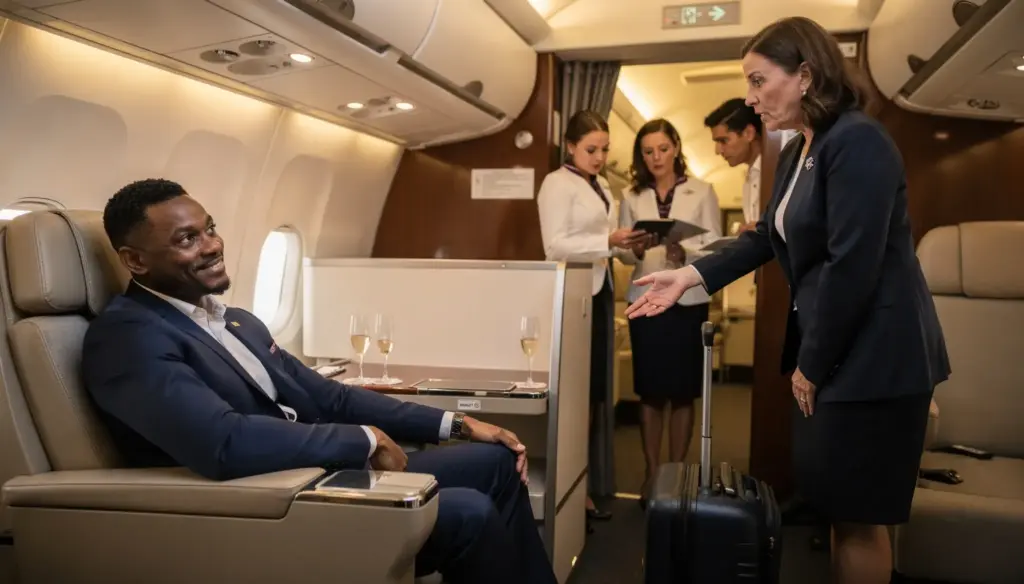
Felicia, walking the aisle before the confrontation fully bloomed, had noticed Gretchen’s stare the way she noticed all cabin weather systems: early, with a professional dread. She had almost intervened with a soft redirect—Can I help you find your seat?—and then the ops call had come in and made intervention into something sharper. She disliked that the timing would look like theater. She disliked more that a grown woman had decided a Black man’s seat needed policing. Nineteen years had not cured Felicia of anger. It had only taught her how to spend anger on the next correct action.
Felicia’s stride changed. She moved up the aisle with the efficient hurry of someone who knew the difference between theater and time. She had worked a hundred flights where directors stayed invisible in seats and a handful where their names suddenly mattered. Grant Cole was the second kind because he still answered when the operation called.
She saw Gretchen Mallory leaned into 3A like a prosecutor. She saw Grant Cole’s face—stoic, calm, dignified in a way that made Felicia’s stomach tighten with recognition. She had worked with him in briefings. She had seen him on the ramp in a reflective vest at 5 a.m. She had watched captains straighten when he walked into a crew room. He was not a celebrity. He was worse, in the best sense: a working executive whose name meant the doors stayed open or shut for reasons that had nothing to do with ego.
“Mr. Cole?” Felicia said, stopping short, voice clear enough to carry. “Operations wants your approval before we close the aircraft door.”
Gretchen’s face dropped. The smugness went out of it like a light switched off in a hallway. What replaced it was not apology so much as shock—an unprepared collapse of the story she had been telling herself about who sat where and why. Her body did a small, involuntary retreat, as if the aisle itself had pushed her back.
Grant stood. He was taller than Gretchen had accounted for. He stepped into the aisle without looking at her, as if her nearness had been weather again, already passed. The tablet stayed on his seat. His voice, when it came, was even.
“Tell them I’m coming,” he said to Felicia.
He moved forward toward the boarding door. Felicia fell in half a step behind him, professional and protective without making a show of either. Behind them, Gretchen stood frozen in the aisle with her patterned handbag and her trench coat and the sudden knowledge that the mistake she had announced had been hers.
Someone two rows back whispered, too soft to identify, “Oh my God.” It was not triumph. It was the sound people made when a story turned and they realized they had been watching something uglier than entertainment.
***
At the forward door, Captain Harrell held a clipboard and a tablet with the MEL package open. A gate agent hovered on the jet bridge side with the kind of worried neutrality gate agents cultivated when directors appeared. The jet bridge smelled like rain and rubber. Grant scanned the deferral language line by line, not because he distrusted maintenance, but because trust without reading was how accidents got their first foothold.
“Dispatch release includes the APU inoperative procedures,” Harrell said. “Fuel for Charlotte plus alternates. My concern is if we divert and then need ground power in a field that’s already taking bounce traffic.”
Grant asked two precise questions about dispatch release and divert fuel, and listened while Harrell walked through the weather corridor options if Charlotte went down. He thought about the passengers behind him who would never know that a deferred piece of equipment and a dirty weather map had been held open by a conversation at a door. That was fine. The point of the work was not applause.
“If we lose the APU on the ground at a divert,” Grant said, “we need ground power availability confirmed at the alternates. Not assumed.”
“Roanoke and Greensboro are good,” Harrell said. “Raleigh’s tight on gates if the whole region’s bouncing.”
Grant nodded. “Approve the release. Close when you’re ready. I’ll be in 3A if the weather desk wants a live call.”
Felicia exhaled, just slightly. “Yes, sir.”
He almost corrected her—he preferred Grant from people who had flown with him—but the cabin was listening now in that soft way, and formality had its uses. Titles could be armor. He turned back toward his seat.
Gretchen had returned to 2A. She was sitting very straight, cheeks flushed, eyes fixed on the seatback screen as if it contained absolution. She did not look at him as he passed. One passenger across the aisle—the white man in the navy blazer—met Grant’s eyes for half a second and then looked away, embarrassed on behalf of a stranger, which was something, and also not enough.
Grant sat. He fastened his seatbelt. He opened the tablet again because the work did not pause for mortification, his or anyone else’s. His hands were steady. That mattered to him more than he liked to admit. Anger that shook your hands was anger that had already started spending you.
During the silent minutes after Grant returned to 3A, the cabin performed its usual pretense of normalcy. Seatbelt clicks. A cough. The soft thud of a bag being resettled. Gretchen felt every sound as accusation. She wanted to stand and leave the airplane somehow, which was impossible, so she wanted the airplane to leave her, which was also impossible. She was trapped with the person she had tried to diminish and with the witnesses who now knew what she was capable of when she felt small.





