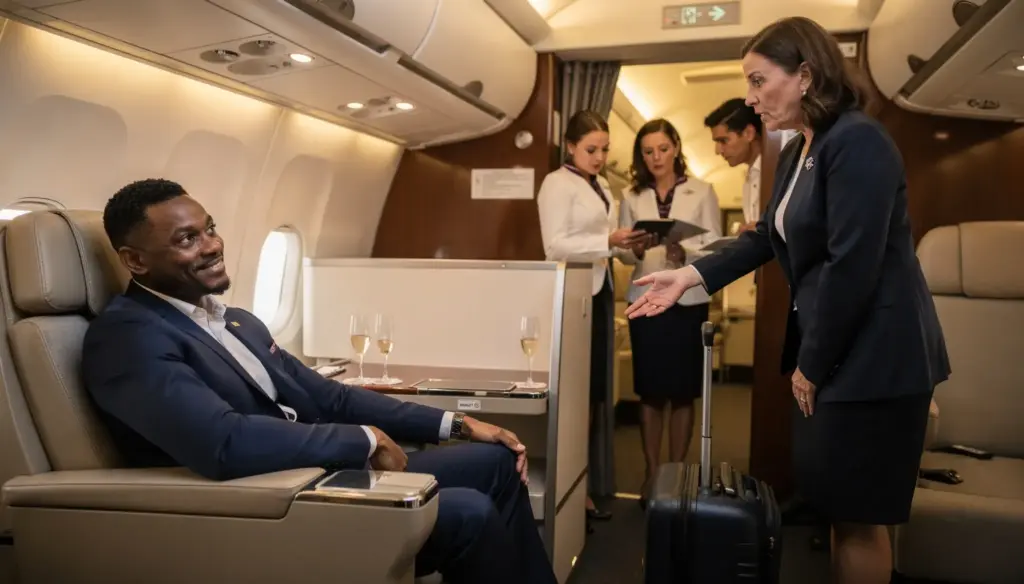
She thought of her father, who had loved rules and hated ambiguity, who had once sent a steak back three times in a restaurant while teenage Gretchen sank into the booth. She had sworn she would never be that person. Looking at her hands now, she understood that she had become a quieter version of the same hunger: the need to correct the room until the room reflected her.
***
Pushback came with the usual choreography: the tug, the salute, the cabin announcement about electronic devices. Gretchen heard none of it clearly. Her ears were full of her own blood. She kept replaying the lean, the question, the smug line about the gate mistake. In her memory it already sounded worse—sharper, more theatrical. She wanted to believe she had only been checking a boarding irregularity. She wanted to believe the man’s race had been irrelevant. Wanting did not make it true.
She had a history of this, if she was honest, and honesty was expensive. In offices she corrected people’s badges. In restaurants she asked to be reseated when the table “felt wrong.” On airplanes she had once reported a family for being “too loud” in a cabin where her own phone calls had been the louder thing. She told herself she was a person who cared about standards. Standards were easier to love than the people they sorted.
Across the thin aisle distance and one row, Grant Cole sat with his tablet and his silence. She hated him for the silence. She hated herself more. Silence removed the argument she had expected to win. Silence left her alone with the shape of what she had done.
Felicia came through with the safety demonstration, scarf bright against the dark blue uniform. When she reached first class, her eyes flicked once to Gretchen and then away—not cruel, not soft. Professional. The look said: I saw you. It also said: I have an airplane to fly with.
Gretchen ordered a ginger ale because water felt too pure for what she had done. She drank it too fast and tasted only carbonation and shame. The woman in 1C glanced back once, then offered a tight, pitying smile that made Gretchen want to disappear into the seat foam. Pity from strangers was a kind of spotlight.
***
Grant did not address her during climb. He had learned, in rooms where prejudice arrived wearing politeness, that speeches rarely changed the speaker. They mostly changed the audience into spectators of your pain. He was too tired for spectators. He was also, in a quieter way, too careful with his own dignity to spend it teaching a stranger how not to be ugly in public.
He thought of Eli. Last weekend they had built a model rocket in the garage, and Eli had asked, with the bluntness of nine-year-old philosophy, whether grown-ups ever got in trouble for being wrong. Grant had said yes. Eli had asked if the trouble fixed the wrong. Grant had said sometimes, and sometimes the trouble just made people quieter about being wrong.
He did not want to become the quiet kind of wrong. He also did not want to become a performance of righteousness for a cabin full of phones. Somewhere behind him, he was sure, at least one person was composing a version of this morning for social media. He hoped, without much hope, that they would leave his face out of it.
At cruise, Nadine pinged him on the ops channel about a separate issue in Dallas—a crew legality squeeze that threatened a bank of evening departures. He handled it in short sentences, approved a deadhead adjustment, and asked for a written summary by end of day. Felicia brought him coffee without being asked, black, the way he took it in briefings. He thanked her by name.
“You all right?” she asked, soft enough that only he could hear.
“I’m working,” he said, which was both true and a boundary.
Felicia nodded. “If you want the passenger’s name for a report—”
“I know how to file a report,” he said, not unkindly. “Thank you.”
She left him alone. That, too, was a kind of respect. The cabin settled into the low hum of a flight that had nowhere dramatic to go. Turbulence came in soft patches. Someone laughed at a sitcom on a seatback screen. Life, absurdly, continued.
Cruise brought a meal service that first class still pretended was an event. Felicia offered Grant the chicken or the pasta; he took the chicken because choosing was easier than declining. He ate without tasting much. Across the cabin, Gretchen declined the meal entirely, then regretted declining because having nothing to do with her hands made the hour longer.
A child in business class—visible through the curtain gap when a flight attendant passed—laughed at something on a tablet. The laugh traveled forward like ordinary life insisting on itself. Grant found himself grateful for it. He texted Vanessa a single word when the signal flickered in: Climbing. She replied: Good. Eli drew you a plane. He smiled at the phone, then put it away before the smile could become something he had to explain to anyone watching.
Grant stared at a weather update and thought about the first time someone had questioned his seat. He had been twenty-six, deadheading in uniform, and a passenger had asked the flight attendant if “the help” was supposed to sit up front. The flight attendant had handled it. Grant had smiled the smile that cost him. He had promised himself he would not smile that smile forever. Some days he still did. Some days he didn’t. Today he hadn’t. That felt like a small, private victory with no audience.
***





