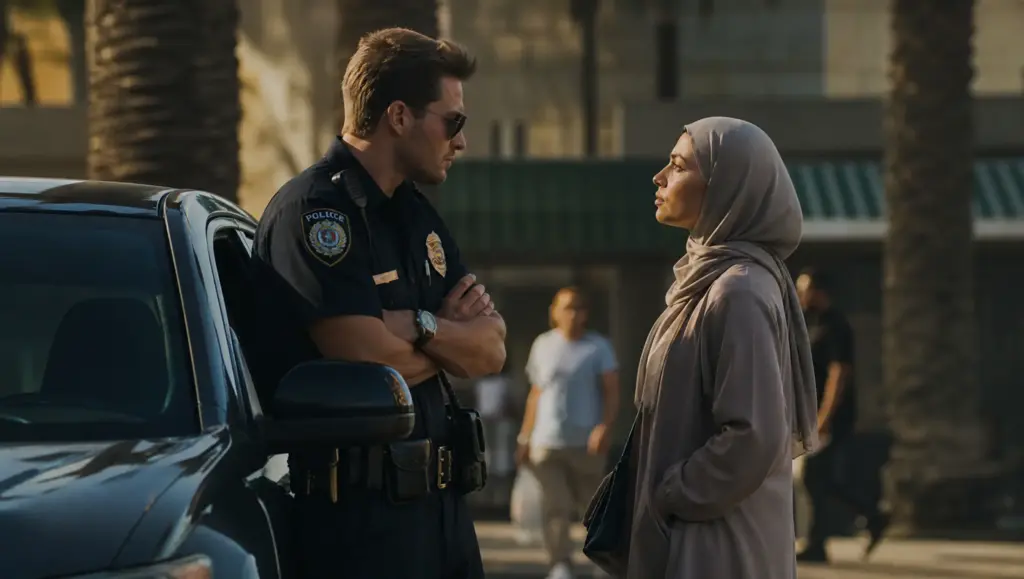
“He drove it to the cemetery,” he said. “After my mother. She died in ninety-eight, pancreatic, it was fast, four months. And every Sunday he drove that car out to Resurrection and sat with her for an hour and drove back. Every Sunday for eleven years. I used to go with him sometimes. He’d sit in the car with the door open, right on the grass. He’d turn the key to wait for the light, you know, the—” he made a small circle in the air with his finger— “the glow plug light, and while he was waiting he’d touch it. The medal. Every time. I don’t think he even knew he did it.”
Selma closed her eyes for a moment.
“He died in oh-nine,” Gene said. “March. Heart. In the kitchen. They found him with the coffee still on.” He was quiet. “I got the car. I was the only one. I didn’t— I wasn’t in great shape, then. My wife and I were— we split the next year. I moved out into a place on Hampton. One of those four-family buildings. No garage. I parked it on the street. And I was drinking, then. I’m not going to pretend I wasn’t. I’d come home from a shift and I’d have six or eight and I’d fall asleep on the couch, and I don’t know—” his voice went tight— “to this day I don’t know if I locked it. That’s the thing. I don’t know. I’ve thought about it so many times I can’t remember anymore what’s a real memory and what’s me thinking about it. November tenth. Two thousand ten. I came out at six in the morning to go to work and it was gone. Just a dry rectangle on the street where it’d been, because it rained in the night.”
“You reported it.”
“I’m a cop. Of course I reported it. I reported it to my own department. Guy I went through the academy with took the report. He was real nice about it. He said, Gene, you know as well as I do, these old diesels, they go across the river, they get parted out, the engines go to Mexico, somebody’s running a water pump off it in Juárez by Christmas. He said, I’m sorry about your dad’s car. And the insurance paid out. Thirty-one hundred dollars.” He laughed that laugh again, the empty one, but this time it was aimed at himself. “Thirty-one hundred dollars. I spent it on my lawyer.”
“They recovered it,” Selma said. “In Illinois. In 2011.”
“Nobody told me that.”
“The insurance company would have known. They took the title when they paid you. When it was recovered it belonged to them.”
“I know how it works,” he said, and then, more quietly, “I know how it works. I know. I moved twice that year. Everything went to the house. Colleen kept the house.” He rubbed his face with both hands, hard, and when he took them away his eyes were red. “Maybe she got a letter. Maybe she threw it out. Maybe it said, dear sir, your vehicle has been recovered, and she threw it out because it had my name on it, and I can’t even blame her. I wasn’t a guy you’d forward mail to.”
Selma thought about her father’s letter, with the spelling she had checked, going to that house. She did not say anything about it. Not yet.
“So the thing is,” Gene said, and stopped.
She waited.
“The thing is, I never stopped looking.” He did not look up. “I know that sounds— I know what that sounds like. But I didn’t. Every old Mercedes I saw. Every one. Doesn’t matter what color, I’d look, and if it was cream I’d look harder, and if it was a sedan, a three-hundred, I’d get the plate. And I’d run it.” He said this last part very quietly. “You know what MULES is?”
“No.”
“It’s the state system. The database. Plates, licenses, warrants, everything. You type in a plate and it tells you whose car. And every time you run something it logs it. Your badge number, the time, what you ran. You’re supposed to have a reason. A call, a stop, an investigation. It’s a crime to run somebody for personal reasons. They fire guys for it. There was a guy in my district, they fired him two years ago for running his ex-girlfriend’s new boyfriend.” He swallowed. “Sixteen years. I don’t even know how many. Fifty. A hundred. Old Mercedes all over south city, old men driving to church, a kid in Tower Grove with one he bought for his girlfriend. And I’d run it, and it’d come back to somebody, and I’d see it wasn’t— and I’d drive on. Nobody ever pulled my history. Nobody ever had a reason to.”
“Until today,” Selma said.
He nodded at his hands. “I saw you on Gravois. By the windmill. I saw the color and I saw the shape and I thought, okay, another one. And I got behind you and I saw the dent.”
“The dent,” she said.
“I put that dent there.”
She looked at him.