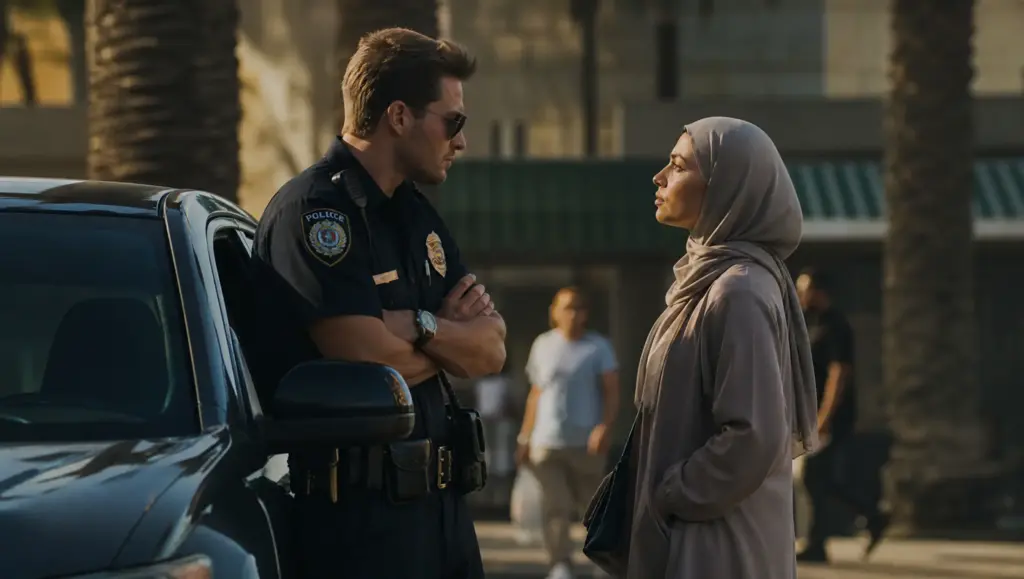
He was coming across the lot toward her. He was bigger out of the car than in it, not tall so much as wide, a man in his fifties with a heavy neck and a gray brush mustache and a gut that pushed the front of his duty vest out over his belt. His hair was cut very short and had gone almost entirely white. Three stripes on each sleeve. The name tag over his pocket said KOPECKY. He walked like his knees hurt him. He did not walk toward her. That was the first strange thing. He walked toward the car, and when he got to it he did not come around to her side but stopped at the rear bumper, on the passenger side, and stood there looking at it, at the trunk lid and the taillights and the chrome of the bumper, the way the old men at gas stations looked at it. Then he walked slowly up the passenger side, trailing his eyes along the body, and when he got to the rear passenger door he stopped again.
He looked at the dent.
He looked at it for a long time. Long enough that the young man at the pickup truck across the island had stopped pretending to look at his own pump and was openly watching. Then the sergeant bent, with a little grunt, one hand on his knee, and put two fingers of his other hand into the dent, the way you would put your fingers into a footprint in wet cement to see how deep it went.
“Excuse me,” Selma said. “Can I help you, Officer?”
He straightened up. He came around the front of the car, past the squared-off grille and the star, and stopped six or seven feet from her, with the car’s long hood between them and the pump island at his back. Up close his face was red across the cheeks and nose in the way of a man who spent a lot of time outdoors or drank, or both, and his eyes were a very pale gray-blue, and they did not look at her. They looked past her, at the driver’s window, at the interior, at the dash.
“This your car?” he said.
“Yes.”
“This is your car.”
“Yes, sir. It’s my car.”
And he laughed.
It was not a big laugh. It was short, a single breath let out through the nose and the corner of the mouth, the kind of laugh a man gives when someone tells him the check is in the mail. It was the laugh of someone who had been told a story he had heard before. He shook his head a little, and for the first time he looked directly at her, and she watched him take her in, all of her, the navy blue coat and the plain gray scarf pinned under her chin and the work boots she had not changed out of and her face, which was forty-one years old and did not wear makeup on weekdays, and she watched him arrive at a conclusion.
“Okay,” he said. “Sure it is.”
“I’m sorry?”
“Ma’am.” He said it the way you would say it to a child who had been caught with a hand in a cookie jar and was explaining that the cookies had fallen in. “Come on. You’re telling me this is yours. This car. Your car.” His eyes went, very briefly, to her scarf and back. “Not your husband’s. Not your uncle’s. Not some guy’s who sold it to your cousin for cash out of a lot in East St. Louis. Yours.”
“Yes.”
He laughed again, shorter. “A lady like you.”
She said nothing. Across the island the young man with the pickup had finished fueling and hung up his nozzle and was standing by his truck with his hands in the pocket of his sweatshirt. The QuikTrip employee under the overhang had lowered her phone.
Selma had been here before. Not here, at this pump, with this man; but here, in this place that was not a place but a kind of weather, a kind of light. She had been here at nineteen at a Schnucks when a woman in a fleece vest told her to go back where she came from, and she had said, very politely, Ma’am, I came from Itaska Street, and the woman had looked at her like she had been slapped. She had been here at twenty-six at an airport, in a small room with a table and two chairs and a man from the government who wanted to know why she had traveled to Sarajevo for eleven days, and she had told him it was to bury her grandmother, which was true, and he had asked her the same question four more times in different words, and she had answered it the same way four more times in the same words, until he let her go. She had been here a dozen times at a dozen gas stations and parts counters and parent-teacher nights, every time someone looked at her and arrived at a conclusion, and she knew what it felt like, the heat that came up the back of her neck under the scarf, the way her hands wanted to shake and she would not let them. She knew what to do with it. You set it down. You set it on the floor next to you, like a heavy bag you would pick up again later, and you kept your hands free.
“Officer,” she said. “Is there a problem with the car?”
“You tell me.”
“I don’t think so.”
“No? You don’t think so.” He put his hands on his belt, one on either side of the buckle, thumbs hooked in. “Where’d you get it?”
“It was my father’s.”
“Your father’s.”
“Yes.”
“And where’d your father get it?”





