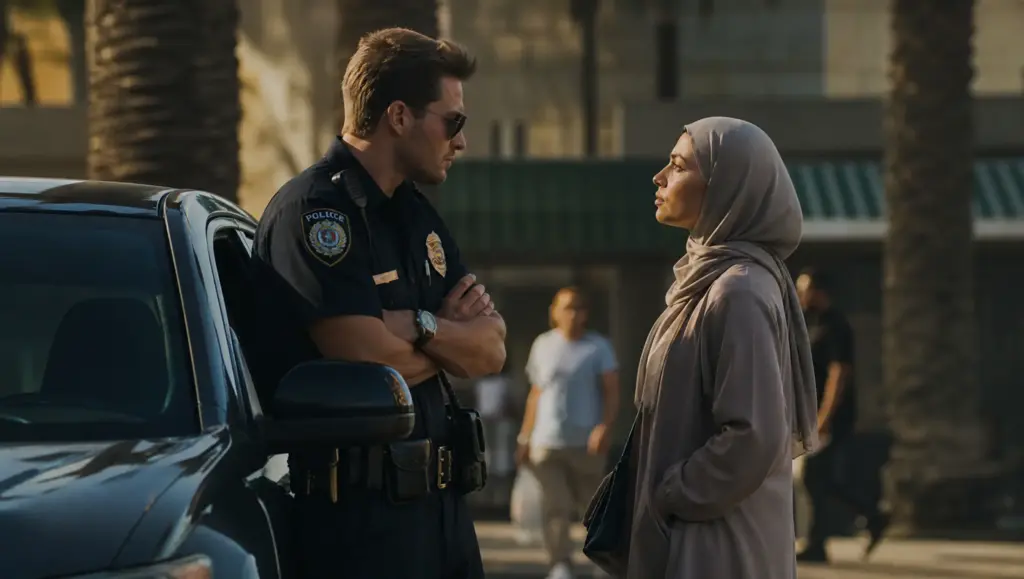
“And he kept a St. Christopher in his car. For thirteen years.”
“He said it wasn’t his to take out. He said a woman gave it to her husband so he would come home, and you don’t take that out of a car just because you paid the auction.” She hesitated. “He said nobody in Bosnia, when the shells were falling, asked anybody whose saint was over the cellar door.”
Gene took the envelope. He held it in both hands, between his knees, and looked at it. He did not open it.
“I laughed at you,” he said.
“Yes.”
“I saw you standing by it, and I—” He stopped. He made himself go on, she could see him make himself, the way her father made himself lift an engine block off the stand. “I’d already decided, before I got out of the car. I’d decided it was stolen, and I’d decided who stole it, and I looked at you and you fit. That’s the truth. I’m not going to stand here and tell you I’d have done the same thing to some guy in a Cardinals hat. I wouldn’t have. I’d have figured he got lucky at an auction. I looked at you and I figured you were the end of the line for my dad’s car. Somewhere it ended up after it got passed around. And I thought, of course. Of course that’s where it went.” He looked up at her. “That’s what I thought. I’m not proud of it. I’m telling you because you asked me what I was doing, and that’s what I was doing.”
Selma did not say that it was all right. It was not all right. She stood in front of him with the plastic sleeve of papers in her hands and her father’s list inside it, written in her own eighteen-year-old handwriting with his at the bottom, polite is armor, and she let the not-all-right sit there between them in the cooling air, because it was true, and he had said it, and she did not have to pick it up and carry it for him.
“Thank you for telling me,” she said.
He nodded. He turned the hardware-store envelope over in his hands. Through the paper she could see the outline of the little screwdriver, the knurled handle, the swivel cap on the end.
“You want me to take it,” he said.
“I want you to do whatever you want. It’s yours. It was always yours. That’s what he said.”
Kenan was on the bench at Carondelet Park when she got there at six-nineteen, the last kid, with his shin guards in his lap and his cleats tied together by the laces and slung over his shoulder, the way the older boys did it. Coach Villalobos was sitting at the other end of the bench with a clipboard and a whistle around her neck, and she stood up when the cream car came around the curve by the boathouse and gave Selma a wave that said, it’s fine, it happens, and then looked at Selma’s face as she got out and stopped waving and said, “Everything okay?”
“Everything’s okay,” Selma said. “I’m sorry. Thank you for staying with him.”
“He’s a good kid. He helped me pick up all the cones.”
Kenan did not get up right away. He sat on the bench with his arms crossed and his chin down and his cleats over his shoulder and looked at her from under his eyebrows, which was the look he had gotten from her father, and which he had been practicing, she was nearly sure, in the bathroom mirror.
“You said you wouldn’t be late.”
“I know. I’m sorry, dušo. Something happened.”
“What happened?”
She sat down on the bench next to him. The park was going blue around them, the trees along the lake gone black at the tops, the lamps on the path coming on one by one. Out on the water two ducks were arguing. In twenty minutes it would be Maghrib, and they would pray it at home, all of them, Tarik too if he could slip away for ten minutes, on the good rug in the living room and on her father’s cheap one, which she had brought home and would bring back to the shop on Monday.