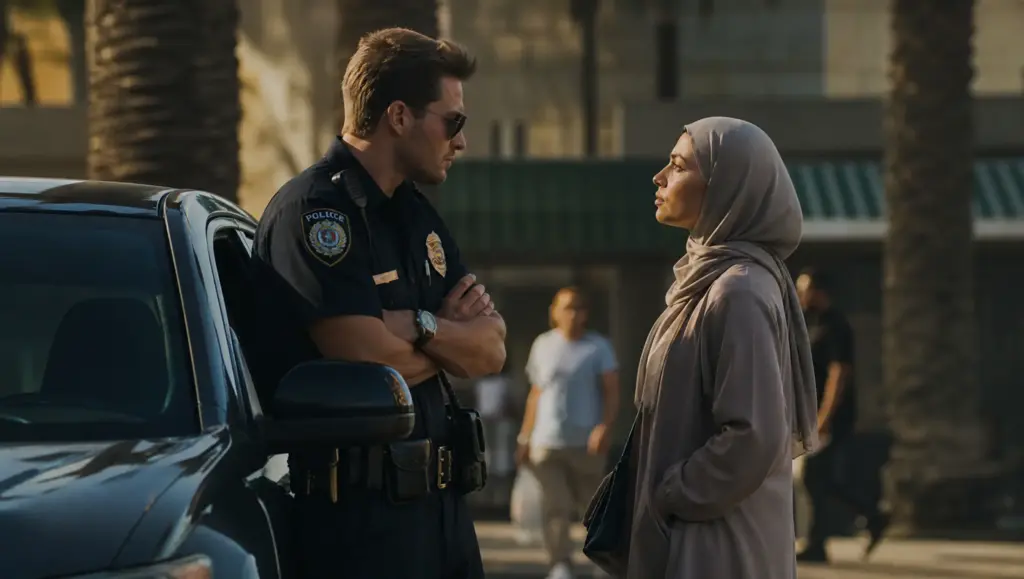
“It has a rebuilt title.”
“It’s a salvage car. It was stolen.”
“It was stolen in 2010,” she said. “And recovered in 2011, in Illinois. The insurance company took title and sold it at auction, and my father bought it, and he rebuilt it, and the state of Missouri inspected it and issued a rebuilt title in 2013. It’s been inspected every two years since. You can see all of that when you run the number. You already know you can see that.”
“I know what I can see.”
“Then you know it’s mine.”
“I know,” he said, and his voice cracked in the middle of the word, and he cleared his throat hard and started again, louder. “I know a car like this doesn’t just turn up. I know a car like this gets stolen off a street in south city, and it goes across the river to a chop shop, and it comes back a year later with a nice clean piece of paper on it and nobody asks a single goddamn question about where the paper came from.” His hand moved on his belt, from the buckle to the place above his holster where his thumb could rest on the radio clipped there, and stayed. He did not touch the radio. “Give me the keys.”
“No, sir.”
“Ma’am, I’m telling you to give me the keys to that vehicle.”
“And I’m telling you no, respectfully. You don’t have a reason to take them. The car comes back clear. I’m the registered owner. I’ve shown you my license.”
“I’ll have it towed.”
“On what basis?”
He opened his mouth and closed it.
Across the pump island, the young man with the lawn trailer had taken his hands out of his sweatshirt pocket. He was not holding anything; he was standing with his arms loose at his sides the way men stand when they have decided to stay somewhere and have not decided what they will do there. He looked at Selma. “You good, ma’am?” he called over.
“I’m all right. Thank you.” She hesitated, then made herself say it. “Would you mind staying a few minutes? If you have time.”
“Yeah,” he said. “I got time.”
The sergeant turned his head and looked at him. “Sir, I’m going to need you to move along.”
“I’m just standing here, officer.”
“I said move along.”
“It’s a gas station,” the young man said, and did not move, and did not raise his voice, and after a second the sergeant turned back to Selma as if the young man had evaporated.
Selma looked at the clock on the pump. Five-sixteen.
“Sergeant Kopecky,” she said. She said his name carefully, the way he had said hers. “I’d like to go pick up my son. He’s nine. His practice ends at six, at Carondelet Park, and if I’m late he has to sit on the bench and wait. I would like very much not to be late. So I’m going to ask you one more time. What is the reason you’re detaining me?”
“I told you the reason.”
“You told me it was stolen. It was stolen sixteen years ago. That’s not a reason. That’s history.”
And he laughed again. It was the third time, and it was different from the first two; there was nothing in it at all, no amusement, not even contempt, only a kind of exhausted disbelief, as if somebody had told him the last joke in the world and it was the same as all the others.
“History,” he said. “Yeah. Okay. That’s good. You know what, lady, I don’t care what the paper says. Paper says whatever somebody pays it to say. I’ve been doing this almost thirty years. I know how this goes. A car like this, a car somebody—” he stopped, and started again, and it came out of him in a rush, low and ugly— “and it ends up with somebody who comes over here and opens a shop on Morgan Ford with cash out of a shoebox and puts their wife behind the counter in a—”
He stopped. He did not finish it. He did not have to finish it; she could see the end of the sentence in the place where his eyes went, which was to her scarf and away.
She did not set that one down. She found she could not. She stood with it in her hands, heavy, hot, and she understood that she was angry in a way she had not let herself be angry in years, maybe since she was a girl in the apartment on Itaska Street listening to her father come home and not say anything for two days. Her hand was shaking around the key. She let it shake.
Then she turned her back on him.
It was the one thing her father’s list did not say to do, and it was, she would think later, the only thing on the list or off it that would have worked. She turned her back on the sergeant and stepped to the driver’s door and put the key into the lock, the plain steel blade into the slot under the chrome handle, and turned it.
There was the pause. And then, all around the car, every lock button rose at once, with the long soft sound of the vacuum letting go, like a breath held for a long time and finally let out.
Behind her she heard him make a sound. She could not have said what kind of sound. It was very small.
She opened the door and stood in the angle of it with one hand on the top of the frame and turned around.