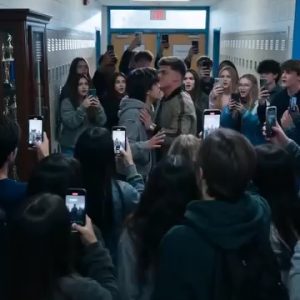
“He meant it,” I said. “He said it because he knew it would hurt.”
The room fell quiet.
Dr. Alvarez asked Julian’s father to let the investigation proceed.
No one could make the recordings disappear.
The investigation
Over the next several days, the school interviewed students, reviewed the videos, and checked the earlier reports.
The findings confirmed that Julian had repeatedly harassed and physically intimidated me. The hallway incident wasn’t an isolated misunderstanding.
Julian was suspended under the school’s disciplinary policy and removed from team activities while the school determined the appropriate next steps. The students who had participated in the harassment were dealt with according to their individual roles.
The assistant principal was also required to answer for dismissing my earlier reports. The school reviewed its reporting procedures and established a clearer way for students to raise safety concerns.
I wasn’t asked to sit across from Julian and accept an apology.
I wasn’t required to forgive him.
Instead, Dr. Alvarez arranged a safety plan: a staff contact I could reach directly, changes to hallway supervision, and clear instructions that Julian was not to approach or intimidate me.
For the first time, the adults were taking responsibility for making the school safer.
The conversation with my father
That evening, I found Dad in the garage, replacing a worn belt on an old sedan.
He looked up when I walked in.
“School okay?”
I almost said yes.
Instead, I told him everything.
The insults. The shove. The kick. The videos. The principal’s office.
Dad set down his wrench.
“Are you hurt?”
“Just sore.”
He checked the back of my head anyway, then pulled me into a careful hug.
“I wish you’d told me how bad it had gotten.”
“I thought I could handle it.”
“You shouldn’t have had to handle it alone.”
I told him what Julian had said about him.
Dad gave a tired smile.
“Son, a person’s worth isn’t measured by the price of his watch or the name on his building.”
“I know.”
“And what did you do when he tried to kick you?”
“I got out of the way. I didn’t hit him.”
Dad nodded.
“Then you remembered what we practiced.”
I waited for him to say I should have fought harder.
He didn’t.
He simply said, “I’m proud you got home.”
The hallway after the cameras
A week later, I walked past the trophy case again.
The glass had been inspected. The hallway looked exactly as it always had: bright lights, rows of lockers, framed photographs of championship teams.
But the students were different.
Some looked embarrassed. A few offered quiet apologies for filming instead of helping. Brianna stopped me near the stairwell.
“I should’ve said something sooner,” she said.
“Yeah,” I replied. “You should have.”
She accepted that without making excuses.
I didn’t suddenly become popular. I didn’t become the school’s new fighter. I didn’t need to.
I went to class. I kept training with Dad. I learned that I could report what happened without having to prove I was tough enough to endure it.
And Julian’s name no longer made me feel like I had to shrink.
What my father really taught me
At the end of the semester, the school held its athletic awards.
Julian wasn’t there.
I sat near the back with Dad, whose work shirt still smelled faintly of motor oil. When the principal spoke about student safety and the responsibility to intervene when someone is being targeted, I glanced at him.
He was listening carefully.
Afterward, we walked to the old pickup.
“Do you think Julian will change?” I asked.
Dad shrugged.
“That’s up to him. You don’t have to wait for him to change before you live your life.”
I looked back at the school.
For months, Julian had tried to make me believe that my father’s job made me less important. He’d used his size, his money, and his teammates to make the hallway feel like a place I didn’t belong.
But my father had taught me something Julian had never learned.
Strength wasn’t the ability to make someone afraid.
It was the discipline to protect yourself without becoming the person who hurt you.
Julian’s kick had missed.
The real turning point wasn’t the moment he slipped. It was the moment the people watching stopped treating my humiliation as entertainment—and started telling the truth.
I walked beside Dad toward the pickup.
His hands were still stained with greas
The grease beneath my father’s fingernails never completely washed out. He could scrub his hands raw over the utility sink with pumice soap and warm water until his knuckles turned the color of bruised peaches, and still, thin crescent moons of black carbon would remain embedded in the skin. On Tuesday mornings, when he dropped me off two blocks down from the wrought-iron gates of Oak Creek High so the idling rattle of his 1998 Ford F-150 wouldn’t draw stares from the student parking lot, those hands would rest on the cracked vinyl steering wheel like two worn leather mitts.
“Head up, Alex,” he had told me that morning, the truck cab smelling of fast-food coffee, wintergreen pain-relief rub, and burnt transmission fluid. “Keep your weight centered. Remember where your feet are.”
“It’s just AP Chemistry, Dad,” I had lied, adjusting the strap of my frayed canvas backpack. “Nobody’s throwing hooks in the lab.”





