He hadn’t smiled. Mateo Rivera had spent his twenties fighting out of a cramped, tin-roofed gym in East Los Angeles before a shattered kneecap and a newborn son traded his hand wraps for a torque wrench. He knew what a boy looked like when he was bracing for impact. He had seen the faded blue smudge along my collarbone the week before—the mark left when Garrett Vance had pinned me against the biology wing drinking fountain while Julian Cross poured half a bottle of sports drink over my calculus binder—and even though I’d blamed it on a slipped wrench in the garage, Dad had begun oiling the swivel chain on the heavy bag behind our shop every night at seven.
“A ring is just four ropes, mijo,” Dad had said, his dark eyes steady in the truck’s side mirror as a silver Porsche Macan with a student parking decal roared past us. “People build rings out of all kinds of things. Hallways. Offices. Money. The geometry doesn’t change. You let a man back you into a corner where the ropes meet, you’re fighting on his terms. Keep your space.”
By 3:15 that afternoon, I was out of space.
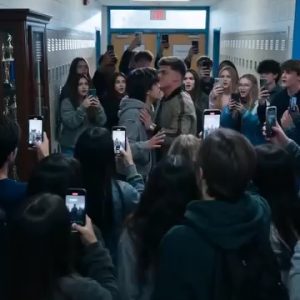
The tempered glass of the varsity trophy case vibrated against my shoulder blades with a low, hollow thrum. Inside the cabinet, three decades of brass footballs and silver track batons trembled on their velvet risers. Julian Cross had the bunched grey cotton of my hoodie twisted tightly inside his right fist, his knuckles pressed hard against my sternum, pinning me between the mahogany frame of the display case and the three-inch rubber soles of his designer sneakers.
“Say it again for the cheap seats, Rivera,” Julian said. His voice wasn’t loud; it didn’t have to be. He spoke with the lazy, practiced projection of an all-conference linebacker who had spent three years listening to his own name echo over the stadium loudspeaker on Friday nights. “Tell Garrett what your old man charges to change the oil on a real car.”
Around us, the main academic corridor had congealed into a tight, grinning amphitheater. Thirty or forty students formed a dense semicircle between the robotics bulletin board and the double doors leading toward the athletic wing. Above their heads, the fluorescent ceiling tubes buzzed with a cold, sterile light, reflecting off dozens of raised smartphone lenses. Tiny red recording dots blinked in the gloom.
Twenty feet away, near the intersection of the administrative hall, Assistant Principal Miller paused with a leather folio tucked beneath his arm. For two seconds, his eyes met mine over the shoulder of a sophomore girl filming in vertical mode. Miller’s gaze flickered from mine to the embroidered oak leaf on Julian’s varsity letterman jacket—the same jacket funded by the Cross Development Group, whose corporate logo currently hung across the newly renovated sixty-thousand-dollar scoreboard at the north end of the football field.
Miller sighed, checked his watch, and muttered loudly enough for the back row to hear, “Clear the hall in two minutes, folks. Knock off the hallway drama and head to your buses.” Then he turned the corner, the click of his dress shoes fading toward the faculty lounge.
The semicircle tightened by half a step. The oxygen in the corridor seemed to thin, replaced by the sharp scent of winter coats, sour glee, and expensive cologne.
“Look at him looking for a bailout,” Garrett Vance laughed from Julian’s left, his phone held six inches from my face. “Nobody’s coming, Garage Kid. Miller’s got a four o’clock tee time.”
“I just want to go to my locker, Julian,” I said. My voice sounded remarkably flat to my own ears, though my heart was hammering a rapid, dry rhythm against my ribs. I kept my hands open at my sides, palms brushing the rough seams of my jeans.
Julian tilted his head, his blond hair falling across his forehead in the effortless way that ended up in the yearbook’s superlative pages every spring. He looked away from me, angling his chin toward Garrett’s lens. It was a performance. Everything Julian did in the B-wing corridor was calibrated for a fifteen-second clip that would circulate through five group chats before dinner and disappear before any adult with a conscience could screen-record it.
“Your poor dad can’t teach you anything, Alex,” Julian said, his lip curling into a mock-sympathetic pout for the cameras. “Except how to crawl under a chassis and beg for scraps. Actually, wait—maybe he can use that rag in your back pocket to buff my rims before I leave. Think he takes food stamps, or just loose change from the cup holder?”
A sharp, braying laugh went up from the varsity boys clustered near the water fountain. Even a few students who sat near me in AP History—kids who borrowed my notes when they missed class for ski trips—let out nervous, complicit chuckles, their eyes glued to their screens as if watching the moment through glass absolved them of standing three feet away from it.
The heat that rose behind my eyes had nothing to do with fear.
I saw my father at midnight the previous November, lying on a piece of flattened cardboard beneath a rusted delivery van while sleet blew beneath the warped aluminum door of Rivera Auto. His arthritic fingers had been so stiff from the cold that I’d had to hand him the socket wrenches one by one, yet he had stayed under that chassis until two in the morning because the van belonged to Mrs. Gable from down the street, and without it, she couldn’t make her early-morning catering deliveries. He hadn’t charged her for the labor. He had come inside at 2:30 AM, eaten a cold bean burrito over the sink so he wouldn’t wake me, and left four twenties on my desk to pay for my AP exam registration fees.
Julian Cross had never carried a weight heavier than a barbell with a spotter standing behind him.





