When my sneakers crunched on the gravel outside and I ducked beneath the steel door, he didn’t look up immediately; he was tightening a serpentine belt tensioner with a long-handled ratchet, listening to the feel of the metal with the focused quiet of a watchmaker.
Click-click-click. Pause. Quarter-turn.
He eased the pressure off the wrench, wiped his forehead with the back of his forearm, and looked over at me.
“You’re late, mijo,” he said, reaching for a red shop rag on the fender. “Bus break down?”
I set my backpack down beside the air compressor. For the past six months, this was the moment in the evening where I would put on a smile, complain about chemistry homework, and grab a broom to sweep the sawdust out from under the alignment rack. I had protected him from Oak Creek High the same way he tried to protect me from the late notices that sometimes came in the mail when a supplier raised the price of brake rotors.
I looked at the back of his hands as he wiped the grease from his wrench.
“No,” I said. “I was in the principal’s office until five-thirty. Dr. Alvarez gave me a ride to the corner.”
The shop rag stopped moving. Dad set the ratchet down in the metal tray with a soft clink and turned fully toward me. Beneath the harsh white glare of the trouble light, his dark eyes swept my face with the practiced speed of an old cornerman between rounds—checking my nose, my jaw, my knuckles, the collar of my hoodie, and finally the way I was holding my neck slightly stiff to the left.
“Come here under the light,” he said quietly.
I stepped over the orange air hose and stood beside the fender. He didn’t touch me with his greasy fingers; instead, he used the clean inside cuff of his forearm to gently tilt my chin down, inspecting the small purple knot and the dab of clear antiseptic ointment at the base of my skull.
His jaw clenched once, the muscle bunching beneath his cheek, before he forced his shoulders to drop. He stepped over to the utility sink, pumped a dollop of orange grit soap into his palms, and scrubbed until his hands were clean enough to touch my shoulders.
“Tell me,” he said, leaning back against the workbench with a paper towel in his hands. “From the beginning. Don’t leave out the parts you think I don’t want to hear.“
So I told him.
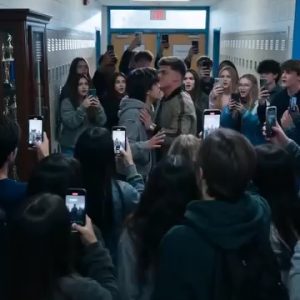
I leaned against the cold metal fender of the Honda and let six months of silence spill out onto the garage floor. I told him about the first week of school, when Garrett Vance had taken a picture of the F-150 at the corner light and air-dropped it to the sophomore class with a meme about landscapers. I told him about the ruined calculus binder, the two yellow slips buried in Mr. Miller’s drawer, the detour behind the cafeteria loading dock in the rain, and finally the trophy case, the forty phones, Julian’s kick, and Roger Cross’s tailored coat in the principal’s office.
While I spoke, Dad didn’t pace. He didn’t curse or kick the tool cabinet the way I had secretly feared he might. He simply stood with his arms folded across his chest, the blue patch reading MATEO over his heart rising and falling in slow, deep breaths, listening with every ounce of stillness in his body.
When I got to the part where Julian had mocked his hands and talked about begging for scraps—and how Roger Cross had tried to buy my silence with fleet maintenance contracts—my voice finally cracked. I looked down at my shoes, ashamed that even repeating the words inside my father’s shop felt like bringing filth across our threshold.
“I’m sorry I didn’t tell you in October,” I whispered, my throat tight. “You work fourteen hours a day so we can live in the district edge zone. I didn’t want you to think the scholarship was a mistake.“
For a long moment, the only sound in the garage was the hiss of the air compressor cycling off in the corner and a slow guitar ballad drifting from the radio.
Then two heavy, warm hands gripped my shoulders and pulled me forward.
My father wasn’t a tall man—at sixteen, I already had half an inch on him—but when he wrapped his arms around me, it felt like being anchored to oak timber. My face pressed against the canvas shoulder of his work shirt, smelling of lava soap, WD-40, and the quiet, unbreakable steadiness that had held our house together ever since my mother died when I was eight.
“Look at me, Alex,” he said, stepping back just far enough to hold me by the upper arms. His eyes were bright and fierce under the shop light. “You never apologize to me for what small men say to make themselves feel tall. You hear me? I thought I could handle it alone when I was your age, too. Nobody is meant to carry a ring on their own back. That’s why fighters have corners.”
He gave my shoulders a gentle squeeze, then let out a dry, tired huff that turned into a faint smile.
“So this Roger Cross wants to send his trucks here?” Dad shook his head, glancing around at the neatly racked rows of wrenches and the spotless hydraulic lift. “Tell him my schedule’s booked through midsummer. I’m picky about my clientele.”
A small, involuntary laugh escaped my chest, loosening the last knot behind my sternum.





