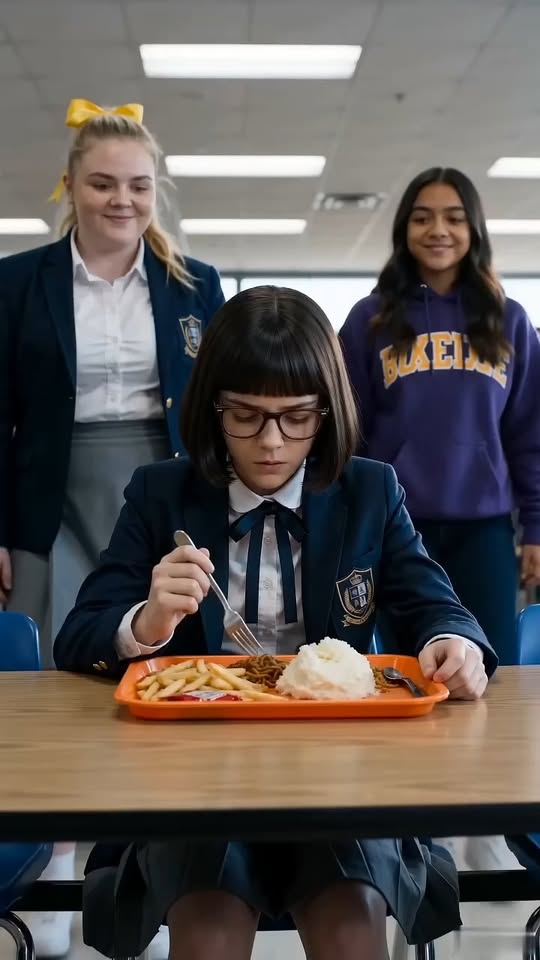
They Flipped My Lunch to Make Me Snap—Then a Note Changed Everything
I was sitting alone when Madison leaned over my shoulder.
“Eating alone again?”
I kept my eyes down.
“Leave me alone.”
She laughed, then grabbed my tray. One hard flip—and everything went across the table. Fries, noodles, mashed potatoes. The whole cafeteria started watching.
I didn’t move.
Madison leaned even closer.
“What? You gonna cry?”
That was when I looked up. Then I stood.
Her smile changed immediately.
Madison stepped toward me first. Her arm came across fast. I ducked. She turned to follow. I moved again. Then Brooke joined in from the other side. Another swing. Another step off-line.
For a few seconds, both of them were trying to close me in between the tables. But every time they moved, I was already changing the angle.
Madison stumbled toward a chair. Brooke spun back toward me. I straightened up.
The cafeteria went quiet. Neither of them was laughing anymore.
And just as Madison started pushing herself upright again, I noticed something near the table that hadn’t been there before.
It was a folded white napkin.
At first, I thought someone had dropped it during the commotion. Then I noticed my name written across the outside in blue ink.
LAURA.
I looked around the cafeteria.
A girl sitting two tables away was watching me. Her name was Nora, and she was usually so quiet that most people barely noticed when she entered a room.
She didn’t wave.
She didn’t call my name.
She simply tapped two fingers against the table, then looked down at the napkin.
I picked it up.
Inside, there were only two sentences:
I heard them planning this. They wanted you to swing first. I’ll tell the truth.
Underneath was Nora’s name.
I read it again, and suddenly the fight I thought I had just survived looked very different.
Madison was still on the floor, rubbing her elbow. Brooke had moved beside her, whispering something I couldn’t hear. Neither girl was looking at the napkin.
I folded it carefully and slipped it into my pocket.
Then I understood why Madison had kept asking what I was going to do about it.
They hadn’t simply wanted me to cry.
They had wanted me to lose control.
And they had expected the entire cafeteria to remember only the moment I finally did.
My name is Laura. I was sixteen, halfway through my junior year, and I had spent most of that school year trying to become invisible.
Not because I was ashamed of myself.
I just wanted to get through the day without giving Madison and Brooke another reason to make me the subject of their jokes.
They had a way of turning ordinary things into public entertainment. If someone wore the wrong shoes, they noticed. If someone answered a question incorrectly, they repeated the answer at lunch. If a student sat alone, they treated it like an invitation.
For a while, I thought ignoring them would make them lose interest.
It didn’t.
They started with comments about my clothes and the lunches I brought from home. Then they began taking the chair beside me, moving my backpack, and making sure I knew when they were talking about me.
I never gave them the reaction they wanted.
That seemed to bother Madison more than anything else.
She liked an audience. Brooke liked being close enough to Madison to share the attention. Together, they could make a person feel surrounded even when only two people were doing the talking.
I had learned to keep my answers short and my eyes on whatever I was doing.
My mother used to tell me that walking away was not the same as being weak. She had signed me up for a basic martial arts class when I was younger, mostly because I was nervous around unfamiliar people and she wanted me to feel more confident.
I had stopped attending regularly, but I remembered the most important lesson.
I didn’t have to prove I could hurt someone.
I only had to protect myself long enough to get somewhere safe.
That was why I hadn’t swung at Madison when she came toward me.
I was trying to get out of the space between the tables without letting either girl knock me down.
But the cafeteria had seen only the last few seconds.
And I knew how quickly a story could change when the people telling it were more popular than the person defending herself.
A cafeteria supervisor finally reached us and told everyone to step away.
Madison stood up, brushing crumbs from her varsity sweatshirt. She looked annoyed rather than frightened, and that bothered me because she seemed certain she could still control what happened next.
“She attacked me,” she said.
I turned toward her.
“You flipped my lunch.”
“You got in my face.”
“You came toward me.”
Brooke immediately stepped between us.
“Can you stop acting like you did nothing? Everybody saw you fighting.”
That was the part that made my stomach tighten.
Everybody had seen something.
But not everybody had seen the beginning.
The supervisor asked us to come with her. I followed, keeping my hands at my sides and making sure the folded napkin stayed in my pocket.
Madison walked ahead, talking loudly enough for the students nearby to hear.
“She thinks she can do whatever she wants because nobody ever says anything to her.”
Brooke nodded along.
I didn’t answer.
I was still thinking about Nora.
The note was small, and it could not prove everything by itself. But it meant someone had heard them planning something before the tray hit the table.
For the first time that afternoon, I had a reason not to accept the version of events Madison was already building.
The assistant principal met us in a small office near the main hallway.
He asked everyone to sit down and explain what had happened, one person at a time. Madison volunteered immediately.





