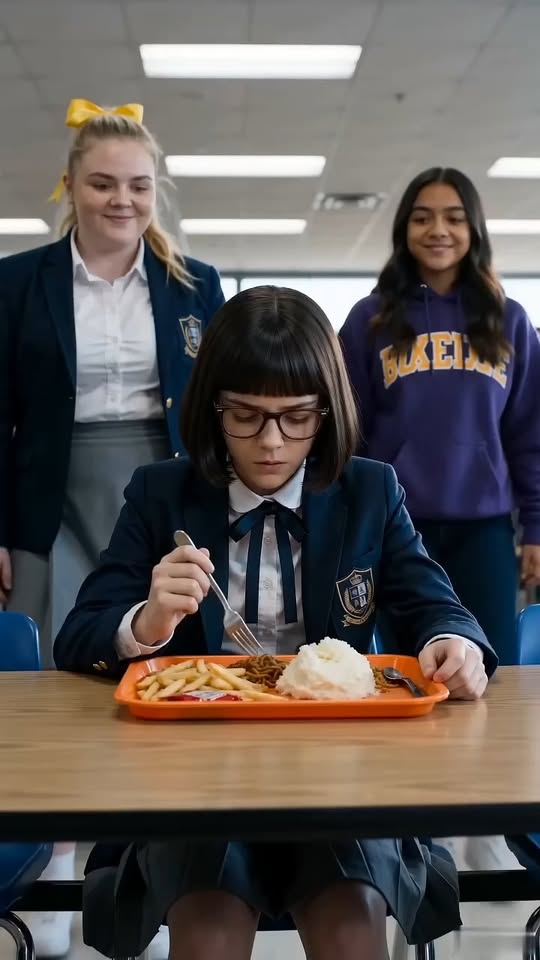
She described how she had supposedly approached me because she was concerned about my behavior. She said I had become aggressive, that I had stood up suddenly, and that she was only trying to protect herself when I moved toward her.
Brooke supported her account.
According to them, the tray had fallen during the confusion.
I listened without interrupting.
When it was my turn, I explained that Madison had approached me, insulted me, and deliberately flipped my food across the table. I described how she moved toward me afterward and how Brooke joined her.
I did not say I had beaten anyone.
I did not claim I had never moved toward them.
I told the truth about what I had done: I had stepped away from their swings and tried to keep them from cornering me.
The assistant principal asked whether anyone had witnessed the beginning.
I took the napkin from my pocket.
“I think someone did.”
He unfolded it and read the message.
His expression changed slightly, but he didn’t jump to conclusions.
“Who wrote this?”
“Nora. She was sitting near us.”
He asked if I knew whether she would be willing to speak with him.
“I don’t know,” I said. “But she said she would tell the truth.”
Madison leaned forward.
“That is ridiculous. Nora wasn’t even involved.”
The assistant principal looked at her.
“I didn’t ask whether she was involved. I asked whether she witnessed what happened.”
Madison sat back.
For the first time since the lunchroom, she didn’t have an immediate answer.
The assistant principal asked the supervisor to bring Nora to the office if she was still available. Then he separated us and told us not to contact one another until he had spoken with everyone.
I was sent to wait in a small conference room.
I could hear muffled voices in the hallway, but I couldn’t make out the words. My hands were still shaking. I kept thinking about the food on the table, the students watching, and how easily Madison had turned the whole thing into a performance.
A few minutes later, Nora came in.
She held her backpack against her chest and looked as if she wanted to turn around and leave.
The assistant principal thanked her for coming and asked her to explain what she had seen.
Nora glanced at me.
Then she looked at the floor.
“I heard them talking about Laura before lunch,” she said.
She explained that she had been in the hallway near the cafeteria when Madison and Brooke were discussing what they planned to do.
They had been laughing about how I never reacted to their comments.
Madison had said that if she could get me angry enough to swing at her, everyone would finally see what she called my “real attitude.”
Brooke had asked what would happen if I simply walked away.
Madison had answered that she would keep pushing until I did something.
Nora remembered those words because she had heard something similar before.
She had been the target of their jokes the previous semester.
At the time, she had tried to ignore them too. They had taken her notebook, passed it around, and laughed at a personal note she had written to herself. When she complained, they told people she couldn’t take a joke.
Nora had decided she would stay out of their way after that.
“I didn’t want them to start on me again,” she admitted. “So when I heard them talking about Laura, I didn’t say anything.”
The assistant principal asked why she had written the note.
Nora rubbed the edge of her backpack strap.
“Because I saw what happened after Madison flipped the tray. I knew they were going to say Laura started it. I thought if I didn’t tell someone, it would happen again.”
Her voice grew quieter.
“I didn’t want her to think everybody was against her.”
I looked at Nora.
She had been sitting only two tables away while the whole cafeteria watched me.
I had assumed she was another person who had decided to stay quiet.
Now I understood that she had been afraid, too.
The assistant principal thanked her and asked whether she would be willing to provide a written statement. Nora nodded.
That small decision changed the direction of the meeting.
Madison and Brooke were called back separately.
At first, Madison insisted Nora was lying because she didn’t like them. Brooke said she couldn’t remember the hallway conversation.
But when the assistant principal asked them why they had approached me in the cafeteria, their answers began to differ.
Madison said she was joking.
Brooke said they were only trying to get me to admit I had been talking about them.
Then Madison turned toward Brooke.
“You were the one who said she would probably swing.”
Brooke’s face tightened.
“You said we should keep going until she did something.”
The assistant principal stopped them.
He told them that blaming each other would not answer the question. He also made clear that flipping someone’s food and then physically confronting them was not harmless teasing.
Madison crossed her arms.
“She didn’t even get hurt.”
“That isn’t the standard,” he replied. “The question is what happened and who chose to escalate it.”
For a moment, Madison looked toward me.
I expected another insult.
Instead, she asked whether I was really going to make this a big deal.
I thought about the lunch I had lost, the food scattered across the table, and the students who had watched me become the day’s entertainment.
Then I thought about Nora’s note.
“I didn’t make it a big deal,” I said. “You did when you decided I wasn’t allowed to eat lunch without being bothered.”
Madison looked away.
The school contacted our parents and began its review of the incident. The assistant principal explained that the school would consider the statements, speak with the students who had been present, and decide what disciplinary steps were appropriate.
He also made one thing clear.





