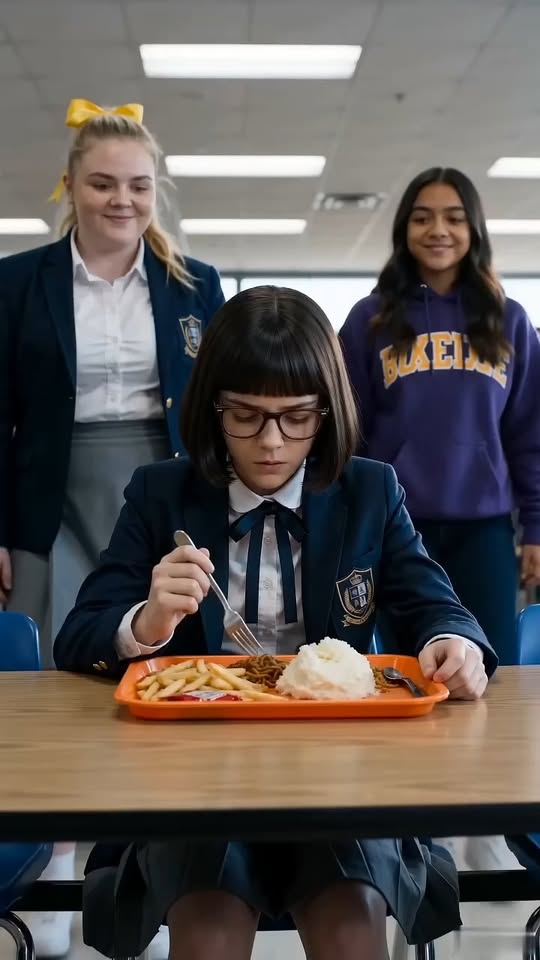
The next time someone sat alone, I wanted them to see an empty chair before they saw a reason to leave.
The cafeteria at Crestview High always smelled of scorched mozzarella, industrial floor bleach, and damp wool coats, a thick, humid soup of odors that pressed against the glass curtain wall overlooking the snowy courtyard. At 12:14 PM on a Thursday, the noise inside the room was a physical weight—four hundred voices overlapping beneath low acoustic tiles, punctuated by the scrape of tubular steel chair legs and the hiss of the soda dispensers near the kitchen line.
I sat at the far end of Table 14, the narrow laminate bench tucked beneath the dead stairwell where the vending machines hummed.
In front of me sat a red molded-plastic tray holding a paper boat of crinkle-cut fries, a scoop of lukewarm mashed potatoes drowning in translucent brown gravy, and a small plastic container of garlic noodles I had brought from home to supplement the two-dollar reduced-lunch ticket. Alongside the tray lay my open AP English composition book, my left forearm resting across the top margin so nobody walking past could read what I was writing.
For five months, I had treated junior year like a minefield that could be crossed safely if I simply stepped in the exact same footprints every day. Keep my chin down in the B-wing hallway. Answer questions in four words or fewer when Mr. Henderson called on me in chemistry. Eat at the dead end of Table 14, clear my tray at 12:36 before the five-minute warning bell crowded the trash cans, and slip into the library stacks before the varsity lacrosse girls left their round tables near the center windows.
I wasn’t hiding because I hated myself. I was hiding because my mother worked sixty hours a week as a night-shift respiratory therapist at County General, sleeping between nine in the morning and four in the afternoon with a box fan running outside her bedroom door, and the absolute last thing she needed when she woke up was a phone call from an assistant principal about her sixteen-year-old daughter getting dragged into hallway drama.
Then a shadow fell across my notebook, smelling sharply of coconut hair mist and chewing gum.
“Eating alone again, Bennett?”
Madison Vance leaned over my right shoulder, her palms planted flat on the grey laminate table three inches from my elbow. She was wearing her white-and-navy varsity cheer fleece unzipped over a cropped sweater, a delicate gold chain resting in the hollow of her throat. Two steps behind her left hip stood Brooke Miller, her arms crossed over her chest, a half-empty iced coffee cup dangling from two manicured fingers while her eyes flicked sideways to make sure the boys at Table 11 were watching.
I didn’t turn my head. I kept the tip of my mechanical pencil resting on the blue line of my notebook paper, watching the reflection of the fluorescent lights shimmer in the little pool of brown gravy on my tray.
“Leave me alone, Madison,” I said, keeping my voice low enough that it wouldn’t carry past the vending machines.
Madison let out a bright, theatrical sigh, looking back over her shoulder at Brooke and the two sophomore girls loitering near the condiment stand. “God, she’s always so hostile. You come over to check on somebody because they sit by the trash cans every single day like a serial killer, and she bites your head off.”
“Maybe she doesn’t speak English during fourth period,” Brooke murmured, loud enough to draw a snigger from a boy in a letterman jacket at the next table. “Hey, Laura, where’d you get the Tupperware? My grandma throws out butter tubs that look nicer than that.”
My jaw tightened by a fraction of an inch, a tiny muscle bunching beneath my ear, though I kept my eyes fixed on the page. Don’t feed the room, my mother always told me. Years ago, when I was eleven and newly arrived in the district after my father left, Mom had traded three weekend shifts to pay for two years of traditional karate and Aikido classes at a cramped community center gym downtown—not so I could win trophies, Sensei Matsuda had drilled into us on the worn canvas mats, but so I would learn how to breathe when someone invaded my space. A person who tries to provoke you is handing you a hot coal, Laura, he used to say, adjusting his glasses. If you refuse to close your fingers around it, they are the only ones whose hands get burned.
For five months, refusing to take the coal had worked—or at least, it had kept them limited to drive-by whispers in the locker bay and snide comments about my thrifted corduroy coat.
Today, though, Madison didn’t walk away when I stayed silent.
Instead, she shifted her weight closer, her hip brushing my shoulder as she looked down at my untouched food. There was a tight, restless glitter in her blue eyes—the look of an actress who had promised the front row a spectacle and realized the curtain was already halfway up.
“I asked you a question, Laura,” Madison said, her voice dropping its fake sweetness for a hard, metallic edge.
Before I could pull my hand back, her manicured fingers hooked beneath the front lip of my red plastic tray.
With one sharp, upward jerk of her wrist, she flipped it.
Time seemed to fracture into sticky, slow-motion fragments. The red tray cartwheeled backward across the center of the table with a loud, hollow clatter. My plastic container of garlic noodles tumbled through the air, popping its lid and spilling pale, oiled strands across the open pages of my English notebook. Lukewarm gravy and mashed potatoes splattered across my gray cardigan sleeve and hit the opposite bench with a wet slap, while crinkle-cut fries skittered across the linoleum floor like yellow chalk.





