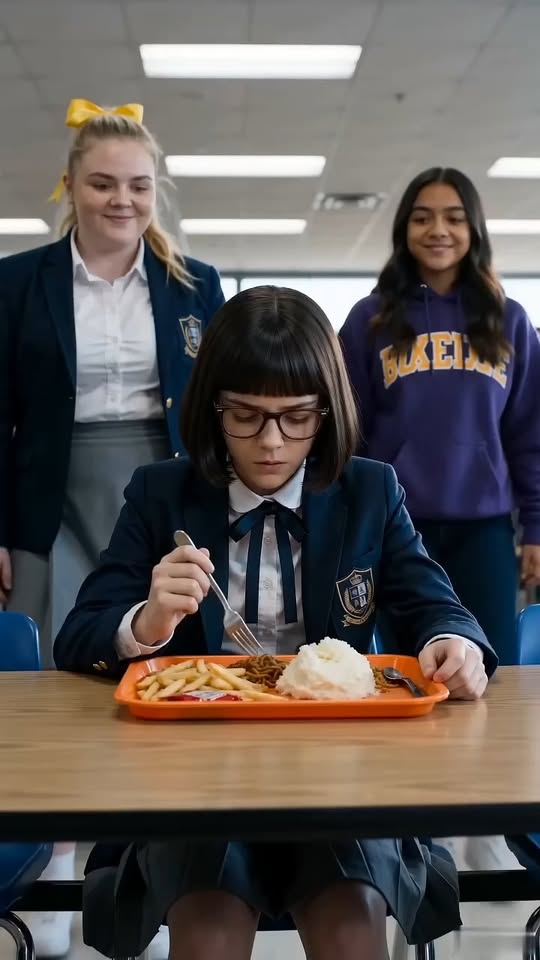
There would be no direct contact between Madison, Brooke, and me while the matter was being handled.
I didn’t ask for them to be expelled.
I didn’t ask for some dramatic punishment.
I wanted to be able to sit down, eat my lunch, and finish a school day without wondering whether someone was about to grab my tray or start another scene.
That seemed like a reasonable thing to ask.
The following morning, I almost didn’t go to the cafeteria.
I considered eating in the library or taking my lunch outside. The thought of walking past Madison’s usual table made my stomach tighten.
Then I remembered that I had done nothing wrong by sitting where I wanted to sit.
I carried my lunch into the room.
The cafeteria sounded exactly as it always did. Chairs scraped against the floor, students talked over one another, and someone near the serving line complained that the pizza was cold.
For a moment, I stood near the entrance with my tray.
Then I saw Nora.
She was sitting at a table near the windows, looking down at her lunch.
There was an empty chair across from her.
She glanced up and gave me a small nod.
I walked over.
“Is this seat taken?” I asked.
“No,” she said. “I saved it.”
I sat down.
We didn’t talk much at first. Nora asked what class I had after lunch, and I told her. I asked whether she had finished the assignment for science. She said she had, but she wasn’t sure about one of the questions.
It was ordinary conversation.
That was what made it feel so different.
Nobody was watching to see whether I would react.
Nobody was trying to make the table into a stage.
I was simply eating lunch with another person.
Over the next several days, the school followed up with the students who had been present. A few admitted they had seen Madison flip the tray but had laughed because they thought it was part of the usual joking.
One student said she had heard Madison tell Brooke to keep pushing after I asked to be left alone.
Another said she had been uncomfortable but hadn’t wanted to get involved.
The school did not treat every student who had watched as equally responsible. Instead, the assistant principal spoke with them about the difference between witnessing an incident and encouraging it.
Madison and Brooke received disciplinary consequences under the school’s rules, along with restrictions intended to keep them away from me during the review period.
They were also required to address the incident directly rather than describe it as a mutual disagreement.
The apology did not come immediately.
A few days later, Madison approached me near the lockers while Brooke waited farther down the hall.
“I didn’t think you were actually going to report it,” she said.
I closed my locker.
“You thought I would just let it happen?”
She shrugged.
“I thought you would keep ignoring us.”
I looked at her for a moment.
“That doesn’t mean you get to keep doing it.”
She glanced down the hallway.
“People are acting like we’re terrible people now.”
“I can’t control what people think.”
“You could tell them it wasn’t that serious.”
I shook my head.
“I told them what happened. I’m not going to change it to make you feel better.”
She looked irritated, but she didn’t raise her voice.
For once, she walked away without trying to get the last word.
Brooke eventually gave a short apology during a meeting with the assistant principal present. It wasn’t warm or particularly thoughtful, but she acknowledged that she had joined in and that she shouldn’t have.
I accepted that she had said it.
I did not pretend everything was suddenly fine.
Trust isn’t something someone gets back just because they have been told to apologize.
Nora and I kept eating lunch together.
Sometimes another student joined us. Sometimes we talked about schoolwork. Other days, we barely spoke at all.
I learned that Nora liked drawing and wanted to study graphic design after graduation. She learned that I was better at remembering details than remembering dates.
Neither of us became a different person because of what happened.
We just stopped spending so much energy trying to avoid people who wanted us to feel small.
A few weeks later, I found the folded napkin in the pocket of my backpack.
The ink had faded slightly where the paper had been pressed against my notebook.
I heard them planning this. I’ll tell the truth.
I had kept it because it reminded me that someone had noticed what happened before the story could be rewritten.
But it also reminded me of something else.
Nora had been scared.
She could have stayed quiet and nobody would have blamed her for wanting to protect herself. Instead, she had chosen to speak, even though she knew Madison and Brooke might turn their attention toward her again.
I didn’t need the note to prove I was stronger than the girls who had attacked me.
I needed it because it showed me I wasn’t the only person who had seen what was wrong.
The next Monday, a new student walked into the cafeteria carrying a lunch tray.
She looked around for a place to sit, then paused near our table.
There were two empty chairs.
I moved my backpack off one of them.
“There’s room here,” I said.
She smiled a little and sat down.
Nora passed her a napkin, and I moved my drink to make more space.
The cafeteria kept moving around us. People talked, laughed, traded food, and hurried through lunch before the next bell.
No one was watching us.
No one was waiting for a reaction.
I unfolded the old note one last time, then tucked it into the back pocket of my notebook instead of throwing it away.





