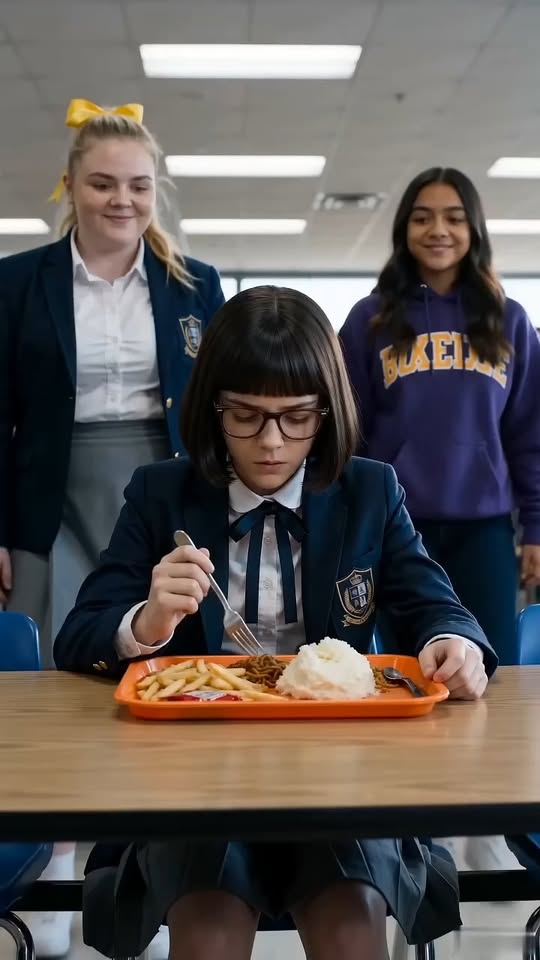
When I stepped out past the cash registers carrying a clean red tray, the cafeteria sounded exactly the way it always did on a Friday—chairs scraping against linoleum, freshmen arguing over basketball brackets, someone near the milk cooler complaining that the pepperoni pizza was burnt on the bottom. At Table 11, Garrett and the varsity boys were arguing over a video game on someone’s phone; two of them glanced up as I walked past, looked briefly embarrassed, and immediately went back to their fries without saying a word.
I paused near the concrete pillar, looking toward the far corner by the stairwell. Table 14 was empty.
Then I caught movement out of the corner of my eye near the tall windows overlooking the snowy courtyard.
At Table 16—bathed in the bright, pale winter sunlight streaming through the glass—sat Nora Lindqvist.
Her charcoal sketchbook lay closed beside her brown paper bag. Directly across from her, on the clean grey laminate of the opposite bench, sat an empty wooden chair with her knit scarf draped lightly over the backrest to keep passersby from taking it.
As I stood holding my tray, Nora looked up from her apple, met my eyes across the aisle, and gave a tiny, unmistakable nod toward the chair.
I walked over to the window table and stopped beside the bench.
“Is this seat taken?” I asked.
A small, genuine smile touched the corners of Nora’s mouth as she reached across the table and pulled her scarf off the chair back. “No. I saved it for you.”
I set my red tray down on the table, slung my backpack over the chair frame, and sat down in the sunlight.
For the first two minutes, neither of us talked about Madison Vance, or Mr. Miller’s office, or the white napkin tucked safely inside the zippered inner pocket of my binder. Instead, Nora pointed her plastic fork at the corner of my AP English notebook and asked if Mr. Ross had assigned chapters four through six for Monday. I told her he had, and offered to show her the rubric notes from the essay prompt; she asked if I was any good at balancing redox equations for third-period chemistry because she kept getting the oxidation states backward on question seven.
It was completely ordinary conversation.
And sitting there with the winter sun warming the back of my clean blue sweater, listening to the normal clatter of trays around us while Nora sketched a tiny, hilarious cartoon of a confused sodium atom on the corner of her lunch bag, I realized why ordinary felt like a miracle.
Nobody at our table was scanning the entrance with tight shoulders. Nobody was treating a quiet person as an audition for a group chat. We were just two sixteen-year-old girls eating lunch on a Friday afternoon.
Over the following two weeks, the ripples from Thursday’s fourth-period lunch settled into a permanent shift in the architecture of the junior class.
Mr. Miller and the new student-services counselor didn’t stop with Nora’s statement. On Monday and Tuesday, they pulled six students who had been sitting at Tables 11 and 12 into the conference room one by one. Without Madison sitting two feet away to dictate the narrative, the wall of complicity crumbled quickly. Garrett admitted he had heard Madison tell Brooke to “keep pushing her” right before the tray flipped; a sophomore girl near the condiment stand admitted she had started filming because Madison had told her in third period that “something funny was gonna happen to Laura Bennett at lunch.”
The administration didn’t suspend the bystanders, nor did they turn it into an assembly lecture that everyone would roll their eyes at. Instead, Mr. Miller called each of those witnesses in with their parents to watch the silent security camera footage from the ceiling dome above the register—watching two girls box a classmate into a corner while thirty teenagers reached for their phones instead of a teacher—and required each of them to write a reflection for their permanent citizenship file on the line between witnessing an incident and serving as its unpaid camera crew.
On the following Wednesday evening, my mother sat in the fourth row of the Crestview auditorium in her best navy dress, clapping until her hands were pink as Dr. Vance called my name across the stage and pinned the gold-and-blue National Honor Society crest onto my lapel.
Two days after that, on a rainy Tuesday afternoon after the five-day suspension ended, I was standing at my locker in the B-wing swapping out my chemistry binder when the ambient chatter in the hallway dipped slightly.
Madison Vance walked down the center tiles toward her locker three doors down. Further back by the drinking fountain, Brooke stood waiting by the stairwell—though the two of them were no longer walking shoulder-to-shoulder the way they had since freshman year. Without her varsity cheer fleece (stripped for the remainder of the winter basketball season under the athletic code), Madison looked smaller in a plain grey hoodie, her eyes flicking defensively toward the students who stepped aside to give her a wide, cool berth.





