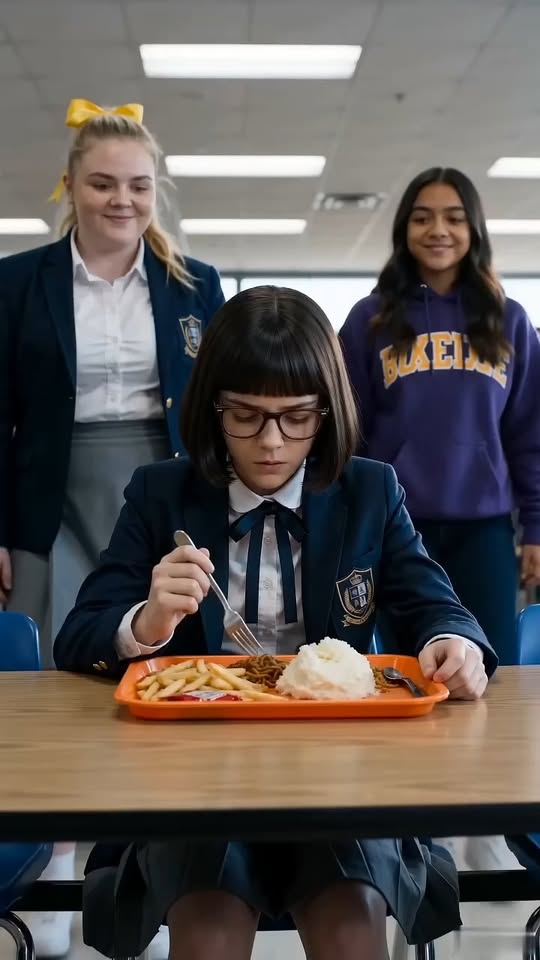
“Here is what is going to happen right now,” Mr. Miller said, his voice dropping into the formal, by-the-book cadence of a district hearing officer. “Laura, you are going to step into the nurse’s alcove across the hall to wash that gravy off your sleeve and wait in the chairs by Mrs. Higgins’s desk. Brooke, you are going to sit in the attendance office lobby. Madison, you stay right in that chair. Nobody touches a cell phone. If I find out a single text message was sent between the two of you while I am interviewing witnesses in Conference Room B, I will treat it as tampering with a school investigation and add three days of out-of-school suspension before we even get to the cafeteria incident. Understood?”
Brooke swallowed hard and nodded, clutching her purse against her ribs as she stood up. Madison crossed her arms tightly over her varsity fleece, glaring at the cinderblock wall without answering.
Twenty minutes later, after I had blotted the worst of the gravy stain out of my cardigan with cold wet paper towels in the nurse’s sink, Mr. Miller opened the door of Conference Room B and motioned me inside.
The conference room was slightly larger than his office, with an oval laminate table surrounded by six swivel chairs and a frosted window facing the inner courtyard.
Nora Lindqvist sat in the chair closest to the corner, her oversized charcoal sweater pulled down over her wrists so only the tips of her fingers showed as she clutched the straps of her canvas backpack against her chest. She looked so pale beneath the fluorescent lights that the faint scatter of freckles across the bridge of her nose stood out like specks of cinnamon. She looked like someone who had spent the last fifteen minutes trying to talk herself out of jumping through the window.
“Have a seat at the end there, Laura,” Mr. Miller said, closing the door and sitting down on the long side of the table with his yellow legal pad and the plastic sleeve holding the white napkin. “Nora has already given me a preliminary verbal statement on her own, and she agreed to repeat the relevant portion with you present so we are completely transparent before I call the other two girls back in. Nora, go ahead and tell us what you heard before lunch.”
Nora glanced at me for a fraction of a second, her hazel eyes wide and nervous, before dropping her gaze to the wood-grain pattern on the table.
“My third-period class is at the far end of the B-wing, three lockers down from Madison’s,” Nora said. Her voice was soft, slightly raspy from disuse, like someone testing a microphone in an empty church. “Today, my binder ring snapped when the bell rang, so I was kneeling down behind the open door of my locker picking up loose-leaf paper. Madison and Brooke came around the corner from the restroom and stopped at Madison’s locker. Because the steel door was between us, they didn’t see me on the floor.”
She twisted the nylon strap of her backpack around her thumb until the tip turned white.
“Madison was mad because she got a C-minus on the AP English essay Mr. Ross handed back this morning, and she saw that Mr. Ross read a paragraph from Laura’s paper out loud to the class as the example,” Nora continued, glancing up briefly as my eyes widened in surprise.
I hadn’t even thought about first period. Mr. Ross had read an anonymous excerpt from my essay on The Crucible without naming me—except Madison sat diagonally behind my desk and must have recognized the handwriting on the rubric when I slid it into my folder.
“Madison said she was sick of Laura walking around acting like she was better than everybody while dressing like a charity case,” Nora said, her voice steadying slightly as she recalled the exact words. “Brooke said, ‘Just dump her weird Tupperware in the trash again like we did last month.‘ And Madison laughed and said, ‘No, she never reacts when we do stuff behind her back. She just sits there like a robot. Watch—at lunch today, I’m gonna flip her whole tray right in her face and crowd her against the bench until she finally loses it and swings at me. Everybody knows she took karate when she was a kid. Once she throws one punch in front of the whole cafeteria, Miller’ll have to suspend her for three days and she’ll get kicked out of the National Honor Society induction next week.‘”
A cold, hollow sensation opened behind my ribs.
National Honor Society induction was next Wednesday night. My mother had already requested a shift swap three weeks in advance so she could sit in the auditorium and watch me get pinned—the only evening event she had been able to attend all year. Under Crestview’s bylaws, any disciplinary suspension for physical fighting during junior year resulted in automatic, permanent disqualification from NHS.
Madison hadn’t just been bored at lunch. She had seen my essay in first period, remembered the NHS candidate list posted outside the counseling office on Monday morning, and decided to erase my name from it before fifth period.
“And what did Brooke say when Madison proposed that?” Mr. Miller asked, his pen moving rapidly across the legal pad.
“Brooke asked, ‘What if she just gets up and walks away like she always does?‘” Nora answered. “And Madison said, ‘Stand on her left side by the other bench so she can’t get out. If we corner her after the food hits her shirt, she’ll have to shove one of us to move, and Garrett’s table will see her put hands on us.'”
Mr. Miller stopped writing. He looked at the legal pad for a long moment, then looked at Nora.





