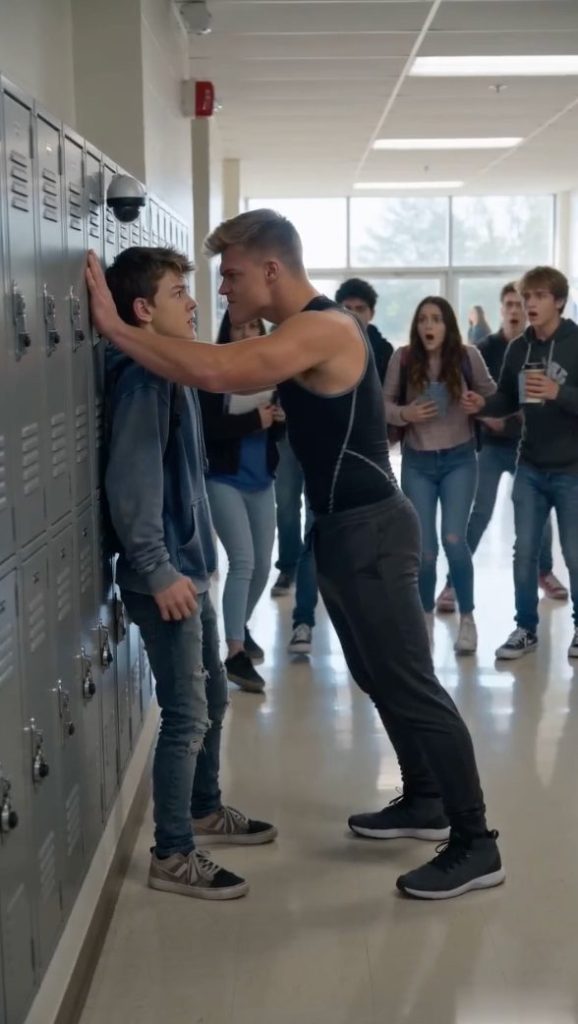
The first thing I heard was the sound of metal bending beneath a pair of enormous hands.
The second was the sudden silence of nearly fifty students who had been laughing and talking only moments earlier.
By the time I realized what was happening, my back was pressed against a row of cold gray lockers, and the most untouchable football player at Westbridge High was standing close enough for me to see the anger gathering in his eyes.
Trent had planted one palm against the locker on either side of my head.
His broad shoulders blocked the hallway lights, and his black athletic tank top stretched tightly across the muscles he seemed determined to display.
The October morning was cold enough that most students had arrived wearing jackets, but Trent never seemed interested in dressing for the weather.
He dressed for attention, and attention was something he had never struggled to get.
“You’re standing in my spot, new kid,” he said.
There was nothing special about the place where I stood.
It was a narrow stretch of hallway between the mathematics wing and the main administrative office, beside a locker I had been assigned three weeks earlier.
But Trent had decided the space belonged to him, and at Westbridge High, that was usually enough.
I kept my hands inside the pockets of my faded blue hoodie.
My uncle had warned me about moments like this.
He owned a small boxing gym two towns away, where I had spent enough afternoons learning to move my feet, protect my face, and understand the difference between defending myself and proving something.
He had taught me that anger could make a strong person careless and a frightened person dangerous.
“The loudest person in the room is usually the weakest,” he liked to say.
He had made me promise not to let my temper decide what happened at my new school.
So I stood still.
I looked at Trent’s collarbone instead of his face, keeping my breathing even while the crowd grew thicker around us.
Someone laughed nervously.
Sneakers squeaked against the polished floor.
A backpack bumped against another student’s shoulder as everyone tried to move closer.
Trent leaned forward.
“Look at me when I’m talking to you.”
I raised my eyes slowly.
His expression hardened, perhaps because he had expected me to flinch.
He was accustomed to students moving aside when he approached, laughing at jokes that weren’t funny, and pretending not to notice when he singled someone out.
My silence was apparently more offensive than an insult.
“What?” he demanded.
“You too good to answer?”
“No,” I said quietly.
“I just need to get to class.”
That should have ended it.
Instead, Trent looked over his shoulder at two football teammates standing in the crowd.
One gave him an encouraging grin, and the other folded his arms as though settling in to watch a performance.
Trent turned back toward me and reached for my backpack.
He pulled it off my shoulder so sharply that one strap caught beneath my elbow.

I stumbled forward half a step before catching my balance, and the zipper split open with an ugly ripping sound.
A few students gasped.
“Give it back, Trent.”
He laughed.
“Listen to that.
He knows my name.”
He held the backpack away from me with one hand and began searching through it with the other.
A pencil case fell onto the floor, followed by a folded mathematics worksheet and a small ruler.
Then his fingers closed around the thick leather cover of my sketchbook.
My stomach tightened.
Of everything in that backpack, it was the one thing I could not easily replace.
I had spent months filling those pages with architectural drawings, structural concepts, measurements, and designs for a statewide engineering scholarship.
There were building elevations, cross sections, load calculations, and careful revisions made after long evenings of studying.
Some pages contained three or four attempts at the same idea, each one corrected in pencil until the proportions finally looked right.
It wasn’t simply a school assignment.
It was the closest thing I had to a plan for my future.
Trent lifted the sketchbook above his head.
“What is this garbage?” he said.
“You drawing little houses?”
One of his teammates snickered.
“Maybe he’s designing a dollhouse.”
Trent flipped through several pages, bending the binding backward.
I could see the corners beginning to crease beneath his fingers.
“That’s for a scholarship application,” I said.
“Please don’t damage it.”
His smile widened.
“A scholarship?”
I regretted speaking almost immediately.
“Wow.
Everybody hear that?
The new kid thinks he’s some kind of genius.”
A few students laughed because Trent was laughing.
Others stood silently, looking uncomfortable, but nobody stepped forward.
I extended one hand.
“Just give me the book.”
For a moment, he held it directly in front of my face.
Then he gripped the leather cover with both hands.
The sound of the first pages tearing was surprisingly loud.
It wasn’t one clean rip.
The binding resisted, and thick sheets pulled unevenly from the spine while Trent forced the two halves apart.
A folded architectural drawing slipped loose and drifted toward the floor.
Several other pages followed, scattering between the shoes of the students surrounding us.
He tore again.
Something inside my chest seemed to collapse.
I watched a drawing I had spent seventeen hours completing fall against a dirty sneaker.
The student wearing it moved backward, leaving a gray mark across the carefully shaded roofline.
Another page slid beneath a locker, its corner bending against the metal.
Trent dropped the torn remains of the sketchbook.
“There,” he said.
“Now you can start over.”
The laughter sounded farther away than it should have.
I could barely hear anything over the pounding of my heartbeat.
My fingers curled into fists inside my pockets, and for one terrible second, I imagined exactly how easy it would be to step forward.





