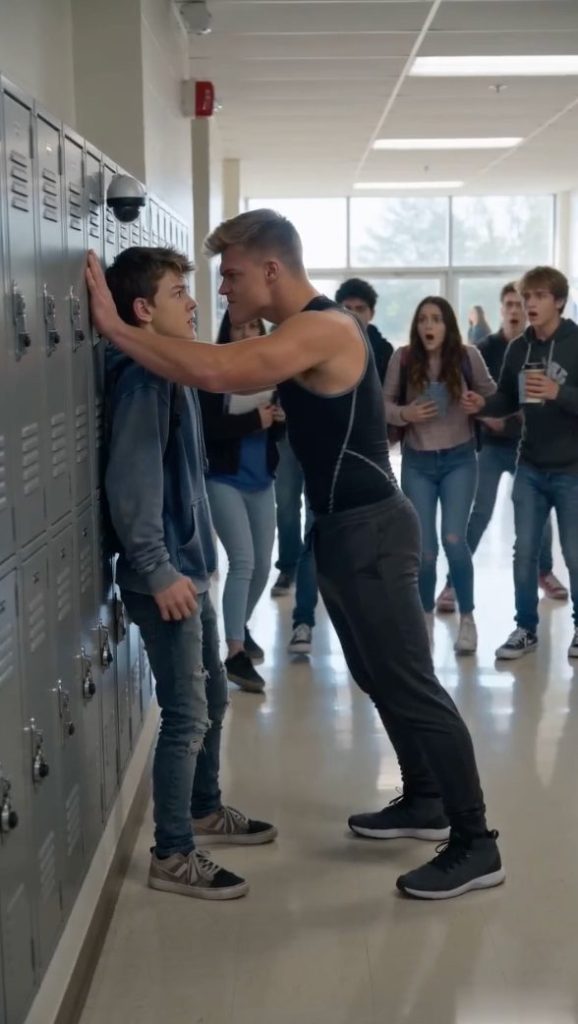
The representative held my gaze.
Then she wrote down my words.
“Thank you,” she said.
“That’s important for us to understand.”
I left the meeting room feeling exhausted.
I had told the same story so many times that the words were beginning to sound unfamiliar.
But I also felt something I hadn’t felt since the first morning.
I felt as though the facts were finally being taken seriously.
That afternoon, my mathematics teacher asked how the scholarship portfolio was progressing.
I showed her several reconstructed pages.
They weren’t identical to the originals.
Some lines were cleaner.
Others were less detailed.
I had discovered mistakes in two calculations while rebuilding them, and I had adjusted the dimensions of one entrance.
She studied a drawing for several seconds.
“You changed the courtyard.”
I nodded.
“The original plan didn’t provide enough covered space near the east side.”
She smiled.
“That’s a good correction.”
I looked at the paper.
“I only noticed because I had to draw it again.”
She rested one hand on the desk.
“I wish you hadn’t been forced to.”
“Me too.”
“But that doesn’t make the improvement any less real.”
I looked down at the new drawing.
It was the first time I had thought of the reconstructed portfolio as something other than a poor replacement.
Maybe it could still represent my best work.
The scholarship coordinator replied that evening.
The program would accept clear reconstructed pages and supplementary photographs, provided I submitted the portfolio within the original deadline and identified any reconstructed material accurately.
There would be no guarantee of selection.
There would also be no automatic rejection simply because my originals had been damaged.
I sat in front of the screen for a long time, reading those words.
Then I went to the gym.
My uncle was sweeping the floor when I arrived.
I held up my phone.
“They said I can still apply.”
He stopped sweeping.
“Really?”
I nodded.
He smiled.
Not the exaggerated kind of smile people gave when they wanted to convince someone everything was fine.
A real one.
“Well,” he said, “I guess we’d better get you some more drawing paper.”
We worked late that night.
I drew while my uncle finished cleaning the gym and balancing his paperwork.
Every so often, he glanced into the office and asked whether I needed water, a ruler, or another sheet.
He didn’t hover.
He simply made sure I wasn’t doing everything alone.
Around ten o’clock, I noticed him watching me from the doorway.
“What?”
I asked.
He shook his head.
“Nothing.”
I raised an eyebrow.
He smiled.
“I just haven’t seen you concentrate like that since before you transferred.”
I looked down at the drawing.
“Feels good.”
He nodded.
“Yeah.
It does.”
For a few minutes, the school disappeared from my thoughts.
There was only paper, pencil, light, and the quiet satisfaction of making something work.
Then my phone buzzed.
Another message from the district.
The representative wanted to arrange a follow-up meeting the next school day.
She explained that she would be speaking with staff members and reviewing available recordings.
Principal Evans would also be asked to provide an account of his observations and response.
I read the email aloud.
My uncle listened.
Then he asked, “Do you want me there?”
I looked toward the half-finished drawing.
“Yes.”
“Okay.”
I hesitated.
“Do you think they’ll actually show us the camera footage?”
“I don’t know,” he said.
“School recordings involve other students, so they may limit what they share.”
I nodded.
“But they can review it.”
“Exactly.”
I stared at the screen.
For days, I had imagined that camera as the one thing capable of telling the truth without hesitation.
Now somebody with the authority to examine it was actually looking.
I didn’t know what the recording would show.
I remembered the hallway clearly, but memory could be imperfect.
Maybe the camera angle would miss the sketchbook.
Maybe the crowd would block the principal.
Maybe the second confrontation had happened just outside its field of view.
I forced myself not to build an imagined victory around footage I hadn’t seen.
The district would make its own assessment.
All I could do was tell the truth.
The following school day felt different.
Principal Evans wasn’t visible in the hallway during morning arrival.
The secretary looked unusually busy, and two unfamiliar adults passed through the administrative corridor carrying folders.
Students whispered about district officials being in the building.
Some said the football program was being investigated.
Others claimed Trent had already been suspended, which was clearly untrue because I saw him outside the cafeteria before lunch.
I didn’t repeat any of the rumors.
I had learned how quickly stories changed when people enjoyed telling them.
During fourth period, I received a message asking me to come to the meeting room after lunch.
My uncle would join by arrangement with the district representative.
I spent the next hour trying to concentrate on classwork.
The effort was nearly useless.
At lunch, the girl who had recorded the first incident approached my table.
“Can I sit?”
I nodded.
She placed her tray across from me.
For a moment, she picked at her food without speaking.
Then she said, “Somebody from the district talked to me.”
I looked up.
“About the video?”
“Yeah.”
“What did you tell them?”
“The truth.”
I waited.
She looked down.
“I told them Trent ripped your book and you didn’t do anything to him.”
I felt my shoulders loosen slightly.
“Thank you.”
She hesitated.
“I also told them I laughed.”
I looked at her.
She gave a small, embarrassed shrug.
“I figured if I was going to tell the truth, I should tell all of it.”
I didn’t know what to say.
She continued.
“I showed them the second recording too.”
My fingers stopped moving.
“You still had it?”
“Yeah.”
I remembered the moment after seventh period, when she had held up her phone near the drinking fountain.
“What does it show?”
“Trent grabbing your hoodie.





