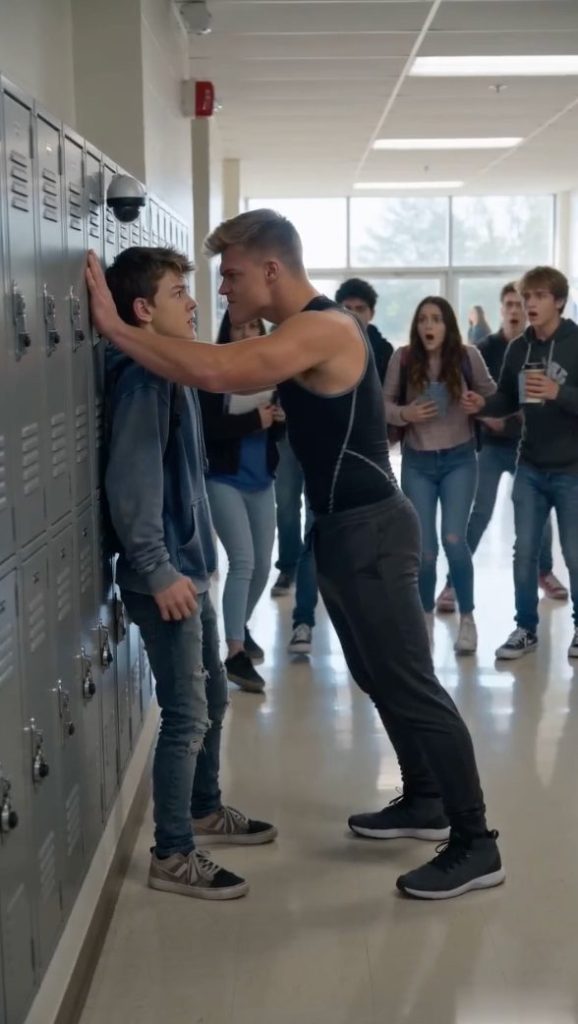
My uncle had taught me more than enough to understand distance, balance, and the openings created by someone leaning too far into a confrontation.

But he had also taught me what happened after the first punch.
And I knew exactly whose side this school would take.
I forced my hands open.
Near the edge of the crowd, a girl held her phone upright, recording everything.
She had a small smile on her face, the kind people wore when they believed something humiliating was also entertaining.
I looked past her toward the administrative office.
That was when I saw Principal Evans.
He had stepped into the hallway holding a steaming coffee mug.
His gray suit jacket was open, and his neatly combed hair looked almost silver beneath the fluorescent lights.
He stopped.
His eyes moved from Trent to the torn pages scattered across the floor.
For one brief moment, we looked directly at each other.
I thought he was going to intervene.
He didn’t.
Principal Evans turned toward the staff corridor and walked away.
That small movement hurt more than I expected.
There was no confusion in his expression, no indication that he hadn’t understood what was happening.
He had seen the crowd, the torn book, Trent standing over me, and the pages on the floor.
He had simply decided none of it required his attention.
Trent noticed where I was looking.
“Don’t bother,” he said.
Then he drove his shoulder into my chest.
The impact knocked me backward against the locker vents.
I lost my footing and slid down the metal doors until my knees struck the floor, directly among the scattered drawings.
Trent stood over me.
“I’m going to find you after seventh period,” he said.
“And if you’re still wearing that stupid blue hoodie, I’m taking it off you.”
He nudged one crumpled sheet across the floor with his shoe.
It landed against my knee.
Then the morning bell rang.
The crowd began to disappear almost immediately.
Students who had been laughing moments earlier suddenly remembered they had classes to attend.
Backpacks swung over shoulders, footsteps hurried away, and the circle around me opened until the hallway was nearly empty.
Nobody asked whether I was all right.
I remained on my knees.
The drawing against my leg showed the entrance to a community learning center, a design I had been developing around the idea that good architecture should make people feel welcome rather than small.
I remembered working on that page until nearly two in the morning, moving a doorway a few inches because I wanted wheelchair access to feel like a natural part of the entrance.
Now a dirty shoe print covered the doorway.
I picked it up carefully.
Then I began gathering the others.
Some had been torn directly through the middle.
Others were bent, stained, or missing corners.
I slid my fingers beneath the lockers to retrieve loose pieces, brushing dust and small bits of paper from the floor.
By the time I had collected everything I could see, my knees were aching.
I stood with the ruined sketchbook pressed against my chest.
That was when I noticed the black security camera mounted above the lockers.

Its small dome reflected the hallway lights.
I had passed beneath it every morning without giving it much thought.
Now I found myself staring at it, remembering exactly where Trent had stood, where the crowd had gathered, and how Principal Evans had paused in the doorway.
I understood something I hadn’t understood a few minutes earlier.
I didn’t need to convince Trent to stop.
I needed someone with the authority to hold him accountable to see what had happened.
And there was a difference.
I looked down at the ruined pages one last time.
Then I went to class.
By the time I reached my mathematics classroom, the lesson had already begun.
My teacher stopped writing on the board when I entered, and every student turned toward the door.
“You’re late,” she said.
“I know.
I’m sorry.”
She noticed the torn papers in my arms.
“Is everything okay?”
I could have told her the truth.
I could have described the lockers, the crowd, the backpack, and the way the principal had looked directly at me before walking away.
But twenty-five students were watching, and several of them had already witnessed what happened.
I didn’t want to give anyone another performance.
“I had a problem in the hallway,” I answered.
Her expression changed.
“Do you need to go to the office?”
The word office made my throat tighten.
“No, ma’am.”
She studied me for a moment before pointing toward my seat.
“All right.
Sit down.
We’ll talk after class.”
I walked to the back row, placed the torn drawings beneath my desk, and opened my notebook.
For the next forty minutes, I copied equations without understanding most of them.
Numbers had always been comforting to me.
They followed rules.
They didn’t change because somebody was popular or because a football team needed to win on Friday night.
A correct calculation remained correct no matter who wrote it.
That morning, even mathematics seemed distant.
Every few minutes, my eyes dropped toward the papers beneath my desk.
I kept thinking about the scholarship.
The statewide engineering program accepted only a small number of students each year.
The application required academic records, recommendations, and a design portfolio demonstrating how applicants approached real problems.
The financial assistance attached to the scholarship could make an engineering education possible for students whose families couldn’t easily cover the cost.
I had been working toward it long before transferring to Westbridge.
My portfolio was the part of the application I cared about most.
Grades could show that I understood equations, but my drawings showed how I thought.
They contained the questions I asked when something didn’t work, the mistakes I corrected, and the small improvements I discovered after hours of effort.
Trent had destroyed the physical proof of that work in less than thirty seconds.





