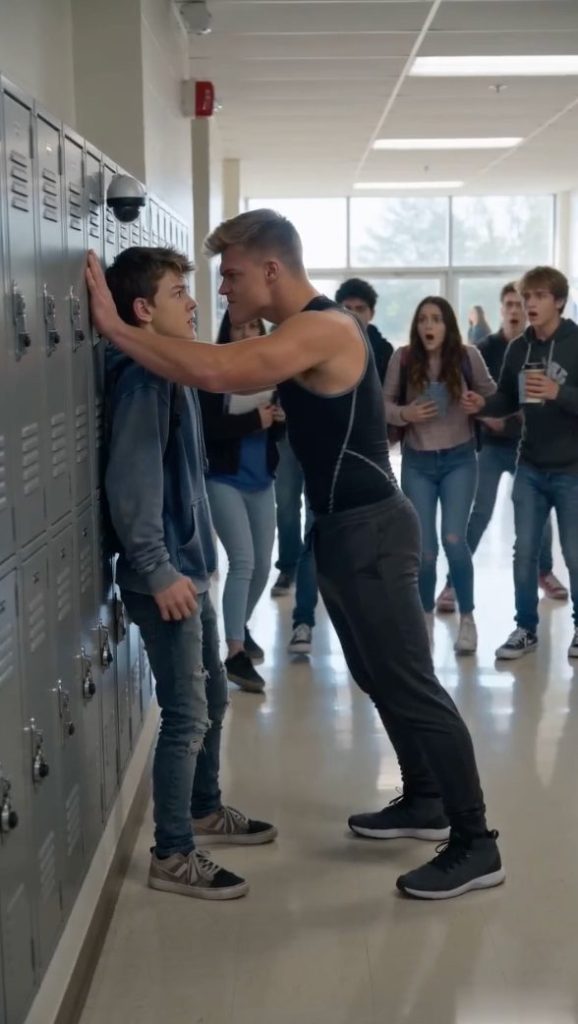
Trent appeared in one of the recent team photographs, standing in the front row.
I looked back at Evans.
“There’s a security camera above the lockers.”
His expression changed almost imperceptibly.
“What about it?”
“I’d like the footage preserved.”
He leaned forward.
“Security footage is an administrative matter.”
“I understand.”
“Students are not entitled to access every recording made on school property.”
“I’m not asking you to give it to me right now.
I’m asking you not to delete it.”
He stared at me.
I could feel the room growing uncomfortable.
Finally, he spoke.
“You need to understand that making accusations against other students can have consequences.”
I looked directly at him.
“Are you saying I shouldn’t report what happened?”
“I’m saying you should think carefully before turning an ordinary school conflict into something larger.”
For a moment, neither of us spoke.
Then I reached for the form.
“May I have a copy of my report?”
He hesitated.
The secretary, who had been standing near the door, quietly said, “I can make one.”
Evans looked annoyed, but he didn’t stop her.
A few minutes later, I walked out holding a photocopy marked with the date it had been received.
I had not received help.
I had received something else.
A record that I had asked for it.
I returned to class and tried to concentrate, but the conversation replayed in my mind.
An ordinary school conflict.
Those four words seemed almost impossible to believe.
Trent had taken something I owned, destroyed months of work, threatened me, and grabbed my clothing.
The principal had seen enough to know there was a problem, yet his response was to warn me about making accusations.
At lunch, I opened my notebook and wrote down everything he had said while I could still remember it.
Then I added the time of the meeting.
I wasn’t trying to build a dramatic case.
I was trying to keep the truth from changing every time somebody retold it.
After school, I visited my mathematics teacher.
She was grading papers when I knocked.
“Come in.”
I told her about the meeting.
She listened with the same quiet concentration she had shown the previous morning.
When I finished, she looked troubled.
“Did you receive a copy of the report?”
“Yes.”
“Keep it.”
I nodded.
She leaned back in her chair.
“Have you contacted the scholarship program?”
“Not yet.”
“Do it.”
I looked down at the folder.
“What am I supposed to tell them?”
“The truth.
That your portfolio was damaged and you’re working to recover it.”
I hesitated.
“What if they think I’m making excuses?”
“Then they’ll decide based on what you submit.
But give them the chance to make that decision.”
She opened a drawer and pulled out a blank sheet of paper.
“Would it help if I wrote a recommendation describing the work I’ve seen?”
I looked up.
“You would do that?”
“Of course.”
Something in my chest loosened.
She turned toward her computer.
“I can’t replace those drawings.
But I can confirm that you created them and that you’ve been working seriously on this project.”
I swallowed.
“Thank you.”
She smiled faintly.
“Don’t thank me for telling the truth.”
That evening, I wrote to the scholarship coordinator.
I explained that my original portfolio had been damaged at school and that I was rebuilding several pages.
I asked whether repaired drawings, clear photographs, and reconstructed designs would still be considered.
I didn’t demand special treatment.
I didn’t ask anyone to ignore the submission requirements.
I simply wanted to know whether the opportunity was still possible.
Then I sent the email.
For a long time afterward, I stared at the empty space beneath the message.
It felt strange to ask for something so reasonable when I had spent two days being treated as though my existence was unreasonable.
My uncle called while I was sorting another set of drawings.
“How’d it go today?”
I told him.
He was quiet when I repeated the principal’s warning about accusations having consequences.
“Did you save the report?”
“Yes.”
“Good.”
I hesitated.
“There’s video.”
He stopped speaking for a moment.
“From the girl?”
“She sent it this morning.”
“What does it show?”
“The book.
Trent tearing it.
The principal walking away.”
He let out a slow breath.
“Do you still have the original?”
“Yes.”
“Keep it that way.
Don’t edit it or pass it around.”
“I wasn’t planning to.”
“Good.
What about the second incident?”
“She recorded some of that too, but I haven’t asked for the file.”
“Would you like me to be there when you speak to the district?”
I leaned back in my chair.
“You think I should?”
“I think the principal has had a chance to respond.”
I looked toward the torn pages spread across my desk.
“Yeah.”
“And?”
I thought of Evans sitting behind his polished desk, explaining that my work was just a notebook.
“He doesn’t want to help.”
“Then the district needs to know.”
I hesitated.
“What if this makes everything worse?”
My uncle didn’t answer immediately.
Then he said, “That’s a fair question.”
I appreciated that more than reassurance.
He continued.
“Reporting something doesn’t guarantee a good outcome.
There may be people who disagree with you.
There may be uncomfortable conversations.
But you have a right to explain what happened, and you can do it without becoming cruel yourself.”
I closed my eyes.
“I don’t want to ruin anybody’s life.”
“Then don’t make that your goal.”
“What should my goal be?”
“The truth.
Your safety.
Your education.
Let the people responsible for the consequences make their own decisions.”
I sat quietly with that answer.
It sounded simple.
It wasn’t.
The next day, I sent a detailed written complaint to the district student services office.
I attached copies of my original incident report, photographs of the damaged portfolio, and the unedited video provided by the student witness.
I identified the two times when Trent had confronted me and requested preservation of any available hallway security footage.





