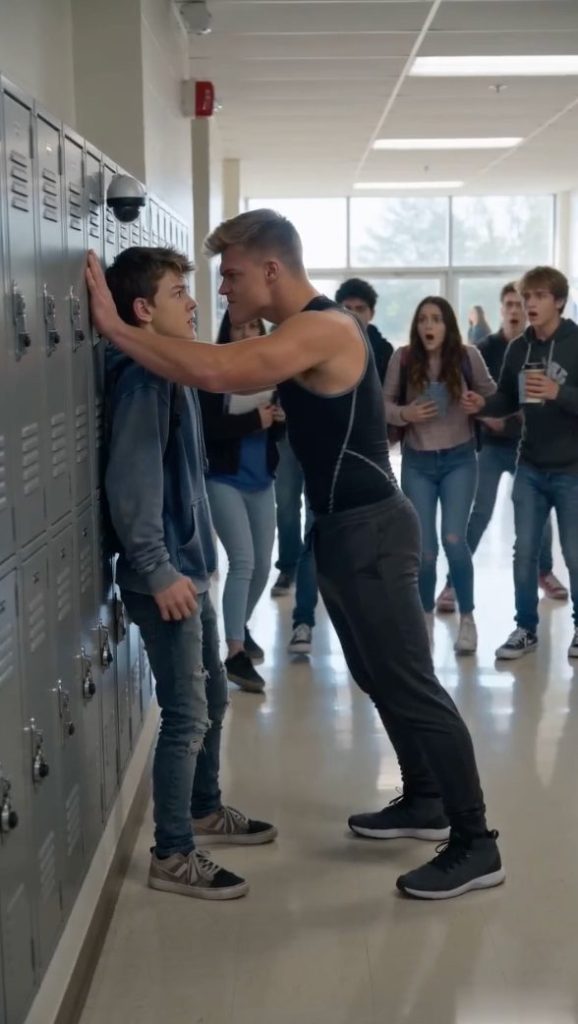
I also explained my concern that Principal Evans had personally witnessed the incidents but had not meaningfully intervened.
Before sending it, I read every sentence aloud.
I removed one line that sounded more angry than factual.
Then I sent the complaint.
I didn’t feel victorious.
I felt exposed.
Somewhere beyond the walls of Westbridge High, a person I had never met would now be reading about one of the most humiliating experiences of my life.
I had no idea whether they would believe me.
For two days, nothing seemed to happen.
Trent continued walking through the hallways surrounded by teammates.
Students still moved aside when he approached.
His name appeared on posters advertising the next football game, and the school announcements praised the team’s performance at every opportunity.
Nobody called me into the office.
Nobody asked for another statement.
I began wondering whether the district email had disappeared into the same silence as everything else.
Then, on Thursday afternoon, I received a reply.
The message was brief and professional.
It acknowledged my complaint, confirmed that it had been referred for review, and said the district would take steps to preserve relevant records.
It also asked whether I would be available to provide additional information.
I read the message three times.
Then I forwarded it to my uncle.
He called a few minutes later.
“You saw it?”
“Yeah.”
“How do you feel?”
I thought about it.
“Scared.”
“That’s understandable.”
“And a little relieved.”
“That too.”
I looked toward the folder on my desk.
“Someone actually read it.”
“Yes,” he said.
“Someone did.”
The following morning, I arrived at school feeling as though every student knew what I had done.
Most probably didn’t.
But Trent did.
He was waiting near my locker, though this time he stood several feet away.
His teammates were beside him, both unusually quiet.
As I approached, he unfolded his arms.
“You’re really going to make this a whole thing?”
I stopped at a safe distance.
“I reported what happened.”
He gave a short laugh.
“You went to the district?”
I didn’t answer.
His jaw tightened.
“You trying to get me kicked off the team?”
“I’m trying to stop this.”
“Stop what?”
I looked at him.
“You know what.”
For a second, his confidence seemed to slip.
Then he glanced toward his friends.
“This guy thinks he’s important now.”
Neither of them laughed.
Trent noticed.
His expression hardened again.
“You better hope your little video shows everything.”
I felt a sudden chill.
He knew about the recording.
I had no idea who had told him, but he knew.
I looked past him toward the camera.
“I’m not going to argue with you.”
I moved toward my locker.
He stepped aside, but not before speaking one last time.
“You’re making a mistake.”
I opened the locker.
“No,” I said quietly.
“I already made one.”
He frowned.
“What?”
I placed my books inside.
“I believed nobody would care.”
For once, he didn’t have an immediate answer.
I closed the locker and walked away.
I could feel him watching me, but I didn’t turn around.
During second period, the administrative office called for me.
My stomach tightened as I walked down the corridor.
This time, however, the secretary directed me into a smaller meeting room rather than Principal Evans’s office.
A district representative sat at the table with a notepad and a closed laptop.
She introduced herself as someone assigned to review student safety concerns, and she asked whether I was comfortable speaking with her.
I said yes.
She explained that she had read my written complaint and wanted to clarify several details.
She also told me that my report would be reviewed alongside other available information rather than treated as a conclusion by itself.
I appreciated that.
It was the first time an adult had explained the process without telling me how I should feel about what happened.
She asked me to describe the first confrontation.
I did.
Then she asked about the second.
I explained how Trent had approached me after seventh period, grabbed my hoodie, and released it when Principal Evans appeared.
She wrote notes as I spoke.
“Did the principal hear you tell him what happened?”
“Yes.”
“What did he say?”
I repeated his words as accurately as I could.
She asked whether I had any injuries.
“No serious injuries.”
“Did you feel physically safe afterward?”
I hesitated.
“Not really.”
She looked up.
“Why?”
“Because Trent said he’d find me after class, and then he did.”
She nodded and wrote something down.
“Have there been further confrontations?”
“He spoke to me by my locker this morning.”
“Did he touch you?”
“No.”
“Did he threaten you?”
“He told me I was making a mistake.”
She made another note.
Then she turned to the damaged portfolio.
I had brought the folder with me because she had requested supporting documents.
When I opened it, several torn pages slid across the table.
She looked at the drawings for a long moment.
“These are very detailed.”
“Thank you.”
“How long have you been working on them?”
“Several months.”
She lifted one of the pages by its undamaged edge.
“And these were intended for a scholarship?”
“Yes.”
She nodded.
“Do you have the application instructions?”
I handed her a printed copy.
She reviewed the deadline and portfolio requirements.
Then she looked back at me.
“Thank you for keeping these materials.”
I tried to smile.
“I wish I hadn’t needed to.”
“I understand.”
The meeting lasted nearly an hour.
Before I left, she asked one final question.
“Is there anything you want to add that you haven’t included in your written statement?”
I thought about Trent.
I thought about the crowd.
Then I thought about the principal standing in the doorway.
“Yes.”
She waited.
“I know people say Trent is important because of football.
And I know the school is proud of the team.”
I paused.
“But I don’t understand why that means the rest of us are supposed to be afraid of him.”





