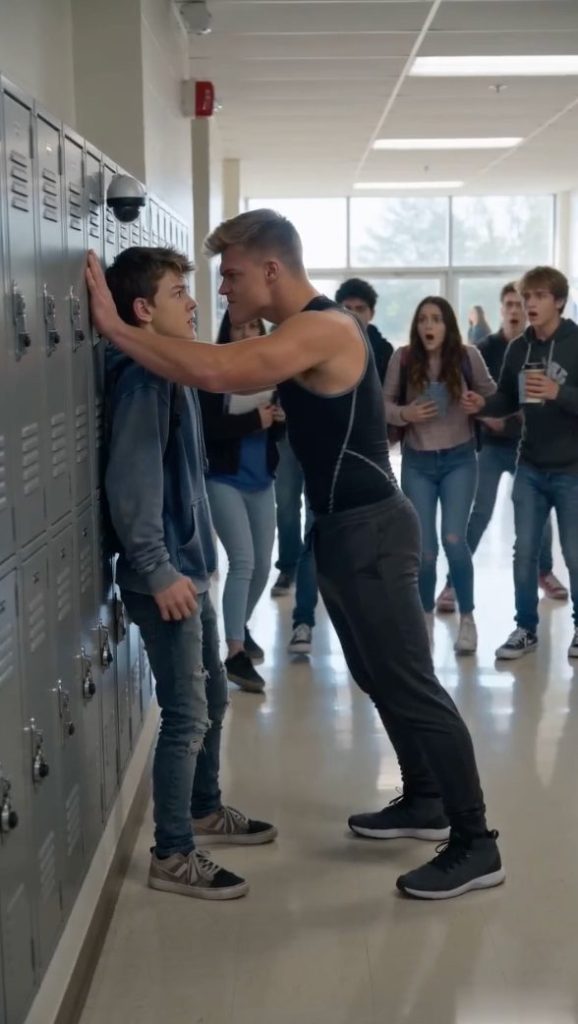
When class ended, I stayed behind.
My teacher waited until the other students had left before approaching my desk.
“Can I see those?”
I hesitated.
Then I handed her the damaged pages.
She spread several across the desk and looked at them carefully.

Her eyes moved over the measurements, structural notes, and shaded elevations.
“These are yours?”
I nodded.
“All of them?”
“Yes, ma’am.”
She lifted a page showing the central courtyard of the learning center.
“These are impressive.”
I looked away.
“They were better before.”
She didn’t respond immediately.
Instead, she examined a torn edge and a footprint across one of the diagrams.
“Who did this?”
For the first time that morning, somebody had asked the question that mattered.
I told her.
Not everything.
Not the entire history of Trent’s reputation or my uncle’s advice.
I simply explained that Trent had taken my backpack, pulled out the sketchbook, and torn it apart in the hallway.
She listened without interrupting.
When I finished, she placed the papers down very carefully.
“Did anyone see?”
“About fifty people.”
“Did you report it?”
I hesitated.
“The principal was there.”
Her expression became still.
“What do you mean?”
“He came out of his office while it was happening.
He looked at us and walked away.”
My teacher lowered her eyes toward the drawings.
For several seconds, she said nothing.
Then she pulled a clean folder from a cabinet beside her desk and placed it in front of me.
“Put these in here,” she said.
“You don’t want to lose any more of them.”
I began arranging the torn pages inside.
She watched me for a moment.
“I’m not going to pretend this is small,” she said quietly.
“I know how much work something like this takes.”
My eyes stung unexpectedly.
It was the first time anyone had acknowledged what had actually been lost.
She handed me the folder.
“But I also don’t want you to decide your opportunity is gone before you’ve spoken to the scholarship office.
Damaged work is not the same thing as work that never existed.”
I nodded, although I wasn’t ready to believe her.
Then she asked me something I would remember for a long time.
“Have you thought about writing down exactly what happened while it’s still fresh?”
I looked up.
“Why?”
“Because details matter.
Especially when several people tell different versions of the same event.”
I thought of the camera.
“I can do that.”
She handed me a blank sheet of paper.
“Then start with the time.”
That afternoon, I wrote the first account of what had happened.
I recorded the approximate time of the confrontation, the location of the lockers, the words I remembered, the students gathered around us, and the principal’s appearance at the administrative doorway.
I described the sketchbook as carefully as I could, including the approximate number of pages and the purpose of the drawings.
I also wrote down what Trent had said about finding me after seventh period.
The threat looked different once it was on paper.
It wasn’t a joke.
It wasn’t an argument between friends.
It was a promise made by someone who believed there would be no consequences.
By lunchtime, nearly everyone at Westbridge seemed to know about the incident.
I could feel conversations changing as I walked past tables in the cafeteria.

Students glanced at my blue hoodie and then looked away.
Others whispered openly, apparently assuming I couldn’t hear them.
A few boys near the vending machines imitated the sound of tearing paper.
I ignored them.
At a table near the windows, the girl who had recorded the confrontation sat with two friends.
Her phone lay beside her lunch tray, and all three were staring at the screen.
When she noticed me looking, she turned it facedown.
I could have approached her.
Instead, I carried my lunch to a quiet table and sat alone.
I wasn’t ashamed of being hurt.
I was ashamed of how many people had enjoyed watching it happen.
That distinction took me a while to understand.
For most of the lunch period, I tried to eat a sandwich while thinking about the scholarship deadline.
I had less than two weeks to assemble my final application.
Some of my drawings existed only on paper because I liked working through early designs by hand.
I had digital versions of several structural calculations and photographs of a few preliminary sketches, but most of the final renderings had been completed in the leather-bound book.
There was no simple way to restore them.
I was staring at my untouched sandwich when my phone buzzed.
A message from my uncle appeared.
How’s school treating you, champ?
I looked at the words for a long time.
Then I typed, Fine.
I deleted it.
I tried again.
Something happened this morning.
Can I come by the gym after school?
His reply came almost immediately.
Of course.
You okay?
I looked down at the folder beside my chair.
I’m not hurt.
He sent another message.
That’s not what I asked.
I couldn’t think of an answer.
So I put my phone away.
The rest of the school day passed slowly.
Every hallway seemed narrower than it had before, and every burst of laughter made me wonder whether it was about me.
By sixth period, I had started watching the clock.
By seventh, I had stopped pretending I wasn’t worried.
Trent had said he would find me after the final class, and I believed him.
I could have left by another exit.
I could have waited in a classroom until the hallway emptied.
I could have asked a teacher to walk with me.
But hiding wouldn’t solve anything.
I also knew that meeting him alone would be foolish.
So when the final bell rang, I stayed near the main hallway where students were still passing and staff members could see us.





