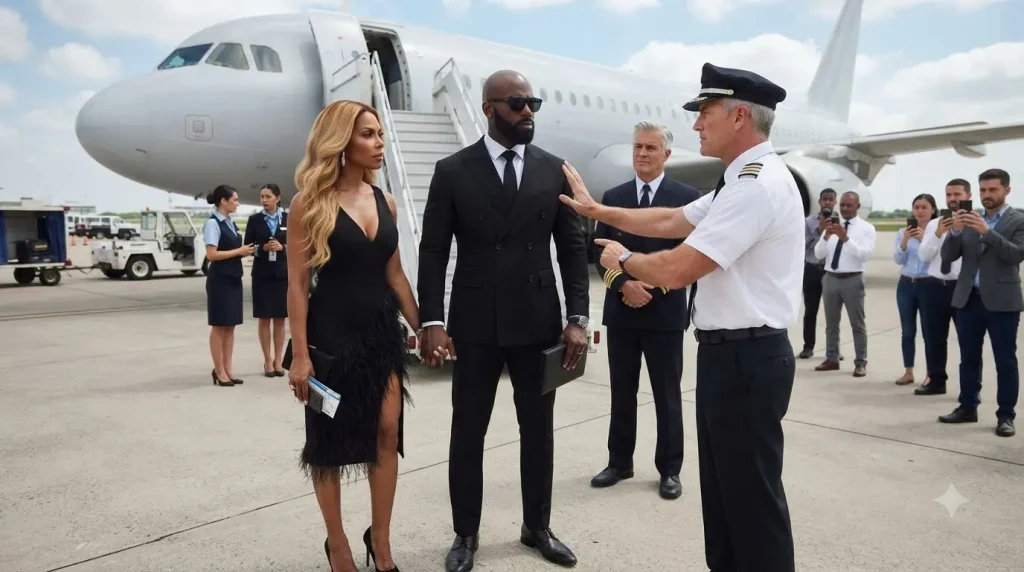
“The contract was based on the premise that Meridian Atlantic was an engineering-led organization with systemic operational integrity,” Daniel said. “What I have seen today is an organization where bias is protected by hierarchy, and hierarchy is protected by cowardice.”
He looked directly into Evans’s eyes.
“We’ll see you at three o’clock, Thomas. Bring your general counsel. And bring whoever is responsible for your human factors audit.”
Daniel reached out, pressed the red disconnect button on Miller’s screen, and nodded to the sergeant.
“Sergeant,” Daniel said. “Would you be good enough to arrange an operations escort across to the private aviation terminal?”
Miller didn’t hesitate for a microsecond. “Right this way, sir. Ma’am, let me take that bag for you.”
The conference room at the private aviation terminal did not smell of jet exhaust. It smelled of lemon wax, leather, and chilled mineral water.
For three hours, Daniel and Alana sat in total, undisturbed silence. They did not call their brokers. They did not post to social media. They did not call their corporate communications office.
Alana sat at the long glass table, her laptop open, her fingers moving across the keyboard with the speed and regularity of a machine tool. On the screen was the 400-page diligence document that Meridian had submitted to Apex six weeks earlier.
Daniel stood by the panoramic window, his jacket off, his sleeves rolled up two neat folds, watching a private Gulfstream G650 taxi toward the ramp.
The aircraft carried the navy-and-gold tail flash of Meridian Atlantic’s corporate fleet.
When the door opened five minutes later, Thomas Reed entered first.
He looked as though he had aged five years in three hours. His tie was slightly crooked, his blue eyes bloodshot, his silver hair wind-whipped. Behind him came Richard Coleman, the regional operations director, whose face was the color of a wet sidewalk; Elaine Mercer, the Vice President of Cabin Operations; and Sarah Jenkins, the airline’s Chief Legal Officer.
Reed stopped three feet inside the door. He looked at Daniel, then at Alana, his hands opening in an instinctive, desperate gesture of contrition.
“Daniel. Alana.”
Daniel didn’t move from the window. “Thomas.”
Reed walked to the table, pulled out a chair, and then hesitated, remaining standing. “I won’t insult either of you by calling it an administrative error. I won’t insult you by calling it a misunderstanding. What happened on that ramp was a disgrace. It was a failure of leadership, a failure of culture, and a personal insult to two people this company values above all others.”
“Sit down, Thomas,” Alana said without looking up from her screen.
Reed sat. His executives followed suit, moving with the terrified, hyper-vigilant quiet of subordinates attending an inquest.
Alana turned her laptop ninety degrees so the screen faced Thomas Reed and his general counsel.
“This is Section 4 of your diligence filing,” Alana said, her voice dropping into the cool, analytical register that had made her the most feared systems auditor in the aerospace sector. “The chapter on Human Systems Reliability and Operational Culture. Page 112. Under ‘Workplace Fairness and Bias Indicators,’ your filing states that over the preceding twenty-four months, Meridian Atlantic recorded zero substantiated civil rights or discriminatory passenger escalations across its international widebody fleet.”
Reed looked at Sarah Jenkins, his lawyer. Jenkins swallowed hard, her hand tightening around a leather notebook.
“That was the certified submission,” Alana said. She tapped three keys. A new window opened, displaying three internal incident logs bearing the Meridian Atlantic internal letterhead.
Richard Coleman let out a soft, barely audible groan.
“These were pulled from your Houston station server forty minutes ago,” Alana said, her eyes pinning Coleman to the back of his chair. “Because when Daniel was standing on that ramp, Richard Coleman hesitated. Daniel asked him why, and Richard had the professional decency to look terrified.”
Alana leaned forward, resting her forearms on the table.
“Incident one: fourteen months ago. Flight 412, Houston to Frankfurt. Purser Mark Jensen demands secondary passport verification from an African-American petroleum geologist seated in Business Class, alleging the credit card name didn’t match the ticket manifest. The passenger was detained for two hours. The complaint was resolved internally with twenty-five thousand bonus miles and an NDA.”
She tapped the screen again.
“Incident two: eight months ago. Flight 608—this exact flight. Purser Mark Jensen refuses service to a Nigerian tech executive in First Class, claiming the passenger’s behavior was ‘erratic.’ The passenger had asked for an extra pillow. Captain Robert Evans backed the purser, threatened to divert to Gander, and had the passenger met by police in London. The case was settled by your risk management division for an undisclosed six-figure sum.”
Alana looked up, her gaze shifting from Jenkins to Elaine Mercer, the cabin operations VP.
“You knew, Elaine,” Alana said.
Elaine Mercer looked as if she were about to cry. “Dr. Harris… those were categorized as customer satisfaction disputes, not operational civil rights violations. Our reporting framework—”
“Your reporting framework was an exercise in corporate fraud,” Daniel said, turning from the window.
He walked to the table, his steps measured, his voice carrying the terrible, resonant weight that made everyone in the room look at the carpet.
“You built an algorithm to hide failure,” Daniel said. “You took every report that indicated a crew member was using safety authority to humiliate non-white passengers, and you dropped it into a bucket labeled ‘service friction.’ You did that because you knew that if those numbers were disclosed in our diligence room, Apex’s human-factors board would have flagged your operational risk score.”
“Daniel,” Reed pleaded, his voice breaking. “I swear to you on my children’s lives, I did not see those logs. The board did not see them.”





