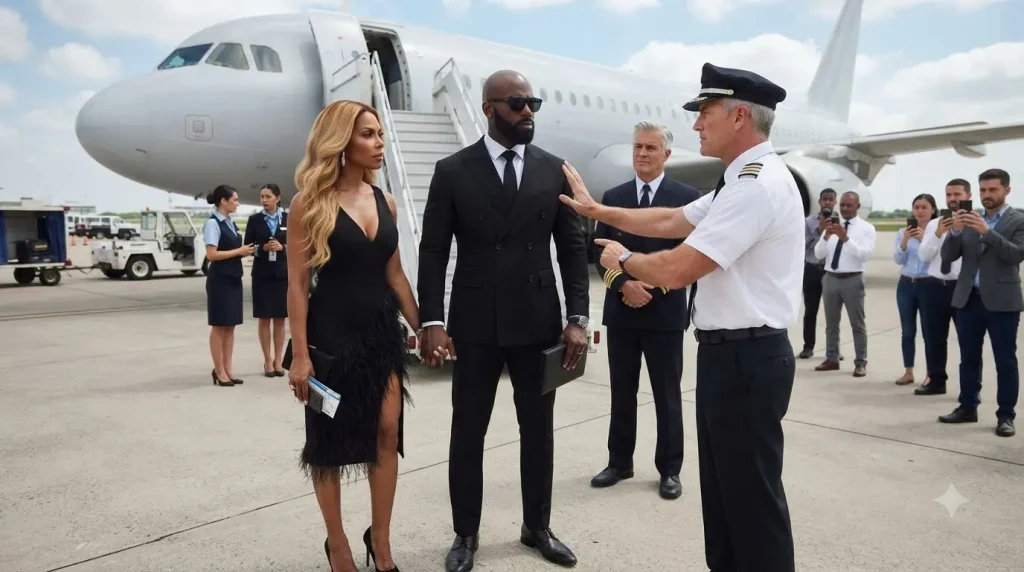
“I am ordering you to clear the galley,” Jensen said, his voice rising, pitching slightly into the high, nasal register of panic masquerading as discipline. “You are interfering with flight crew operations during the pre-departure phase. That is a federal infraction.”
“Then call the captain,” Daniel said. “Call him right now. Do not send an attendant. Tell him that passenger Daniel Harris in 1A requests his presence in the forward vestibule.”
Jensen’s face flushed a deep, mottled red. “The captain is conducting critical pre-flight navigation alignments. He does not take meetings with passengers who refuse crew instructions.”
“He’s going to take this one,” Alana said.
She did not reach for her husband’s arm. She stood with her feet shoulder-width apart, her weight balanced, her chin elevated at precisely the angle she used when addressing the Senate Armed Services Subcommittee on aerospace procurement.
Jensen turned abruptly, snatched the interphone handset from the bulkhead cradle, punched two digits, and spoke in a rapid, heated hiss: “Robert. We have an operational refusal at door 2L. I need you out here. Now.”
Captain Robert Evans did not look like a man who spent his life studying turbulence models. He looked like a man who spent his life enjoying the deference accorded to four gold bars sewn onto a wool cuff.
He emerged from the flight deck with his captain’s cap tucked beneath his left arm, his white shirt stiff with starch, his silver hair cropped close above a ruddy, thick-featured face that suggested thirty-two years of military transport flying followed by twenty years of seniority-based union protection.
He did not assess the situation. He did not look at the boarding passes resting on the galley counter. He looked at Jensen, received a curt, nodding signal from the purser, and then turned his full, six-foot-two frame toward Daniel.
“I understand there’s a refusal to comply with crew instructions,” Evans said, his voice carrying the practiced, heavy resonance of a cockpit announcement.
“There is a refusal to be subjected to arbitrary harassment,” Daniel replied. He took off his sunglasses, folded them with one hand, and slipped them into his breast pocket. His dark eyes met Evans’s pale gray ones with an unblinking, heavy stillness. “Your purser stopped us at the threshold of the cabin. He demanded to verify payment methods for a confirmed, ticketed reservation. When informed that the reservation was cleared through your corporate desk, he ordered us off the aircraft.”
Evans didn’t flinch. “Purser Jensen has thirty-four years of service with this carrier. If he has a question regarding the integrity of a premium-cabin manifest, he has my full authority to resolve it before we button up the doors.”
“He didn’t ask the gentleman behind us for his card,” Alana pointed out, her voice slicing through the thick air. “He didn’t ask the two passengers who boarded ahead of us. He looked at my husband, looked at me, and asked if we were traveling on a staff pass.”
Evans’s jaw tightened. He disliked being addressed by women in that tone; he disliked even more being addressed by passengers who did not lower their voices when a captain entered the room.
“Ma’am, I am not going to debate cabin administration on the threshold of an international flight,” Evans said. “We have an air-traffic control slot over the Atlantic in forty-two minutes. If we miss it, we sit on the pad for three hours. If Purser Jensen feels that your demeanor is argumentative, that is sufficient for me to make a determination under Federal Aviation Regulation Part 121.”
“And what determination is that, Captain?” Daniel asked.
“You’re off,” Evans said. He pointed his index finger toward the open door leading to the jetbridge. “Both of you. Step off my aircraft. You can sort your ticketing discrepancies with the station agents in the terminal. We are closing the door.”
“Robert,” Elena, the junior flight attendant, whispered from the galley, her face pale. “Captain, the boarding passes are green on the reader. They cleared.”
“Elena, clear the service cart,” Evans snapped, not turning around. “Now.”
Daniel looked at Evans for four seconds. In those four seconds, Daniel did not calculate his anger; he calculated the systems failure.
He saw the entire architecture of an institution rotting from the head down: the captain who protected the purser not because the purser was right, but because the captain’s identity depended on absolute, unquestioned sovereignty within his aluminum tube; the purser who used safety regulations as a camouflage for personal malice; the junior crew members who saw an injustice occurring three feet from their faces and looked down at their beverage napkins because their union seniority wouldn’t protect them from retaliation.
“Captain Evans,” Daniel said, his voice dropping so low that Evans had to lean forward an inch to catch it. “You have reached the limit of your professional discretion. If you order us down those stairs, you will not fly this aircraft to London today. You will not fly it anywhere.”
Evans let out a sharp, barking laugh that carried into the forward business cabin.
“Is that a threat, sir? Are you threatening the pilot-in-command of an international flight?” Evans reached for his radio on his lapel. “Purser, get the ramp supervisor and ground security. Tell them we have two non-compliant passengers refusing deplaning orders under Section 91.”
“We don’t need ground security,” Alana said. She reached into her clutch, pulled out her phone, and turned toward the door. “Daniel. Let’s go.”
Daniel didn’t say another word. He turned with military precision, took his wife’s hand, and walked out of the aircraft door.
They did not walk back up the jetbridge into the crowded terminal.
The jetbridge at Gate D8 was an older, hybrid model equipped with an external steel staircase leading down to the active ramp—an access point used by ramp agents, mechanics, and catering crews.





