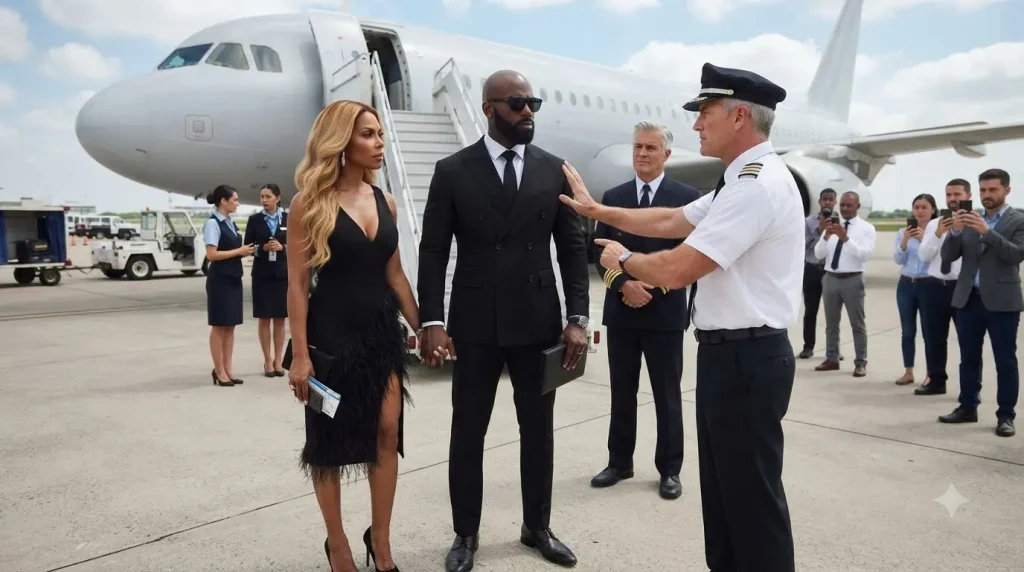
At the boarding gate, the gate agent—a young woman with an identification badge reading Carla—scanned Alana’s phone. The scanner emitted a clean, two-tone chime.
Carla looked at the screen. Then she looked at Alana. Her eyes dropped to the diamond eternity band on Alana’s finger, traveled up the line of her dress, and then drifted to Daniel, who stood three inches over six feet, motionless, his face set in a neutral, relaxed mask.
Carla tilted her head. “You’re seated in Row 1?”
“1A and 1B,” Alana said with a pleasant, practiced smile.
Carla typed three keys on her terminal, frowned, looked at the passports, and then handed them back without the standard greeting. “Proceed down the jetbridge,” she said, her voice dropping into a flat, bureaucratic monotone.
“Thank you, Carla,” Alana said.
As they turned the corner into the enclosed accordion tunnel, Daniel felt the first shift. It was nothing tangible—just the ambient pressure drop that an experienced pilot feels in his inner ear before the variometer registers a downdraft.
“You felt that?” he murmured, not looking at her.
“The three-second hesitation before she handed back the documents,” Alana replied softly, her hand slipping into the crook of his elbow. “She was looking for an employee discount code or an upgrade voucher.”
“Let it go,” Daniel said. “We’re on the aircraft in ninety seconds.”
They did not make it ninety seconds.
At the aircraft door of the Boeing 777-300ER, the primary boarding door was flanked by two flight attendants in Meridian’s navy-and-gold livery. Inside the vestibule, blocking the wide entrance to the forward first-class cabin with an angled, proprietary stance, stood the senior purser.
His silver wings identified him as M. Jensen — Inflight Service Director. He was fifty-something, with thinning sandy hair combed straight back with pomade, a narrow mouth bracketed by deep, discontented creases, and the sharp, hawkish eyes of a man who viewed the passenger cabin not as a service environment, but as a border crossing that required his personal visa stamp.
Behind him, through the galley curtain, the first-class cabin was visible: eight private suites with sliding doors, finished in brushed aluminum and cream leather, each equipped with sixty-inch screens and private wardrobes.
Jensen took their boarding passes from Alana’s hand. He didn’t use the optical scanner mounted on the galley bulkhead. He held the mobile screen up toward the overhead fluorescent tube, his eyes squinting.
“Harris?” he asked.
“That’s correct,” Daniel said. “1A and 1B.”
Jensen looked at Daniel’s suit. His eyes lingered on Daniel’s hands—broad, clean, the skin dark and unblemished, wearing only a plain platinum wedding band. Then his gaze flicked to Alana’s honey-blonde hair, her posture, the casual way she held her small Hermès clutch.
“Are these revenue tickets?” Jensen asked.
The question was delivered without inflection, but in the narrow confines of the forward galley, it struck with the blunt finality of a dropped wrench.
A junior flight attendant behind Jensen, a young Latina named Elena, glanced up from her pre-departure beverage tray, her fingers freezing on a bottle of sparkling water.
Daniel did not remove his sunglasses. “Excuse me?”
“I asked if these are revenue tickets,” Jensen repeated, his voice sharpening slightly. “Or are you traveling on an airline partner pass or corporate non-revenue allocation?”
“They are full-fare first-class tickets,” Alana said, her voice dropping into a tone that was quiet, clear, and utterly devoid of warmth. “Purchased through Meridian’s direct booking portal four weeks ago. Scanned by your gate agent two minutes ago.”
Jensen didn’t move an inch. He did not step aside to clear the aisle. Behind Daniel and Alana, an investment banker with a silver rimowa case sighed and checked his watch.
“We have had an ongoing issue with fraudulent corporate account redemptions on the transatlantic routes this month,” Jensen said, his eyes fixed exclusively on Daniel now. “Particularly out of the Texas hubs. I need to verify the purchasing credit card before I can authorize boarding for 1A and 1B.”
“Mr. Jensen,” Daniel said, his voice dropping half an octave, smooth and resonant as a cello string. “Your gate agent verified our passports against the reservation record. That is the regulatory limit of ground security for boarding. You are a cabin purser. Your responsibility is cabin safety and service delivery. You do not verify merchant processing at the cabin door.”
Jensen’s mouth tightened until his lips disappeared into a pale line. “I have the authority under Meridian Atlantic’s passenger service guidelines to request secondary identification from any passenger whose boarding credentials present an operational anomaly.”
“What is the anomaly?” Alana asked.
Jensen didn’t answer her. He looked past Daniel’s shoulder at the growing line in the jetbridge. “If you cannot produce the physical credit card used to reserve the suites, I’m going to have to ask you to step out of the boarding path and return to the podium so the station manager can re-verify your file.”
“The ticket was booked via corporate wire transfer from our family office accounts,” Alana said, her eyes narrowing until they were like blue ice under the galley lights. “There is no physical plastic. The reservation confirmation carries the authorization code from Meridian’s commercial treasury desk. Would you like me to read you the nine-digit clearance code, Mr. Jensen, or would you prefer to call your revenue accounting office in Atlanta?”
Jensen’s chest rose. He felt the shift in the room; he felt the eyes of the junior flight attendants on his neck. To back down now, in front of a subordinate, after demanding proof, was an intolerable breach of his personal authority.
“Step out of the aircraft, please,” Jensen said.
“No,” Daniel said.
It was a single syllable, spoken with neither volume nor rage, but it had the density of spent uranium.





