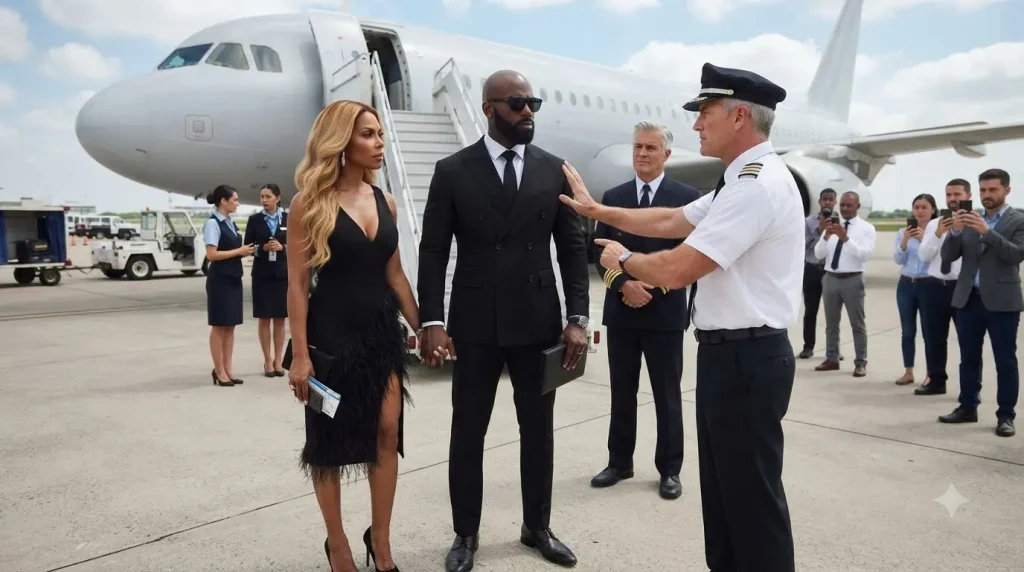
When Evans and Jensen followed them to the threshold to ensure their departure, Evans saw Daniel push through the alarmed emergency access door onto the exterior metal platform, forty feet above the concrete apron.
“Hey!” Jensen yelled, his voice cracking. “You can’t go down there! That’s an active operations area! That’s a federal security zone!”
Daniel and Alana ignored him. They descended the industrial steel stairs, Alana’s heels ringing sharply against the perforated galvanized treads, her hand holding her duster coat against the sudden blast of warm, kerosene-scented wind coming off the taxiway.
Behind them, Evans was already red-faced, leaning over the upper railing, shouting down to a group of baggage handlers loading the aft cargo hold: “Hey! Stop those two! Detain them! Call airport police!”
The ramp at Terminal D was a concrete desert of yellow safety lines, white baggage tugs, fuel hydrants, and screaming auxiliary power units.
Daniel reached the bottom of the stairs, stepped off the final riser, and placed his briefcase on the bumper of an electric ground power cart. He pulled his phone from his inside jacket pocket.
Two airport police vehicles, their blue and red lights already strobing against the gray concrete, were cutting across the ramp from the fire station perimeter, their tires squealing on the fuel-stained tarmac.
Evans and Jensen were coming down the stairs behind them, Evans taking them two at a time, his starchy white shirt billowing, his tie tossed over his shoulder by the wind from a taxiing United 787 three hundred yards away.
“Stay right there!” Evans bellowed, his face the color of raw beef. “Do not move! You are in violation of federal security perimeter laws!”
Daniel did not look at him. He tapped his screen once.
He did not call the airline’s customer service line. He did not call a concierge. He hit a single pre-programmed contact labeled: REED — SECURE.
Six hundred miles away, on the forty-second floor of Meridian Atlantic’s glass-and-steel headquarters tower in Atlanta, Thomas Reed was standing before a massive boardroom screen displaying a flight-tracking map of the North Atlantic corridor.
Surrounding the mahogany table were eight members of Meridian’s executive committee: the Chief Operating Officer, the Executive Vice President for Flight Operations, the General Counsel, and two senior managing partners from Morgan Stanley who were advising the board on the largest capital restructuring in the airline’s sixty-year history.
Reed’s personal phone—a encrypted handset that rarely left his suit pocket—vibrated against his ribs.
He pulled it out, glanced at the caller ID, and held up his right hand to silence his Chief Operating Officer, who was mid-sentence through a slide on fleet fuel-burn metrics.
“Hold on,” Reed said, a broad, triumphant grin spreading across his tanned, sixty-year-old face. “It’s Daniel Harris. The wire must have cleared. We’re about to close the technology alliance.”
Reed pressed the speaker button and brought the phone to his mouth. “Daniel! I was just telling the board that if you and Alana were already in 1A, I was going to send a bottle of eighty-two Dom Pérignon to your suites before pushback. Have you boarded?”
The voice that came through the speaker was not the voice of a celebratory corporate partner. It was the voice that Daniel Harris had used when he informed the Department of Defense that a ninety-million-dollar telemetry payload was structurally compromised and would not be launched under any circumstances.
“Thomas,” Daniel said. His voice was crystal clear, completely unaffected by the roar of the jet engines spooling in the background. “I am standing on the concrete apron of Gate D8 in Houston. Your captain, Robert Evans, and your purser, Mark Jensen, have just ordered my wife and me off Flight 608 at the threshold of the cabin.”
The boardroom in Atlanta went so quiet that the faint hum of the overhead projector sounded like an industrial turbine.
Reed froze. His hand, still holding a gold Montblanc pen, hovered two inches above an execution copy of the joint development agreement.
“Daniel…” Reed’s voice dropped an octave, all the easy southern charm vanishing like mist. “What did you just say?”
“I said your crew refused our boarding passes,” Daniel continued, his cadence steady, rhythmic, and deadly. “Your purser decided that our appearance did not align with his expectations for first-class passengers. He demanded physical credit cards for an electronically cleared corporate wire. When we produced documentation, he claimed we were non-compliant. When we requested a professional resolution, Captain Evans came out of the flight deck, threatened us with federal detention, and had his crew march us off the jetbridge.”
On the tarmac in Houston, the two airport police cruisers skidded to a halt ten feet from where Daniel stood. Four armed officers jumped out, their hands resting on their holstered sidearms, their eyes wide as they took in the scene: a man in a bespoke three-thousand-dollar suit holding an iPhone, a woman in couture standing beside him with her arms crossed, and an airline captain in full uniform red-faced and screaming from twenty feet back.
“Step away from that vehicle!” the lead officer, a sergeant with a graying crew cut, shouted at Daniel.
Daniel held up one finger toward the officer—a gesture of such absolute, unquestioned executive authority that the sergeant actually paused mid-stride, his jaw dropping slightly.
“Thomas,” Daniel said into the phone, holding it at chest height so the microphone picked up every decibel of the Houston ramp noise. “I have four armed airport police officers standing in front of me with their hands on their weapons. Captain Evans is behind me telling them I am a security threat to his aircraft.”
In Atlanta, Thomas Reed did not look at his board. He turned his head slowly toward his Executive Vice President of Flight Operations, an ex-Air Force general named Vance Caldwell.
Reed’s face had gone completely white, the skin around his eyes pulled so tight it looked like paper.





