Greene’s smile froze for a fraction of a second. “I’m just anticipating the worst-case scenario, Your Honor. That’s my job.”
“No,” Marcus Vance spoke up from the corner, his eyes fixed on his open laptop. The federal compliance auditor had been quietly tapping away since they entered the room. Now he turned the screen toward Evelyn and Rachel Brooks. “He didn’t anticipate it, Judge. Look at the metadata on the draft compliance summary we uploaded to the shared DOJ portal yesterday afternoon.”
Brooks leaned over the desk. “Who had view-only access?”
“Chief Wallace, City Attorney Shaw, and—under the chief’s administrative delegation—Deputy Chief Greene,” Vance said. “Greene’s credentials accessed the unredacted receivership recommendation at nine-fourteen last night. For forty-two minutes.”
Wallace’s head snapped toward Greene. “Thomas—you told me you hadn’t even logged into the portal this week.”
Greene stood up abruptly, his country-club composure finally fracturing. “I was doing my job, Adrian! You’ve been rolling over for Washington for eleven months! If she puts this department into receivership, the union walks, the council fires you, and federal monitors run Bellwood for the next ten years!”
“So you called Ray Miller,” Evelyn said quietly.
“I didn’t call anyone!” Greene snapped. “You have zero proof—”
“Actually,” Rachel Brooks said, pulling her own phone from her blazer pocket as a notification chimed softly. “While we’ve been talking, I had an FBI agent from my public-corruption squad walk across the street and knock on Richard Sterling’s door. Ray Miller is a retired cop, Thomas. He knows the difference between a local favor and a federal felony—specifically, conspiracy to obstruct a federal judicial officer under 18 U.S.C. Section 1503.”
Brooks lifted her phone, reading calmly from a freshly received text message.
“Ray Miller didn’t even ask for a lawyer,” Brooks said. “He handed the agent his cell phone. At three-twenty-five this afternoon—while you were sitting right here in Judge Carter’s library drinking her iced tea—you texted him from your personal number: ‘She’s heading out to the mailbox at 3:40. Make the call. Use her name. Monroe is parked two blocks over and knows to grab it.’”
The silence that fell over the library was absolute. Outside, a distant siren wailed once on the highway and faded into the autumn dusk.
Thomas Greene stared at Brooks’s phone, his face turning grey beneath his tan. “Monroe didn’t know who she was,” he muttered, the words escaping him before he could stop them—a confession dressed up as a defense. “I told him it was a test call from the HOA about a repeat trespasser. I told him to go by the book and not take any attitude. I never told him to put her in cuffs—I just wanted her to lose her temper on his body cam! One clip of Judge Carter screaming ‘Do you know who I am?’ at a patrol officer, and the union would have had her recused by Monday morning!”
He looked at Evelyn, his eyes wide with a sudden, sickening realization.
“You didn’t yell,” Greene whispered. “You didn’t even tell him your name.”
“I told him my name,” Evelyn said calmly. “I simply didn’t tell him my title. Because you assumed I would use power the way you use it, Deputy Chief—as a weapon to demand exceptions for yourself.”
Chief Wallace stepped forward, his face carved from stone. He held out his open palm. “Badge and weapon, Thomas. Right now.”
Greene looked at Wallace, then at the United States Attorney, then at the elderly woman sitting quietly behind the mahogany desk with an ice pack beside her wrist. Slowly, his hands shaking, he unclipped his gold deputy chief’s badge from his belt and laid it in Wallace’s palm.
Ten minutes later, after federal marshals arrived to escort Thomas Greene through the side garden gate so no news cameras would catch the arrest, Evelyn walked slowly back out onto her front portico.
The sun had dropped below the treeline, painting the western sky above Ashford Crest in bands of bruised violet and copper. The porch lanterns flickered on automatically, casting warm pools of amber light across the brick walkway.
Down at the curb, Officer Darius Monroe stood alone beside his patrol cruiser. The second sergeant had already confiscated his body camera for the DOJ evidentiary chain and was waiting discreetly in a separate SUV fifty yards back. Monroe’s immaculate uniform looked suddenly too large for him, his shoulders slumped beneath the weight of a silence he had never experienced before.
Evelyn walked down the limestone steps, her low leather shoes tapping softly against the brick. She stopped six feet away from him—outside the reach of his arms, yet close enough to see the tremor in his jaw.
Monroe snapped to attention automatically, his eyes fixed on a point just past her shoulder. “Judge Carter. I—there are no words. I’m going to resign tonight. I’m sorry.”
“Look at me, Officer Monroe,” Evelyn said quietly.
He forced his eyes down to hers. They were red-rimmed, stripped of every trace of the smug certainty he had worn an hour earlier.
“Deputy Chief Greene used you today,” Evelyn said, her voice neither cruel nor forgiving—just clear as winter glass. “Do you understand why he chose you?”
Monroe swallowed hard. “Because I was working Sector Four.”
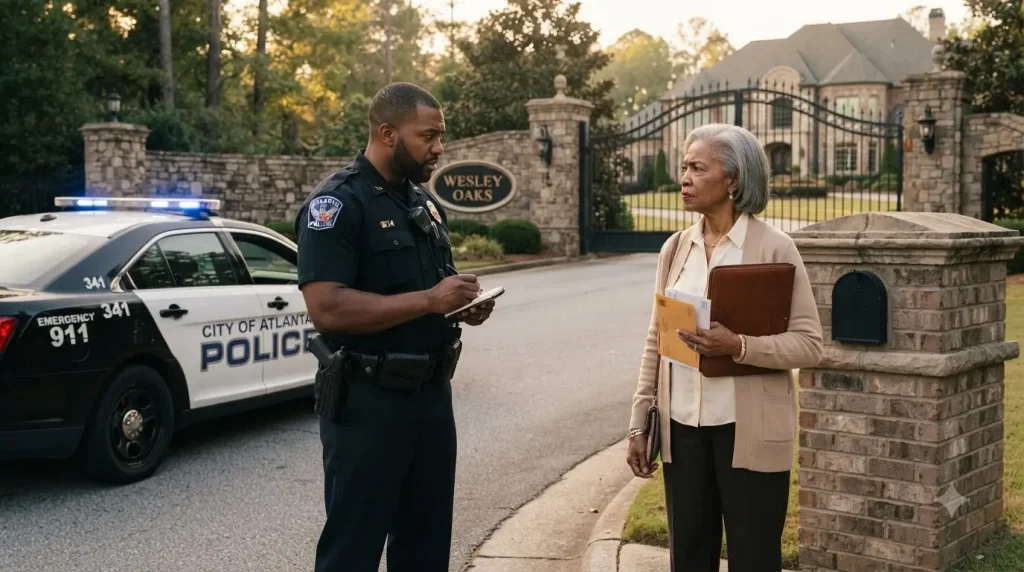
“No,” Evelyn said gently. “Officer Vasquez was closer to my house than you were. Greene chose you because he knew your record. He knew that if he pointed you at an elderly Black woman in an inexpensive cardigan standing in a wealthy neighborhood, he wouldn’t even need to tell you to break the law. He knew your own assumptions would do the work for him.”
Monroe flinched as if she had struck him.
“You thought you were being a tough, thorough police officer,” Evelyn continued softly. “In reality, you were so predictable that a corrupt supervisor aimed you like a loaded weapon and pulled the trigger from my living room.”
A long, painful silence stretched between them on the quiet cul-de-sac.





