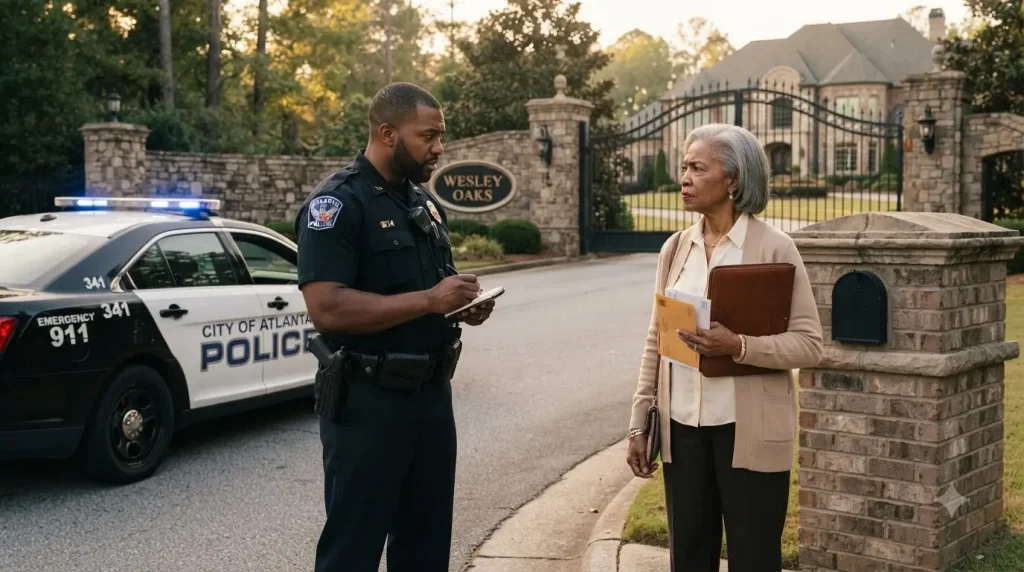
Evelyn looked past him at the red brick facade of her home. “Then perhaps the first question your department should train officers to ask is whether the stranger is actually a stranger.”
“That’s what I’m trying to figure out.”
“By ignoring every verification tool at your disposal except the one that requires me to submit to you.”
Monroe stepped forward another half-pace, closing the gap to less than three feet. The smell of his sharp, citrusy cologne cut through the autumn air. “Let me explain something to you. You might be used to arguing with HOA security guards or homeowners, but when a sworn police officer asks you to identify yourself during an active investigation, running your mouth isn’t going to help your afternoon.”
Evelyn met his gaze without blinking. “An active investigation into what crime?”
“Suspicious activity.”
“Suspicious activity is not a crime under Georgia statute.”
“Possible felony mail theft or criminal trespass.”
“On my own property, into my own mailbox.”
“You haven’t established that.”
“And you haven’t checked.”
Silence fell across the driveway, sharp and taut.
Fifty yards away, in the tall bay window of the neighboring stone colonial, a cream silk curtain shifted two inches to the left, then settled back into place.
Evelyn noticed it. So did Monroe.
She watched his shoulders square instinctively. It was a phenomenon Evelyn had observed in courtroom testimony for forty years: witnesses did not always moderate authority. More often, an audience created pressure to perform it. To win the interaction decisively, so nobody watching from behind a curtain would think the uniform had blinked.
Monroe pointed toward the porch. “If you actually live in that house, this takes thirty seconds.”
“Correct,” Evelyn said.
“Then why are you making it difficult?”
Evelyn let out a quiet, measured breath. “I am not making verification difficult, Officer. I am declining to waive my Fourth Amendment rights simply because a neighbor assumed I did not belong on my own street.”
Monroe’s mouth curved into a humorless smile. “You people watch too many television lawyers. Everybody thinks a sidewalk conversation is a Supreme Court seminar.”
Evelyn said nothing.
His smile vanished, replaced by a flash of raw irritation. “What?”
“Nothing.”
“You looked like you had something to say.”
“I did not.”
Her refusal to take the bait angered him more than shouting ever could have. His eyes dropped from her face to the slim oxblood leather portfolio tucked securely beneath her left arm.
“What’s in the folder?”
“Documents.”
“What kind of documents?”
“Private ones.”
“Hand it to me.”
“No.”
Monroe’s eyes narrowed. “Why not?”
“Because they are private, and you have neither a warrant nor probable cause to inspect them.”
“Are they related to this property? A work order? A deed?”
“Some of them are related to this jurisdiction indirectly.”
“Then I need to see them.”
“You absolutely do not.”
Monroe stepped in and reached out. Evelyn pivoted slightly, drawing the portfolio back against her ribs.
“Officer,” she warned, her voice dropping an octave.
“Give me the folder, ma’am.”
“No.”
His fingers closed around the leather spine. Not violently at first—just a firm, authoritative tug meant to remind her who was stronger. Evelyn did not yank back, but she did not release her grip either.
“This is entirely unnecessary,” she said calmly.
“Let go of the folder.”
“It contains confidential federal court material.”
In a functioning police department, those four words would have acted as a hard brake. To Darius Monroe—flushed with pride, conscious of the curtain next door, convinced he was being played by a stubborn old woman—they sounded like a laughable bluff.
His face darkened. “Federal material?”
“Yes.”
“What are you pretending to be now?”
Evelyn’s eyes narrowed to cold flint. “Excuse me?”
He pulled sharply. The leather tore free from her arthritic fingers. The momentum jarred her right hand, and the three envelopes she had taken from the mailbox slipped loose, fluttering onto the clipped grass beside the curb.
Monroe flipped the portfolio open.
Evelyn stepped forward immediately. “Do not read those.”
He shifted his broad shoulder sideways, using his body to block her reach. The top sheet bore the heavy, embossed seal of the United States District Court for the Northern District of Georgia, followed by a bold header: SPECIAL MASTER’S CONFIDENTIAL AUDIT — BELLWOOD POLICE DEPARTMENT.
Monroe didn’t even read past the first two words. Scornful and impatient, he tossed the open portfolio onto the warm hood of his patrol cruiser. The autumn breeze caught the loose pages, fanning them across the white paint. One sheet—an unredacted dispatch log—slid toward the windshield wiper.
Evelyn reached out to catch it before it blew into the street.
Monroe’s hand snapped out and slapped her wrist away.
It wasn’t a light brush. It was a sharp, stinging strike of bone against bone that sent a hot jolt up her forearm.
For the first time since the cruiser had pulled onto Briarwood Lane, Evelyn’s composure shifted. Not into fear. Into a cold, incandescent anger that had silenced federal prosecutors twice Monroe’s size.
“Do not touch me again,” she said, her voice cutting through the quiet street like a scalpel.
Monroe pointed a rigid finger at her chest. “Back up.”
“You struck my hand.”
“I redirected you away from my vehicle.”
“You struck my hand.”
“Back up, ma’am!”
Evelyn did not move an inch.
Monroe’s hand shot forward toward her upper arm.
“Officer,” Evelyn said quietly, locking her eyes directly onto the green light of his body camera. “Think very carefully about the next ten seconds.”
To Monroe, it sounded like a threat. Later, in his preliminary narrative, he would try to frame those eight words as verbal intimidation. On the high-definition audio of his chest camera, they would sound like exactly what they were: a judicial warning.
His fingers clamped around her bicep.
Evelyn twisted instinctively away from the sudden pressure on her shoulder joint—not enough to break free, barely two inches of recoil, yet it was all the choreography he needed.





