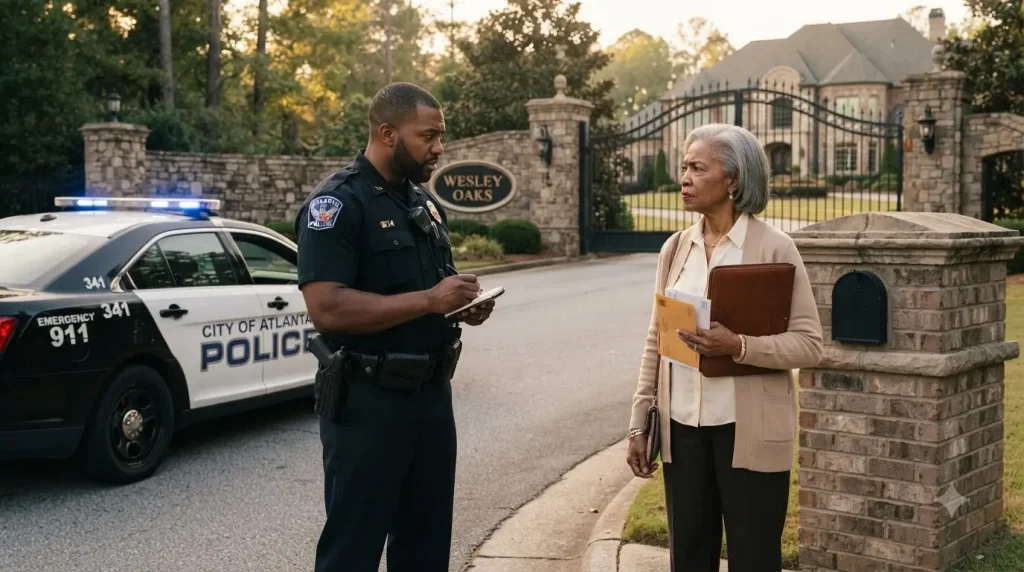
Outside on the front porch, under the watchful eye of a second sergeant Wallace had summoned from headquarters, sat Officer Darius Monroe—stripped of his cruiser keys, waiting for Internal Affairs to download his body camera.
“Let’s hear the 911 audio,” Evelyn said calmly.
Wallace placed his phone on the center of the mahogany desk and pressed play.
Static hissed softly through the tiny speaker, followed by the crisp voice of a Bellwood dispatcher: “Bellwood 911, what is your emergency?”
A man’s voice answered—low, slightly muffled, carrying the flat, compressed cadence of a VoIP line or a burner phone. “Yeah, I’m calling from Briarwood Lane in Ashford Crest. There’s an older Black woman down by the brick house at the end of the cul-de-sac. She’s digging through the mailbox and walking around the driveway. I’ve seen her around before—she tells people her name is Evelyn Carter and claims she owns the place, but she’s definitely not the homeowner. You need to send a unit out here before she breaks in.”
“Sir, can I get your name and callback number?”
“I’d rather stay anonymous. Just send a patrol car. She’s heading back toward the porch right now.”
Click.
Wallace tapped the screen, cutting off the silence.
“The call came in at three-thirty-nine,” Wallace said grimly. “Six minutes before Monroe turned onto Briarwood Lane. Dispatch traced the number immediately—it’s a prepaid burner purchased with cash at a gas station off Exit 12 three days ago.”
“Wait a moment,” Lydia Shaw said, frowning as she adjusted her glasses. “If it’s a burner phone, how did the caller know Judge Carter was walking down to her mailbox at three-thirty-nine? The call says, ‘She’s heading back toward the porch right now.’ That’s live observation.”
“Because whoever made the call—or whoever texted the caller—was watching the driveway,” Rachel Brooks said sharply. She turned toward Evelyn. “Judge, you mentioned a curtain moving next door during the stop.”
“Yes,” Evelyn said. “Number forty-two Briarwood. Richard Sterling’s house.”
At the mention of the name, Chief Wallace’s jaw tightened. “Richard Sterling is the vice chair of the Bellwood Police Foundation. He’s also a major donor to the city council.”
“And a longtime friend of yours, isn’t he, Thomas?” Wallace added, turning his head slowly toward the fireplace.
Deputy Chief Thomas Greene didn’t flinch. He uncrossed his ankles and leaned forward slightly, spreading his hands in a gesture of open, practiced candor. “Richard sits on the foundation board, Adrian. Half the command staff knows him. Are you seriously suggesting Richard Sterling bought a burner phone to swat a federal judge?”
“No,” Evelyn said softly.
Everyone in the library turned to look at her.
“Richard Sterling is in Naples, Florida,” Evelyn said, setting the ice pack down neatly on a brass coaster. “He and his wife left for their winter condo on Monday morning. Their house-sitter, a retired Bellwood sergeant named Ray Miller, waters their orchids on Thursdays. He was the one standing behind the bay window.”
A heavy, electric silence settled over the bookshelves.
Greene’s posture didn’t visibly crack, yet his fingers tightened almost imperceptibly against the leather armrests. “Ray Miller retired five years ago. Why on earth would Ray—”
“Hold on,” Rachel Brooks interrupted, her eyes narrowing as she looked down at the dispatch log on Wallace’s phone. “Chief, check the unit assignment. When that call dropped at three-thirty-nine, how many patrol cars were in Sector Four?”
Wallace scrolled quickly. “Two. Unit 412—Officer Vasquez—was three minutes away near the shopping center. Unit 418—Officer Monroe—was six minutes away near the highway.”
“Then why did Monroe take the call?” Brooks asked.
Wallace’s eyes sharpened as he read the CAD timestamp. “Monroe manually preempted it on his terminal twelve seconds after it dropped. He typed ‘En route, familiar with area’ and bumped Vasquez off the dispatch.”
“Which means,” Evelyn said, her voice quiet and surgical, “Officer Monroe was either waiting for that call—or he was told to watch his screen for Briarwood Lane.”
“That’s pure speculation, Judge,” Greene said smoothly, though a faint flush had crept up the sides of his neck. “Darius Monroe is an aggressive patrol officer. He likes high-profile neighborhoods. He probably saw Ashford Crest pop up on his screen and grabbed it because he wanted to make a good impression with the HOA.”
“A good impression,” Evelyn repeated mildly. “By handcuffing a seventy-two-year-old woman without checking the county tax roll?”
“It was a terrible, inexcusable lapse in judgment,” Greene agreed immediately, shaking his head with well-rehearsed sorrow. “And frankly, Your Honor, given how deeply personal this incident is—how traumatic it must be to be mistreated on your own property by a Bellwood officer—I think we all understand if you need to step back from the consent decree for a few weeks. Or even request a transfer of the special-master assignment to another district judge so there’s no appearance of conflict.”
There it was.
The sentence landed in the quiet library like a dropped coin, ringing clear and unmistakable.
Rachel Brooks went completely still. Chief Wallace stared at his deputy chief as if he were seeing a stranger sitting in his friend’s chair.
Evelyn did not look angry. She simply looked at Thomas Greene with the quiet, devastating clarity of a jurist who had just watched a witness walk straight into a perjury trap.
“A recusal,” Evelyn said softly.
“Purely to protect the integrity of the federal process, Judge,” Greene said, his voice silky with concern. “If you submit a harsh compliance report tomorrow—say, recommending federal receivership—the police union and the city council will immediately point to today’s arrest. They’ll claim you’re retaliating against the department because an officer humiliated you in your own driveway. The Eleventh Circuit would stay your order for eighteen months while they litigate judicial bias.”
“You seem remarkably familiar with the contents of my draft report, Deputy Chief,” Evelyn noted evenly. “Considering I haven’t distributed it yet.”





