At seventy-two, Senior United States District Judge Evelyn Carter had learned that power revealed its truest architecture only when the people around you believed you had none.
It happened in small, unguarded moments. A junior litigator fresh out of an Ivy League law review would slow his cadence in the corridor outside Courtroom 2106, speaking to her in the bright, over-enunciated tones reserved for lost tourists, before watching her step behind the mahogany bench ten minutes later. A corporate lobbyist at a Peachtree Street reception would hand her his empty champagne flute, mistaking her sensible low-heeled Oxfords and unbranded navy wool coat for the uniform of the catering staff. Twice in the last decade, hotel concierges in Washington had gestured her gently toward the service elevator.
Evelyn rarely corrected them quickly. She preferred to listen. People became astonishingly, almost recklessly honest in the presence of someone they had already decided did not matter.
That Thursday afternoon in late October began no differently.
Ashford Crest sat twenty miles north of downtown Atlanta, tucked behind limestone gates, towering white oaks, and enough high-definition perimeter cameras to render privacy an expensive, carefully maintained illusion. The estates along Briarwood Lane were vast but deliberately restrained—built of Georgian red brick, pale Indiana limestone, and slate roofs rather than cantilevered glass. No Lamborghinis revved in the circular drives. No tiered marble fountains threw water twenty feet into the Georgia sky. Wealth in Ashford Crest had long since graduated from shouting; here, it whispered.
Evelyn’s house stood near the quiet cul-de-sac at the end of Briarwood Lane. Three stories of weathered red brick, four fluted white columns supporting a deep, shaded portico, and a sweeping curved driveway bordered by boxwoods she still trimmed herself on Saturday mornings when her arthritis allowed. She had owned the property for nineteen years, having bought it with her late husband, Arthur, the summer he retired from Emory’s cardiology department.
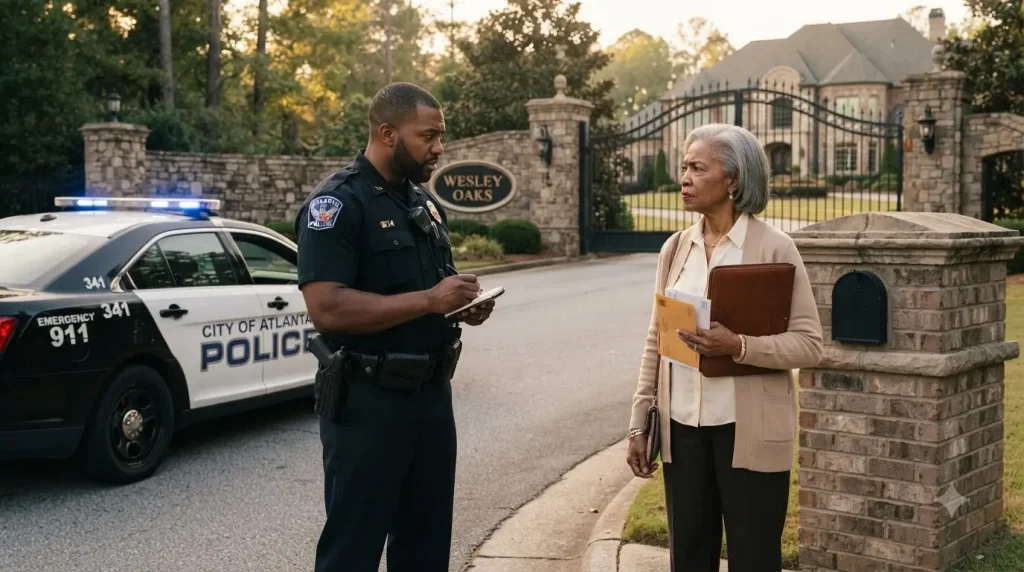
Yet when she stepped off the porch at three-forty-five to collect the afternoon mail, wearing a soft beige cardigan over a cream silk blouse, charcoal trousers, and scuffed leather loafers, she looked nothing like the version of affluence Officer Darius Monroe had been trained to recognize.
That mistake was about to fracture a police department.
Beneath her left arm, Evelyn carried a slim, oxblood leather portfolio. Inside lay forty-two pages of single-spaced notes, precinct dispatch logs, and sworn depositions prepared for a closed-door meeting scheduled to begin at four o’clock sharp.
The guests were already inside her house.
In the paneled library at the rear of the first floor, overlooking the terraced rose garden, sat Bellwood Police Chief Adrian Wallace. Beside him were United States Attorney Rachel Brooks for the Northern District of Georgia, two Bellwood deputy chiefs, a senior civil-rights litigator flown down from the Department of Justice in Washington, Bellwood City Attorney Lydia Shaw, and a federal compliance auditor with a laptop full of statistical regressions.
It was not a social gathering.
For eleven months, Evelyn had served as the court-appointed special master overseeing a federal consent decree governing the Bellwood Police Department. Bellwood was not Atlanta; it was a prosperous, rapidly expanding neighboring jurisdiction stitched together from gated subdivisions like Ashford Crest, gleaming commercial corridors, and older working-class neighborhoods south of the rail line. Two years earlier, a pattern of unlawful pedestrian stops, falsified probable-cause affidavits, and starkly disproportionate enforcement had triggered a Department of Justice investigation—and, ultimately, federal litigation.
On paper, Chief Wallace’s department had made measurable progress. Body-camera activation rates had climbed from sixty-one percent to ninety-four. Use-of-force reports were now reviewed by an independent lieutenant rather than buried in precinct file cabinets. Civilian complaints were logged into a centralized digital ledger.
Yet Evelyn had spent four decades on the federal bench reading between the lines of tidy spreadsheets, and she still had questions. Too many of them.
Specifically, she had questions about discretionary stops in Bellwood’s wealthiest precincts. The ones that rarely resulted in arrests and therefore slipped beneath the statistical thresholds of the quarterly compliance reports. Calls for suspicious persons. Trespassing inquiries involving homeowners standing on their own lawns. Housekeepers detained at bus stops after ten-hour shifts. Delivery drivers ordered out of their vans because a resident didn’t recognize the truck. Black teenagers questioned on sidewalks three doors down from the houses their parents paid property taxes on. Elderly residents challenged while walking their dogs at dusk.
Separated into individual incident reports, each stop looked minor—a misunderstanding, an overzealous neighbor, a five-minute inconvenience. Laid end to end across eleven months of dispatch audio, they formed the unmistakable silhouette of a culture. And culture, Evelyn knew, never announced itself in policy manuals. It revealed itself in the split-second decisions made by officers who believed nobody of consequence was watching.
Inside her oxblood portfolio was a draft recommendation she had not yet shared with Chief Wallace: a formal finding of material noncompliance, paired with a motion to place Bellwood’s patrol division under direct federal receivership.
She never made it back to the front door.
The black-and-white Bellwood patrol cruiser turned silently onto Briarwood Lane just as Evelyn unlatched the brass flap of her brick-encased mailbox at the curb.
The autumn air was crisp, smelling of damp oak leaves and distant woodsmoke. Evelyn noticed the cruiser’s slow glide past the hydrangeas and thought little of it; Bellwood units routinely ran low-speed patrols through Ashford Crest in the late afternoon.
The cruiser rolled past her driveway. Then, thirty feet down the asphalt, its brake lights flared crimson.
The transmission clunked into reverse. White backup lights blinked on, and the heavy Ford Interceptor eased backward along the curb, angling its nose slightly inward to block the mouth of her driveway.
Evelyn’s fingers paused on a stack of envelopes—a utility statement, an alumni magazine from Howard University, and a thick cream envelope from the Eleventh Circuit Judicial Council. She turned slowly over her shoulder.
The driver’s door swung open.





