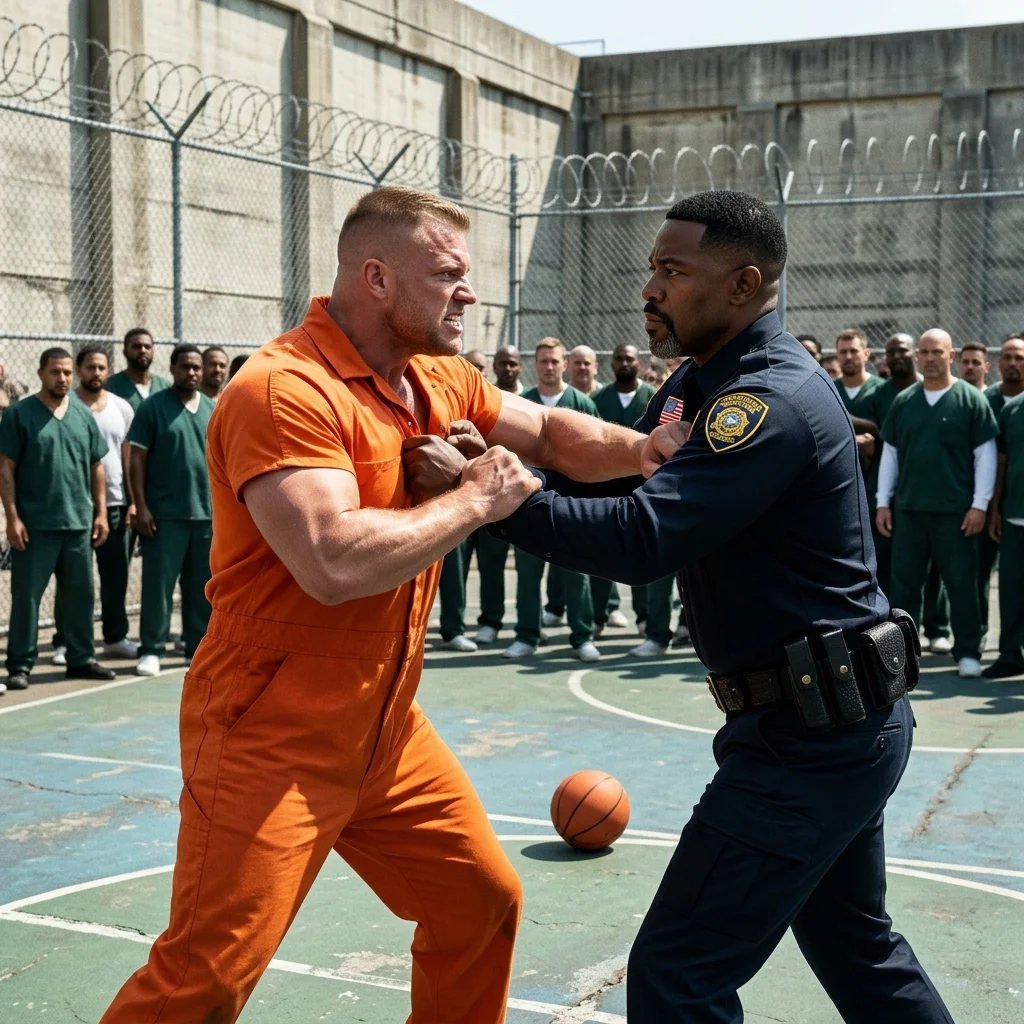
Marcus thought for a moment.
Two inmates had argued over missing personal property.
Another officer had initially blamed the wrong man.
Marcus had corrected the report after reviewing the witness accounts.
He remembered it because the correction had irritated a supervisor.
“Yes,” Marcus said.
Briggs nodded.
“Everybody heard about that.”
Marcus remained quiet.
“You admitted the first report was wrong.”
“Because it was.”
Briggs gave a sad smile.
“Most of us weren’t used to hearing an officer say that.”
Marcus felt his throat tighten.
Briggs continued.
“Then there was the time an inmate needed medical attention and people thought he was pretending.”
“I remember.”
“You got him evaluated.”
“That was my job.”
Briggs shook his head.
“Maybe.”
He looked at Marcus.
“But to us, it meant you still remembered we were people.”
For a long moment, neither spoke.
Then Marcus asked the question that mattered most.
“Did you plan to hurt me?”
Briggs’s expression collapsed.
“I told myself I wouldn’t.”
“But you did.”
“Yeah.”
“You could have stopped.”
“I know.”
Briggs wiped his face.
“I was scared, and I made a terrible choice.”
Marcus didn’t interrupt.
“Hale wanted you angry.”
Briggs stared at his hands.
“I thought if I did what he wanted, maybe they’d leave Elijah alone.”
“And when I didn’t lose control?”
“I didn’t know what would happen.”
Marcus looked at him.
“So you shouted about the missing men.”
Briggs nodded.
“Because I couldn’t stand keeping quiet anymore.”
His voice cracked.
“I spent years convincing myself that being the biggest man in the yard meant being the strongest.”
He looked up.
“Then I realized I was too frightened to tell the truth until somebody else had already taken the risk.”
Marcus closed his notebook.
He thought about the basketball.
The humiliation.
The confrontation.
And the long chain of events that had followed.
He was not ready to excuse Briggs.
He did not believe suffering erased responsibility for hurting another person.
But he understood something now that he hadn’t understood on the recreation yard.
The fight had begun as a scheme to silence an honest officer, but the truthfulness of the witnesses had turned it into evidence against the people who arranged it.
Briggs looked at him.
“Do you hate me?”
Marcus considered the question.
“No.”
Briggs’s shoulders loosened slightly.
“That doesn’t mean what you did was acceptable.”
“I understand.”
“You’ll still have to answer for the assault.”
“I know.”
Marcus stood.
“But I’ll tell the truth about what happened.”
Briggs looked down.
“That’s more than I expected.”
Marcus moved toward the door.
Then he stopped.
“Calvin?”
Briggs looked up.
“Your name was on a release order eleven months ago.”
The inmate’s eyes filled again.
“I know.”
“Why didn’t you give up?”
Briggs stared at him for a long moment.
Then he answered in a voice barely above a whisper.
“Because once I knew what happened to the others, walking away alone wouldn’t have felt like freedom.”
The investigation continued for eight months.
It expanded far beyond Ashcroft.
Financial investigators uncovered improper contractor payments.
Independent reviewers identified failures in custody authorization, recordkeeping, and oversight.
Witnesses described a culture in which prisoners’ complaints had repeatedly been dismissed because they were considered unreliable.
Records showed that the names of people whose sentences had ended had remained active in systems used for contractor reimbursement.
The resulting investigation led to criminal charges against several people involved in the scheme.
Deputy Commissioner Celia Vale was accused of participating in a conspiracy involving fraudulent payments and unlawful custody arrangements.
Captain Hale faced charges connected to falsified records, obstruction, and the improper detention of inmates.
Warden Evelyn Shaw lost her position and faced legal consequences for her role in approving and concealing the arrangements.
Their cases proceeded through the courts, where the evidence would be tested and their individual responsibility determined.
But for Marcus, the most important developments happened outside those courtrooms.
They happened at front doors.
Bus stations.
Family kitchens.
And the quiet places where people finally returned to lives they had almost stopped believing were waiting.
The eleven men received individual legal reviews.
Where no lawful basis remained for custody, courts ordered their release.
Some needed housing assistance.
Others needed medical care, counseling, and help reconnecting with relatives.
Freedom did not immediately repair what had been taken from them.
But it gave them the opportunity to begin.
Marcus never forgot the morning Moses Tate came home.
He stood beside Rebecca outside Ruth Tate’s brick house.
A car stopped at the curb.
The passenger door opened.
Moses stepped onto the sidewalk.
He was thinner than in the photograph on Ruth’s mantelpiece.
His hair had turned almost completely white.
He carried a small bag containing the belongings returned to him.
For several seconds, he stared at the house.
Then the front door opened.
Ruth appeared on the porch.
Her hands rose toward her face.
“Moses?”
He looked up.
His bag slipped from his hand.
“Rosie?”
Ruth hurried toward him.
They met halfway along the path.
The years of uncertainty seemed to vanish as brother and sister embraced.
Neither spoke for a long time.
Then Ruth began crying.
“I kept your room ready.”
Moses held her tightly.
“I know.”
“I kept writing.”
“I know.”
“I thought you might never come home.”
Moses closed his eyes.
“I was afraid I’d forgotten what home felt like.”
Ruth stepped back and touched his face.
“You’re here now.”
He nodded.
“Yeah.”
She took his hand.
“You’re here.”
Marcus turned away slightly.
He thought of the letters.
The false reassurances.
The months Ruth had spent wondering whether her brother had forgotten her.
Now she was holding him.
And nothing in the world could make that moment unimportant.
Simone, standing nearby, quietly lowered her camera.
Marcus noticed.
“Aren’t you going to photograph it?”
She shook her head.
“They’ve waited long enough.”
He looked at his daughter.
“Long enough for what?”
She smiled through tears.
“For a moment that belongs only to them.”
Marcus felt a surge of pride.





