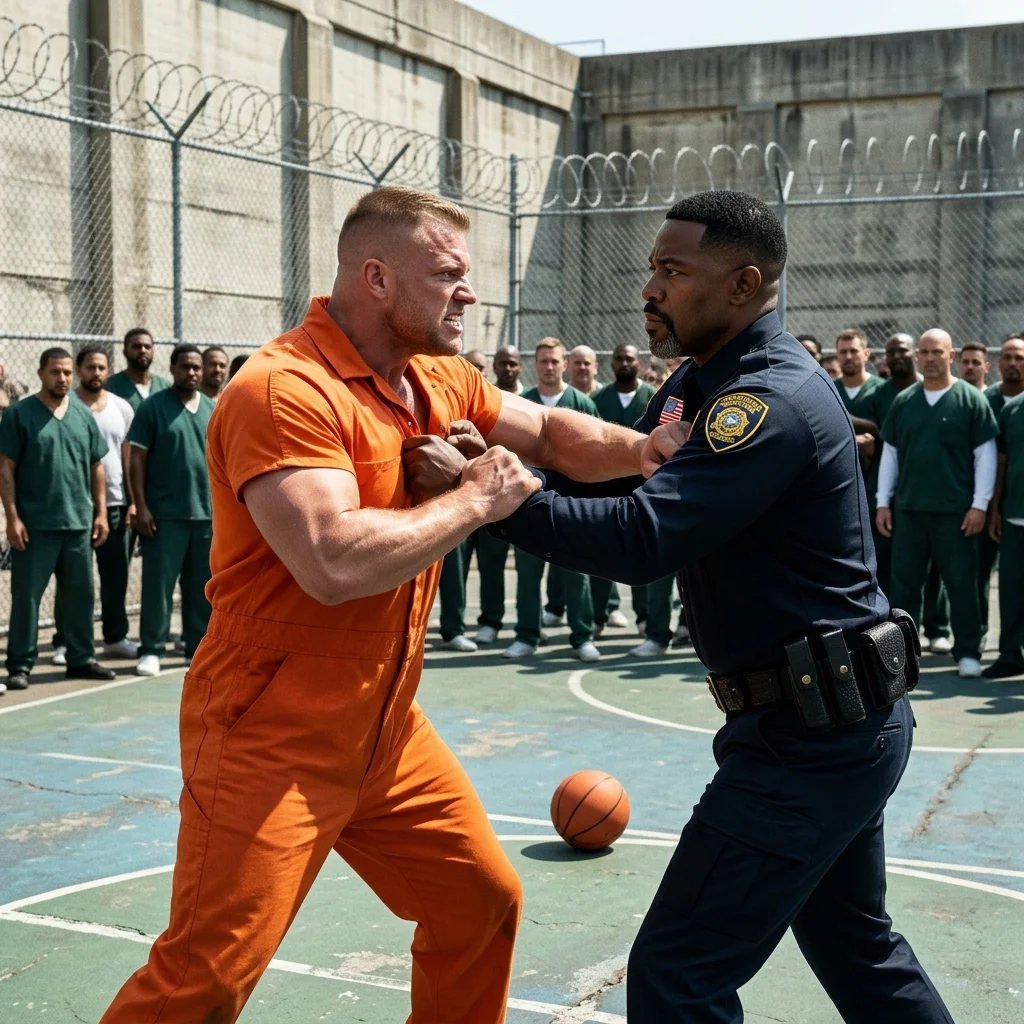
“Did they match?”
“No.”
Marcus picked up the first page.
The name at the top was Elijah Ward.
Age fifty-eight.
Convicted of financial fraud.
Sentence completed nineteen months earlier.
Official status: released.
Current internal housing assignment: restricted unit B.
Marcus turned to the next page.
Moses Tate.
Age sixty-seven.
Officially released fourteen months earlier.
Current internal housing assignment: restricted unit B.
The remaining pages showed the same contradiction.
Different names.
Different convictions.
Different release dates.
But every record pointed toward the same place.
A closed prison wing that should have been empty.
Marcus studied the documents.
“Could these be records that were never updated?”
“That’s what I hoped.”
Lena pulled another sheet from the pile.
“Then I found this.”
It was a contractor payment summary.
The prison’s outside rehabilitation provider, New Dawn Transition Services, had been receiving monthly payments connected to the same eleven men.
Marcus scanned the figures.
“These are housing reimbursements.”
“Exactly.”
“But they’re supposedly no longer in custody.”
Lena nodded.
“According to the contractor, they’re receiving transitional residential services.”
“And according to our internal system, they’re in unit B.”
“Which means somebody is lying.”
Marcus lowered the document.
He wanted to believe there was an innocent explanation.
Perhaps the records had been duplicated during a software migration.
Perhaps the facility had failed to close old cases.
But another detail troubled him.
Every one of the eleven files had been approved by Captain Daniel Hale.
Marcus read the signature again.
Then he turned to Lena.
“Who authorized the contractor?”
“Warden Shaw signed the original agreement three years ago.”
“Does she know about the discrepancy?”
“I don’t know.”
“Then we tell her.”
Lena hesitated.
“Marcus, I’ve worked here long enough to know how quickly people can lose their jobs for asking questions.”
He looked toward the documents.
“And I’ve worked here long enough to know what happens when nobody asks them.”
Warden Evelyn Shaw received Marcus at 8:15 a.m.
She was a sixty-year-old Black woman with silver-streaked hair, a controlled voice, and the kind of quiet authority that rarely required shouting.
She had led Ashcroft for five years.
Marcus respected her because she had established educational programs, expanded mental-health services, and removed several officers after substantiated misconduct complaints.
He also knew that a warden’s public reputation did not guarantee private integrity.
Shaw listened without interrupting as he described the yard confrontation and the disciplinary recommendation entered before it occurred.
When he finished, she leaned back in her chair.
“You’re certain about the time?”
“I saw it myself.”
“Could the system have generated the document incorrectly?”
“Possibly.”
“Then we need to establish that before making accusations.”
Marcus nodded.
“Agreed.”
He placed the housing records on her desk.
“What concerns me more is this.”
Shaw examined the first page.
Her face remained still.
But her fingers tightened slightly around the paper.
“Where did you obtain these?”
“Officer Ortiz identified discrepancies during the incident review.”
“These are internal records.”
“Yes, ma’am.”
“Not documents intended for circulation.”
Marcus held her gaze.
“That doesn’t make the discrepancies disappear.”
For several moments, the only sound was the ticking clock above her office door.
Then Shaw stood.
“Unit B was removed from normal operations fourteen months ago.”
“That’s what the records show.”
“It has remained available for emergency use under a separate administrative arrangement.”
“Then why does the occupancy report show it as closed?”
Shaw didn’t immediately answer.
Instead, she walked toward the window overlooking the prison’s eastern buildings.
“Some arrangements are made above the facility level.”
Marcus felt a deepening uneasiness.
“Are you telling me the state authorized this?”
“I’m telling you there are procedures I cannot discuss until I verify them.”
She turned back toward him.
“File your concerns formally and allow me to review them.”
“With respect, Warden, Captain Hale is already connected to the records.”
“I understand.”
“And Briggs specifically begged me not to let Hale take him to segregation.”
Shaw’s expression hardened.
“Officer Reed, you’re making connections without establishing facts.”
“Then let me speak to Briggs.”
“Why?”
“Because he mentioned prisoners who never returned.”
Shaw considered the request.
Finally, she reached for her phone.
“I’ll authorize a supervised follow-up interview concerning yesterday’s incident.”
Marcus exhaled.
“Thank you.”
“But there’s something you need to understand.”
He waited.
“If you discover something improper, you document it through authorized channels.”
“Of course.”
“Do not take matters into your own hands.”
Marcus nodded.
Shaw’s eyes stayed fixed on his.
“And do not assume the people who seem to be helping you are necessarily telling you the truth.”
At 11:20 a.m., Marcus entered the administrative interview room adjoining restricted unit B.
The corridor was colder than the rest of the prison.
The walls had recently been repainted, but the air still carried the stale smell of an old building kept closed for too long.
A small camera monitored the interview room.
Marcus waited while a supervising officer brought Briggs inside.
The enormous inmate looked different.
The swagger was gone.
He sat with rounded shoulders, keeping his eyes lowered.
For the first time, Marcus noticed how exhausted he seemed.
Briggs had dark shadows beneath his eyes.
His hands trembled slightly as he rested them on the table.
Marcus opened his notebook.
“Let’s start with yesterday.”
Briggs looked up.
“Are you here to write me up again?”
“I’m here to understand what happened.”
“You already know.”
“You attacked me.”
“Yeah.”
“Why?”
Briggs swallowed.
“Because they told me to.”
Marcus remained silent.
Briggs gave a bitter laugh.
“You’re not surprised?”
“I want the truth.”
The inmate looked toward the supervising officer outside the door.
“Somebody told me you were asking questions about transfers.”
Marcus felt his stomach tighten.
“Who?”
Briggs shook his head.
“Doesn’t matter.”
“It matters to me.”
“They said you were getting too close to something.”
“Who said that?”
Briggs stared at the table.
“Captain Hale.”
Marcus didn’t respond immediately.
Briggs continued.
“He told me to make you look dangerous.”
“How?”
“Get you angry in front of the cameras.”





