Some belonged to men who were still serving their lawful sentences at Ashcroft.
Others belonged to former inmates now rebuilding their lives.
Marcus recognized several names.
Elijah Ward.
Moses Tate.
Calvin Briggs.
Beneath the signatures was a folded letter.
Marcus opened it carefully.
The message was written in simple handwriting.
It explained that many of the men from the recreation yard had wanted to thank him.
Not for winning the confrontation.
Not for restraining Briggs.
And not for appearing fearless.
They thanked him for refusing to change his report when powerful people wanted a different story.
They thanked him for listening when a man who had assaulted him said something important.
They thanked him for understanding that the truth could come from people who had made serious mistakes.
At the bottom of the page was one final paragraph.
Marcus read it twice.
Then he slowly sat down.
“Officer Reed, you probably thought we went silent because we were afraid of you that day.”
“Some of us were afraid, but not of you.”
“We were afraid that once again, nobody would believe what we had seen.”
“You gave us a reason to speak.”
Marcus lowered the letter.
For a long time, he stared at the basketball resting in his hands.
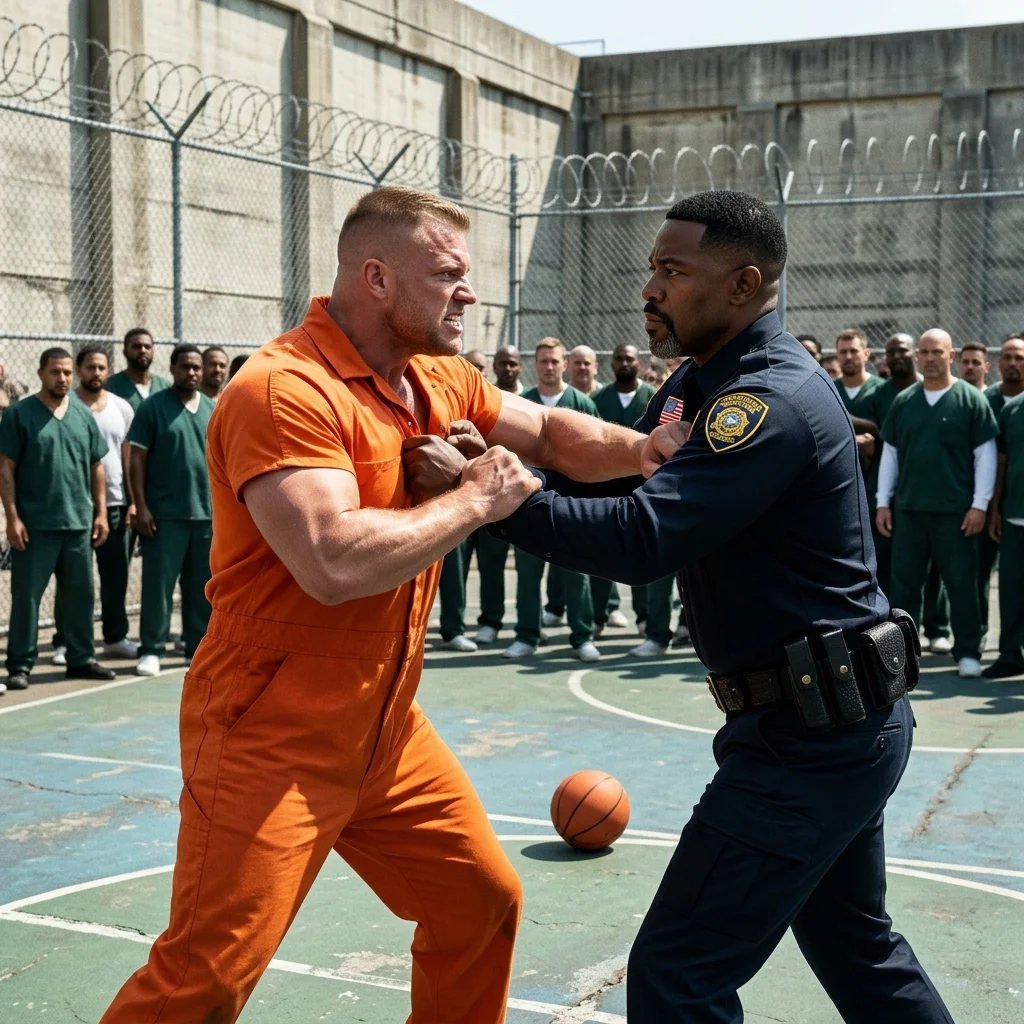
The first basketball had begun a confrontation that nearly destroyed his career.
The second represented something he had never expected to find inside a prison.
Trust.
Not blind trust.
Not trust given because he wore a uniform.
But trust earned through seventeen years of small decisions that had seemed insignificant at the time.
His phone rang.
Simone’s name appeared on the screen.
“Hey, Dad.”
“Hey.”
“Did you get the package?”
Marcus looked at the basketball.
“You knew about this?”
She laughed softly.
“Rebecca helped arrange it.”
“That explains a few things.”
“Do you like it?”
Marcus ran his thumb over the signatures.
“I do.”
Then Simone’s voice became serious.
“Dad, there’s one more thing.”
“What?”
“Remember how you used to tell me Grandpa Solomon wanted you to be a good man?”
Marcus smiled sadly.
“Every day.”
“Well, I think he’d be proud of you.”
Marcus looked toward his father’s photograph.
The old mechanic was still smiling beside the pickup truck.
For a moment, Marcus could almost hear his voice.
The right thing doesn’t become wrong just because somebody powerful dislikes it.
Marcus swallowed.
“Thank you, sweetheart.”
“Love you, Dad.”
“Love you, too.”
The call ended.
Outside, the evening sun settled behind the trees.
Marcus placed the basketball on the shelf beneath his father’s photograph.
Beside it, he laid the folded letter.
He had once believed that the most important moment of his career was the day he brought down the biggest inmate in Ashcroft’s recreation yard.
But now he knew better.
The most important moment had come afterward, when he chose to listen to the man he had every reason to distrust.
And the greatest victory had not happened on the concrete prison yard.
It had happened when eleven forgotten men walked through open doors and returned to the people who loved them.
Marcus turned off the living room light.
For the first time in a long while, he felt at peace.
Because the true measure of justice was never how many people a prison could keep behind its walls.
It was whether the law still mattered when those walls stood between a person and freedom.
And somewhere beyond Ashcroft’s fences, twelve men were finally living lives that, for far too long, had existed only as promises on paper.
THE END.





