She had become the kind of journalist who understood that some stories mattered more than the attention they could bring.
The next significant moment came several weeks later.
Calvin Briggs walked out of state custody after the courts resolved the unlawful hold on his release and the separate proceedings concerning his assault on Marcus.
He had accepted responsibility for what he had done.
He had also provided extensive testimony about the improper detentions.
The authorities had treated those as separate matters.
His participation in exposing the larger scheme did not erase his actions in the recreation yard.
But neither could his misconduct justify keeping him incarcerated without lawful authority.
On the day he left, Briggs wore ordinary clothes.
A plain jacket.
Dark trousers.
Shoes that had been waiting for him in a property bag.
He stepped through the visitor exit slowly.
For a moment, he seemed unsure where to go.
Then a woman standing near the parking lot called his name.
“Dad?”
Briggs stopped.
His daughter, Clara, stood beside a small blue sedan.
She was twenty-six, with blond hair tied back and an expression caught between happiness and disbelief.
Briggs stared at her.
“Clara?”
She walked toward him.
He stood motionless until she reached him.
Then she embraced him.
For a long moment, the enormous man who had once terrified an entire recreation yard could do nothing but hold his daughter and whisper her name.
Marcus watched from a distance.
He had come only to provide a final statement requested during the release process.
He hadn’t expected to witness the reunion.
As Briggs prepared to leave, he noticed Marcus standing near the building.
Their eyes met.
Briggs walked over.
“I didn’t think you’d come.”
“I was here for another reason.”
Briggs gave a small nod.
“Right.”
An uncomfortable silence followed.
Then Briggs extended his hand.
Marcus looked at it.
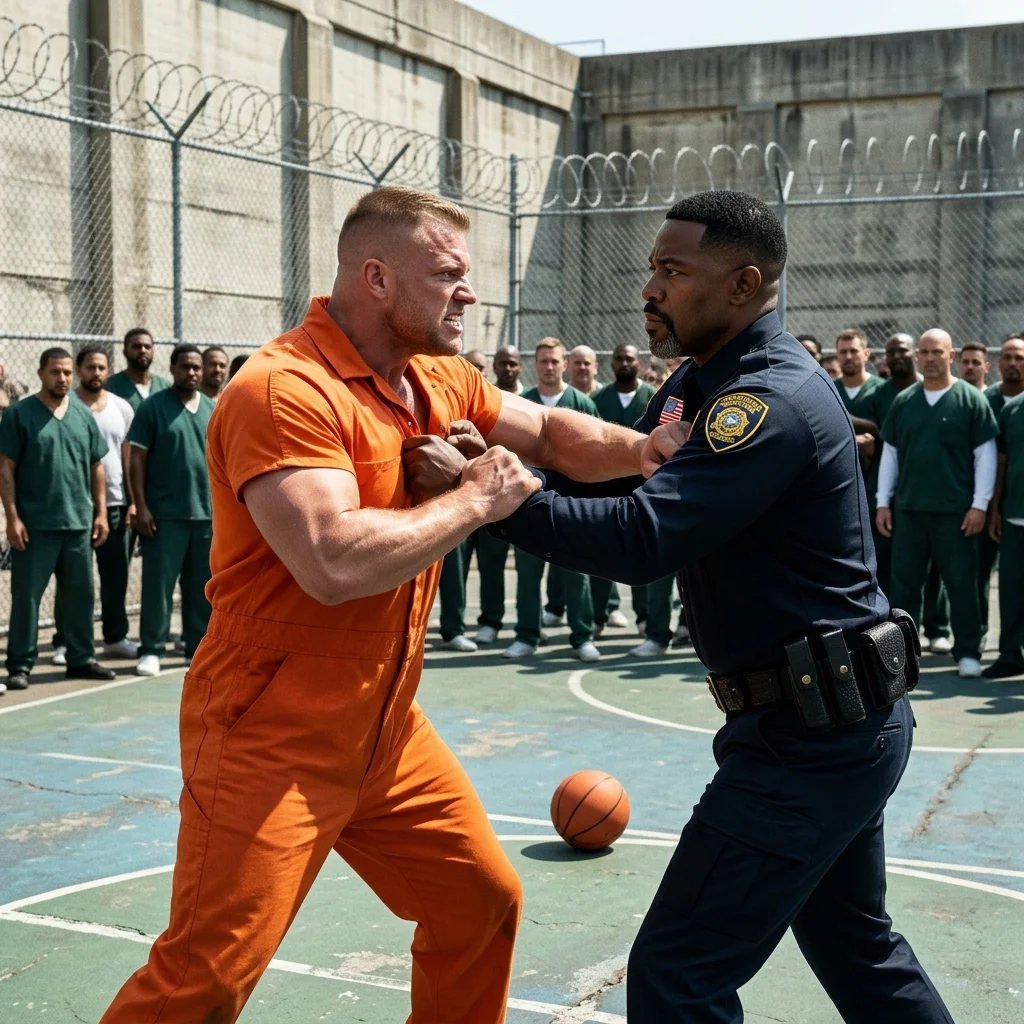
He remembered the basketball hitting him.
He remembered the shove.
The confrontation.
The anger.
And everything that had been revealed afterward.
He shook Briggs’s hand.
“Make good use of your freedom.”
Briggs swallowed.
“I will.”
Marcus held his gaze.
“Being free doesn’t mean your choices stop having consequences.”
Briggs nodded.
“I understand.”
“Then make better ones.”
Briggs looked toward his daughter.
“For her.”
Marcus shook his head gently.
“For yourself, too.”
Briggs’s eyes grew wet.
He nodded again.
Then he walked toward the blue sedan.
This time, no officer followed him.
No one ordered him to stop.
No locked door waited at the end of the corridor.
He simply climbed into the passenger seat beside his daughter.
And they drove away.
One year after the yard confrontation, Marcus stood inside a renovated conference room at Ashcroft.
He was no longer assigned to ordinary correctional duties.
After his administrative leave ended and the misconduct accusations against him were withdrawn, he had accepted a position with an independent correctional oversight program.
His work now focused on reviewing complaints, improving accountability, and helping facilities establish more reliable reporting procedures.
He had not accepted the position because he believed every prison officer was corrupt.
He knew too many hardworking colleagues who had tried to do their jobs with integrity.
He accepted because he understood how easily a system could fail when the truth depended on whether someone powerful was willing to hear it.
Across the room sat new correctional officers preparing for their first assignments.
They watched as Marcus approached the podium.
He carried no dramatic presentation.
No photographs of the yard confrontation.
No images of Briggs being restrained.
Only a thin folder.
Inside were copies of the findings that had changed his life.
Marcus looked at the group.
“When I started working in corrections, I thought strength meant maintaining control.”
The recruits listened.
“I thought being respected meant nobody questioning my authority.”
He paused.
“I was wrong.”
A young officer raised her hand.
“What changed your mind?”
Marcus considered the question.
Then he told them about a basketball.
A frightening inmate.
A confrontation that should never have happened.
And a moment when nearly seventy prisoners fell silent.
He explained how their truthful testimony helped expose a conspiracy that official paperwork had concealed.
He described the temptation to assume prisoners were lying because of their convictions.
He explained why the duty to protect people’s legal rights did not end when those people entered a correctional facility.
Then he said something that stayed with the recruits long afterward.
“A badge gives you authority, but it doesn’t make you right.”
He looked around the room.
“And a prison sentence takes away certain freedoms, but it does not take away a person’s humanity.”
The room remained silent.
Marcus closed his folder.
“Your job is not to win every confrontation.”
“Your job is to carry out the law without forgetting the people affected by it.”
He stepped away from the podium.
For a moment, nobody spoke.
Then the young officer who had asked the question stood.
“Officer Reed?”
Marcus turned.
“Yes?”
“What happened to the inmate?”
“Briggs?”
She nodded.
Marcus smiled faintly.
“He went home.”
“And the others?”
“They went home, too.”
The young woman looked relieved.
Marcus started toward the door.
But another recruit stopped him.
“Sir, can I ask one more question?”
“Go ahead.”
“Do you still believe in the correctional system after everything that happened?”
Marcus considered his answer carefully.
He thought of Hale.
Of Warden Shaw.
Of the eleven people whose legal freedom had existed on paper long before they experienced it.
He thought of Briggs standing outside the prison gates with his daughter.
And he thought of Ruth Tate calling her brother by the nickname nobody else knew.
Finally, he answered.
“I believe a system is only worthy of trust when people are willing to hold it accountable.”
Then he walked out.
That evening, Marcus returned home and found a package waiting on his doorstep.
There was no return address.
Inside was a basketball.
Not the one Briggs had kicked at him.
This one was new.
Across its surface were dozens of handwritten names.





