His rookie partner, Officer Brooke Lawson, fresh out of the academy, read the dispatch from the passenger seat and said nothing. She had learned to read Cole’s acceleration.
The V-formation was Cole’s call.
He angled both cruisers across the driveway of number 14 before the engines cut. Doors opened before the vehicles fully stopped, and the positioning communicated, before any language was attempted, that the situation had already been classified and the range of available outcomes had already been narrowed.
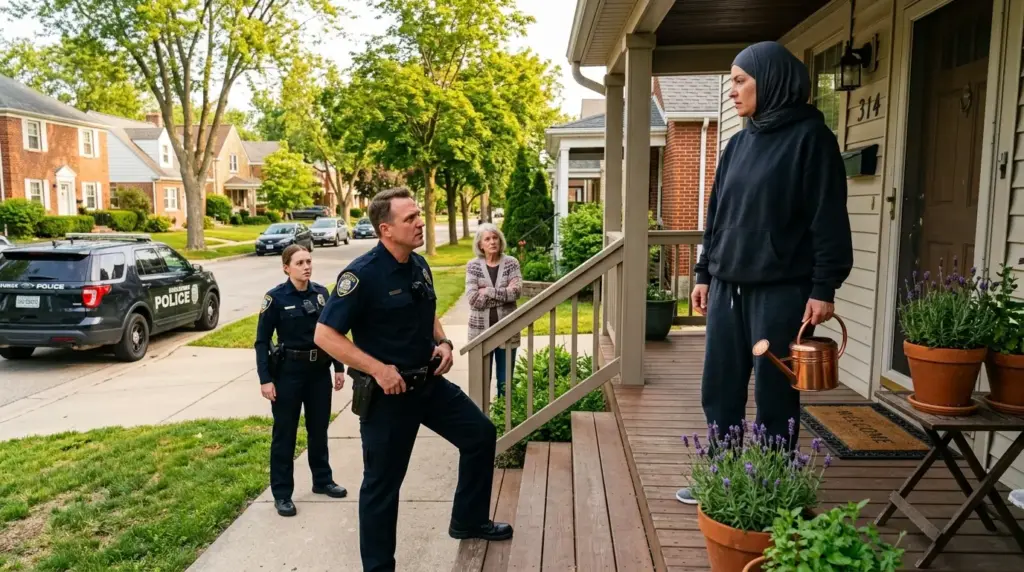
Rachel saw it the moment the cruisers turned onto her street. She had worked alongside law enforcement for a long time, and she knew the difference between officers approaching an unknown situation and officers approaching one they had already decided about. The V-formation was for vehicle interdiction; it was not standard protocol for a suspicious person call at a private residence.
The unsnapping of the holster strap happened on the first step of her front walk, Cole’s hand moving there automatically—not reaching, just touching, just establishing the vocabulary of the conversation before any conversation had begun.
She set the copper watering can on the porch railing. She stood on the top step. She did not retreat toward the door. She kept her hands visible and her spine straight, and she did what she had trained herself to do since her first year in federal court: she cataloged.
Two officers. Lead: mid-40s, broad build, the kind of unhurried stride that announces authority as a presumption rather than a demonstration. Rookie: female, late 20s, hanging back slightly at the base of the steps, posture not fully committed in either direction. Lead’s holster unsnapped by step three. No lights, no sirens. This is not an emergency; this is a conclusion looking for evidence.
Cole climbed to the base of her porch steps and stopped. The elevation difference—her on the top step, him looking up—appeared to register as an additional affront. He looked at her hoodie, her sweatpants, her hair pinned up and partly loose from the morning’s work, and his expression did not change because it had already been set before he arrived.
“Ma’am,” he said, not a greeting, a classification. “Step away from the front door and keep your hands where I can see them.”
The instruction arrived on the quiet street like something dropped from a height. Across the way, Margaret Caldwell’s plantation shutters shifted in their frame.
Rachel looked left, looked right, looked back at Cole with an expression that was entirely level and entirely unimpressed.
“Excuse me?” she said.
“Step away from the door. What are you doing here?”
She placed the pruning shears she had forgotten she was still holding on the small porch table. She did not step back. She stood on her own porch, in front of her own door, in front of the lavender she had planted herself the previous evening.
“I’m watering my plants, officer,” she said. “Is there a problem?”
The word “my” landed with a precision Cole did not register, and she noted with a prosecutor’s automatic attention to detail: both body cameras were running. She could see the small red recording light on Cole’s chest from where she was standing. She made sure to stay in frame.
“We received a call about a suspicious person trespassing on this property,” Cole said. He had hooked his thumbs into his duty belt, the body language of someone settling in for a conversation they intend to win before it starts. “Neighbors say the owner passed away, so I’ll ask you again: what exactly are you doing here?”
The cold, specific clarity of the moment settled over Rachel in a way she would later describe, in the precise language of a woman who had been trained to examine her own reactions as evidence, as something between indignation and recognition. She had prosecuted men for this exact scenario. She had stood at federal podiums and explained what it looked like and what it cost and what the law said about it. She had never had it happen on her own porch.
The indignation was real; she would not pretend otherwise even to herself. It was hot and immediate and entirely justified. But underneath it, operating concurrently, was something colder and more durable: years of courtroom discipline that had trained her to manage emotion the way you manage evidence—carefully, precisely, never letting it make decisions on your behalf.
“I’m perfectly aware of who the previous owner was,” she said. “His name was Edward Harrington. The property was listed some time ago and sold recently. I’m the buyer of record. I live here. I’ve been living here for some time.”
Cole’s face performed a micro-recalibration that was not, in any meaningful sense, an update of his working conclusion. He had arrived with a story; what she said didn’t fit it, so his brain filed it elsewhere.
He let out a short exhale through his nose. He glanced sideways at Lawson—the glance of a man sharing a private editorial—and Lawson, for the first time, dropped her eyes. Something in her face shifted toward something she wouldn’t name yet.
“You live here,” Cole repeated. The tone was not a question; it was disbelief wearing the grammatical clothes of one.
“That is correct.”
“In this house?”
“In this house, yes.”
“Then prove it. I need to see your ID.”
The demand sat in the morning air between them. Lawson shifted her weight at the base of the steps. Across the street, Margaret Caldwell had opened her shutters all the way.





