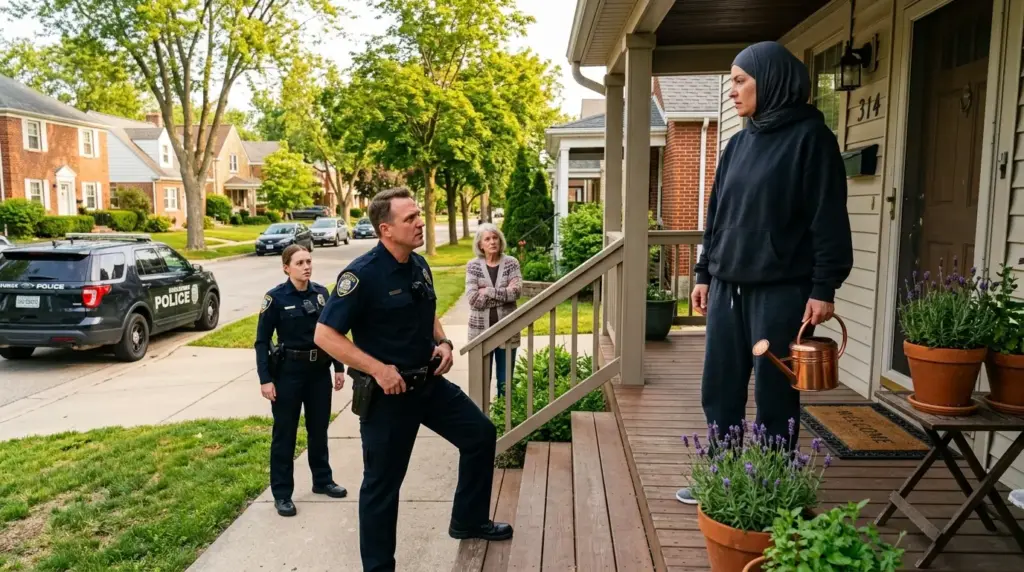
The Oakwood Police Department’s booking desk smelled of institutional coffee and the specific industrial cleaner used on floors that see heavy foot traffic. Desk Sergeant Tom Riley, methodical, neither cruel nor warm, was finishing a notation on the current form in front of him.
When Cole brought Rachel in, he didn’t look up. “What do we got?”
“Obstruction, resisting, suspected burglary,” Cole announced with the tone of a man completing a satisfying task. “Caught her prowling around a deceased owner’s property in Oakwood Heights. Refused to ID herself, escalated the encounter.”
Riley finished his notation. He clicked his pen. He looked up.
He looked at Rachel Bennett. She was standing in front of his counter in a faded college hoodie and gray sweatpants, a scrape along her right cheekbone, hair partly down from where it had been pinned. Her wrists were in front of her now, and even from across the counter, he could see the reddened bands where the cuffs had been.
She looked nothing like any version of the charges Cole had just listed. She looked like someone who was memorizing every badge number in the room—which was, as it happened, precisely what she was doing.
Something in Riley’s pattern recognition filed a quiet, unarticulated objection. He did not act on it yet. He did his job.
“All right, ma’am, name and date of birth.”
“Rachel Bennett,” she said.
Nothing more. No title, no agency, no correction of any assumption. She held his gaze and said nothing else.
Riley typed it in and moved forward because that was what the process required, and he was a man who followed process. “Take the cuffs off, Cole. Fingerprinting, then cell four while I run her through.”
Cole unlocked the cuffs. Rachel brought her arms forward slowly and rubbed her wrists, not performing anything, just addressing the pain the way you address a practical problem, and kept her eyes on Cole’s face. He did not meet them.
“I’m requesting my phone call,” she said, not a question.
“After processing,” Cole said. He slid the fingerprint card across the desk. “Hope you know a good bail bondsman.”
The fingerprinting was quick and professional. The intake search was conducted by a female officer who said nothing that was not procedurally required. Then Rachel was walked down the hallway, past the dispatch station, past the report room—where she noted with a prosecutor’s reflex that Lawson had gone to begin writing something—and into holding.
Cell four was concrete and fluorescent, and smelled of bleach in the stale, recycled air of a sealed institutional space. Metal bench, drain in the floor, wire-reinforced window in the door. The door shut with the clang of a conclusion.
Rachel sat on the bench. She smoothed the front of her hoodie. She put her feet flat on the floor, and she pressed the back of her left wrist against the cold concrete wall and held it there. The scrape on her cheek stung in the specific, persistent way of surface abrasions. She looked at the wall in front of her and allowed herself, for a moment, to know something she was not yet ready to say aloud.
She had prosecuted men for exactly this. She had stood at federal podiums and described it in clinical case law language to juries and judges and congressional staffers. She had known intellectually, precisely, comprehensively what it felt like to be grabbed by the state without cause.
She had never felt it herself.
She understood now that she hadn’t truly known: not the weight of the steel, not the cold of the brick against the face, not the specific degradation of being walked across your own property in handcuffs while the woman who called the police watched from her lawn with her arms crossed. She understood it now in the way you understand things only through the body, not the mind. And she filed it away with the careful deliberateness of a woman who intends to use everything.
Some time later, a young deputy passed a cordless phone through the bars. “Five minutes,” he said.
Rachel dialed a number she knew without looking. The phone rang twice.
“David Ellis.” The voice of a man who answers the same way regardless of what he is doing when it rings. David Ellis, United States Attorney for the Southern District, a man who, in Rachel’s years of working for and beside him, she had seen fully angry exactly twice, both times in the direction of injustice that had been disguised as procedure.
“David, it’s Rachel.”
A micro-pause, reconfiguring. “I told you to take the weekend. If this is about Martinez—”
“It’s not Martinez.” Her voice was even, deliberately steadied. “I’m calling from a holding cell at the Oakwood Police Department.”
The silence on the other end changed. It was the silence of a man reorganizing his understanding of a situation very quickly, which David Ellis did faster than anyone she had ever worked with.
“Say that again.”
“Holding cell four, Oakwood PD. Arrested this morning at my home, 14 Birchwood Lane, Oakwood Heights. Arresting officer Ryan Cole, a veteran. He responded to a 911 call from a neighbor reporting a suspicious person at what she described as a deceased man’s property. He was informed I am the current owner. He demanded identification without legal basis. I declined and cited Terry. He grabbed my wrist, slammed me against the brick wall of my own house—I have a scrape on my right cheek and bruising on both wrists—and arrested me on obstruction, resisting, and suspected burglary.”
She heard, on the other end of the line, the specific sound of a coffee mug being set down.
“Are you hurt?” The first and only personal question before the professional machine started. She knew him well enough to understand what it cost to ask it first.
“Functionally fine. The cheek will heal, the wrists will heal.”





