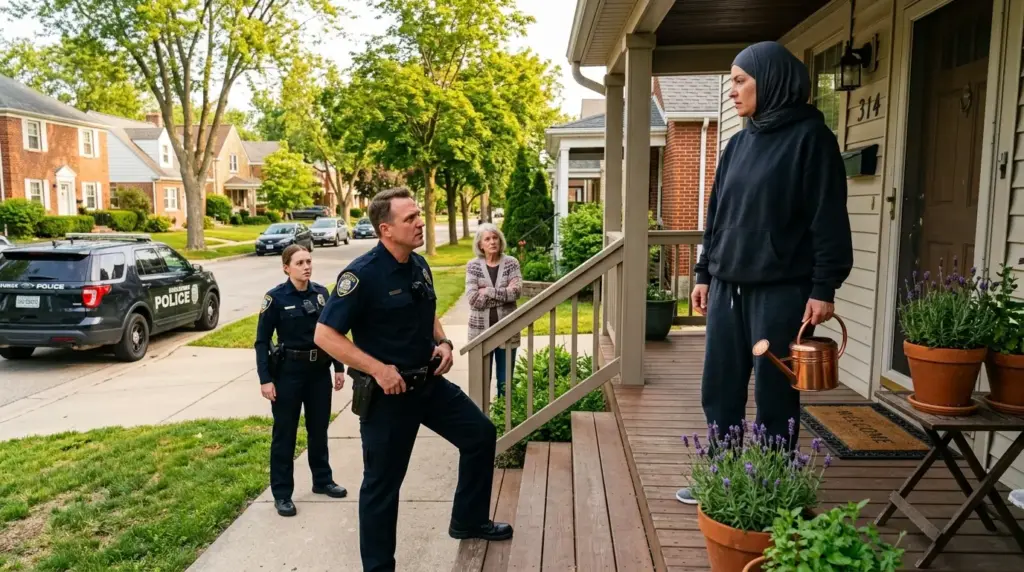
“He arrested the Deputy Chief of the Federal Criminal Division on her own front porch,” Ellis said slowly, and she recognized the register: he was testing whether the sentence was real by hearing it out loud. It was something he did with closing arguments; he said things out loud to see whether they held.
“While she was watering her lavender,” Rachel said. “Yes.”
A pause. Then quietly, the quality in his voice that she had heard only when he was walking toward a verdict that mattered: “I’m calling the field office right now. We can be there in under an hour.”
One beat. The small, controlled smile that had been held carefully behind everything else finally made a brief appearance, invisible to anyone, entirely real.
“Don’t come yet. Give them some time. Let them finish processing the prints. Let the AFIS system run my name through the national database.” Another beat. “I want Cole standing at that booking desk when the result comes back. I want to be in the room.”
A silence. She could hear distantly the sound of a chair. Then:
“You want the database to be the one who introduces you.”
“I want him to understand what he did before I say a word to him,” she said. “I want him to know first from a machine. I want it to be the building that tells him.”
Another silence, shorter this time. David Ellis making the specific calculation of a man who has spent years understanding the difference between legal strategy and theater, and recognizing when they are, in fact, the same thing.
“Give me some time,” he said. “Sit tight.”
“Take your time,” Rachel said. “I’m not going anywhere.”
She passed the phone back through the bars. She sat down on the metal bench. She put her feet flat on the floor and her hands in her lap, and she looked at the concrete wall. And she was still—the specific, trained stillness of a woman who has waited for verdicts and knows that the waiting is part of the work.
Sergeant Tom Riley had run a very large number of names through the AFIS system across his years at the Oakwood PD booking desk. He had seen results that were expected, results that were surprising, results that were merely administrative. He had seen outstanding warrants, alias flags, records longer or shorter than the person’s demeanor had suggested.
He had never seen what appeared on his screen that morning.
He was on his third coffee, working through the notation backlog on two other pending cases, when the AFIS screen updated. The automated system had finished processing. The national database cross-reference had run. The result had returned.
There was a banner he had never encountered—not the standard white or administrative gray: red. Bright, unambiguous red, with a header that he had to read twice before his brain would accept it as real:
RESTRICTED: FEDERAL LAW ENFORCEMENT ACCESS REQUIRED. CLEARANCE LEVEL: TOP SECRET/SCI. AGENCY: DEPARTMENT OF JUSTICE, OFFICE OF THE UNITED STATES ATTORNEY, SOUTHERN DISTRICT.
Below the banner:
BENNETT, RACHEL M. DEPUTY CHIEF, FEDERAL CRIMINAL DIVISION. ACTIVE FEDERAL PROSECUTOR. CURRENT STATUS: IN GOOD STANDING.
Riley stared at the screen. He read it once. He leaned slightly forward and read it again. He removed his reading glasses, wiped them on his shirt in the automatic gesture of a man who does not trust what his eyes are reporting, replaced them with precision, and read it a third time.
The result did not change.
He looked at the phrase Deputy Chief, Federal Criminal Division. He looked at Clearance Level: TOP SECRET/SCI. He looked at United States Attorney’s Office, Southern District. He thought about the woman who had walked through his booking area some time ago: the scrape on her cheekbone, the way she had stood in front of his counter and given him her name and nothing else, with the expression of someone who knew exactly what was coming and had decided to let it arrive on its own schedule.
The coffee mug in his right hand went completely still. He set it down with the careful deliberateness of a man placing something fragile on an uncertain surface.
He looked at the screen for one more second. Then he looked up, down the hallway past the report room, at the far end near the vending machines.
Ryan Cole was leaning against a filing cabinet with two other officers. He was laughing. The laugh was the specific laugh of someone for whom this building has always been a safe place, the laugh of a man on the correct side of every locked door he had ever passed through.
Riley called his name once, quietly, without inflection.
The laugh stopped. The quality of its absence—the way a sound’s sudden ending carries more information than the sound itself—spread outward from Cole to the two officers beside him, and then beyond. So that by the time Cole looked up and across the room toward the booking desk, several people had already stopped what they were doing without knowing why.
“Yes, Sarge. What’s up?”
“Get over here,” Riley said. And then, with the flat certainty of a man who has been doing this long enough to know when something is irreversible: “Now.”
Cole crossed the room with the comfortable stride of a man who has never had a reason to approach his desk sergeant with anything other than routine expectation. He was still wearing the residual warmth of the laugh. He came around the booking counter, stood beside Riley, and looked at the screen.
The smile stayed on his face for approximately two more seconds.





