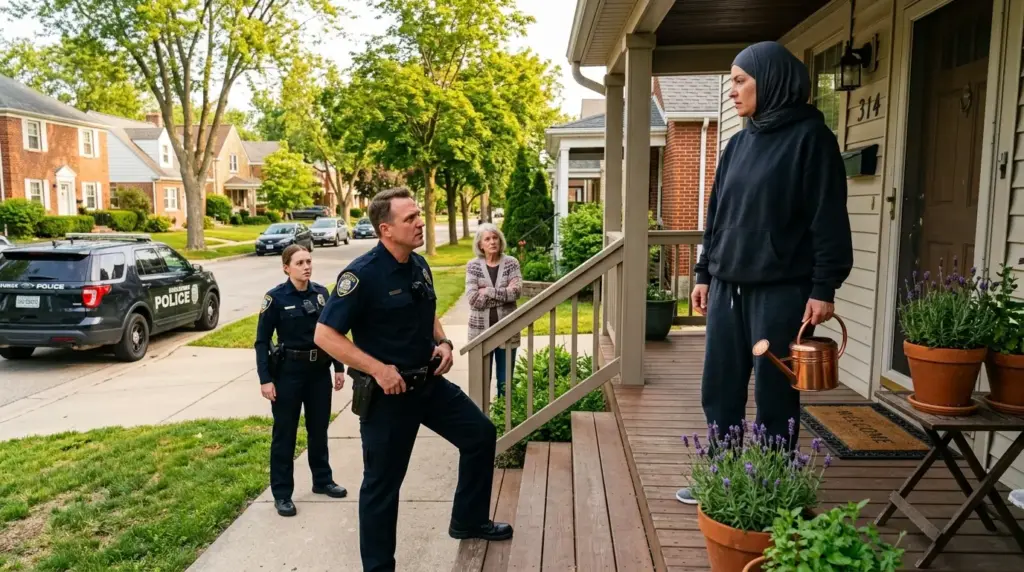
“I am cooperating with the law,” Rachel said loudly, clearly projecting toward the street because she knew neighbors were watching, and she knew what witnesses could do with what they heard. “You are breaking it! My name is Rachel Bennett. You are detaining me on my own private property under color of law, without probable cause and without a warrant. You are committing battery under color of authority! I am naming these violations aloud as they occur. Officer, badge number whatever it is, record this!”
The handcuffs came out. The steel was cold and the ratchet closed—click, click, click—with the mechanical indifference of a thing that does not know or care what it is being used for, entirely indifferent to every word she had said, to every law she had cited, to every fact she had stated about the property she was standing on.
She was walked down her front steps in cuffs, Cole’s hand around her bicep, toward the cruiser parked across her driveway. As they crossed the path, she looked across the street. Margaret Caldwell was standing on her front lawn, arms crossed, watching. The expression on Margaret’s face was the expression of someone whose worldview has just been confirmed—which is one of the most dangerous expressions a human being can wear, because it is indistinguishable, from the inside, from righteousness.
Rachel did not look away from it. She held it and filed it. And in the private space behind her controlled expression, she made her decision: she would give them her name, only her name. She would let the Automated Fingerprint Identification System return what it was going to return. She would let the database introduce her, and she would make sure she was standing at that booking desk when it did.
The cruiser door slammed. The sound was definitive and hollow, and entirely consistent with everything that had happened since the moment the first cruiser turned onto Birchwood Lane. She sat in the hard plastic back seat, wrists aching, and she waited.
She was very good at waiting.
The drive to the Oakwood Police Department took some time by the route Cole chose. He could have taken the direct route; he did not. He took every curve at a speed incrementally faster than posted—not reckless by any measurable standard, but calibrated. Each turn sent Rachel sliding against the side panel, each one a small private exercise of the only dimension of power still available to him in this phase of the morning. It was the kind of thing that doesn’t appear in reports and doesn’t generate complaints, because the person experiencing it is already under arrest, and the person doing it knows exactly how much pressure they can apply while remaining technically within the guidelines.
Rachel did not react. She sat with her back as straight as the molded plastic allowed, feet flat on the floor, eyes forward through the wire mesh divider, and she did not give him the satisfaction of a sound.
Lawson was in the passenger seat, gripping her radio with both hands, staring at the windshield with the focused attention of someone who has decided that looking only at the road ahead is a form of not being complicit—which she was beginning to understand was not the same thing as actually not being complicit.
After some time, she spoke.
“Cole.” Quiet, careful. “When we get back, before booking, maybe we run the deed of sale. Check the property record. She cited Terry by name. She knew the statute number.”
“That’s not how this works,” Cole said. He said it the way men say things that are supposed to end conversations. “I know what a liar looks like. She refused a lawful order. That’s obstruction. We have probable cause from the dispatch call. She’ll explain herself to a judge.”
Lawson did not speak again. She looked at the road. Her knuckles were white on the radio, and she did not say what she was thinking, which was: I don’t think that’s what obstruction means, and I don’t think that was a lawful order.
She would spend the rest of the drive deciding whether what she was thinking was something she was going to act on.
In the back seat, Rachel ran the inventory quietly. Every word Cole had said, timed and sequenced. Every step of the escalation ladder, from the V-formation to the holster strap to the wrist grab to the brick wall to the handcuffs—the cheek still stinging, the wrists bruised in bands where the steel had closed. She had prosecuted men for exactly this constellation of events, and she knew what a complete evidentiary record looked like from the inside of a case file.
And then, for one moment that she allowed to be only itself and nothing else, she thought of her mother.
They will never let you just be.
The specific exhaustion in her mother’s voice when she said it—not bitterness, never bitterness, just the patient weight of a woman who had been right about this for years and had never stopped hoping to be proven wrong.
Rachel pressed the thought down into the place where she kept things that were true but not useful at this precise moment. Then she returned to what was: she would give them her name, nothing else. She would ask for her phone call. She would call David. She would tell him to wait, to time it with precision, because she wanted to be standing at the booking desk when the automated system returned its result.
She had built federal cases for a long time. She knew what it meant to let evidence speak for itself, and she knew the particular power of evidence that arrives in a room before anyone has had the chance to manage it.
The cruiser turned into the Oakwood PD sally port. The heavy doors rolled shut behind them. She was ready.





