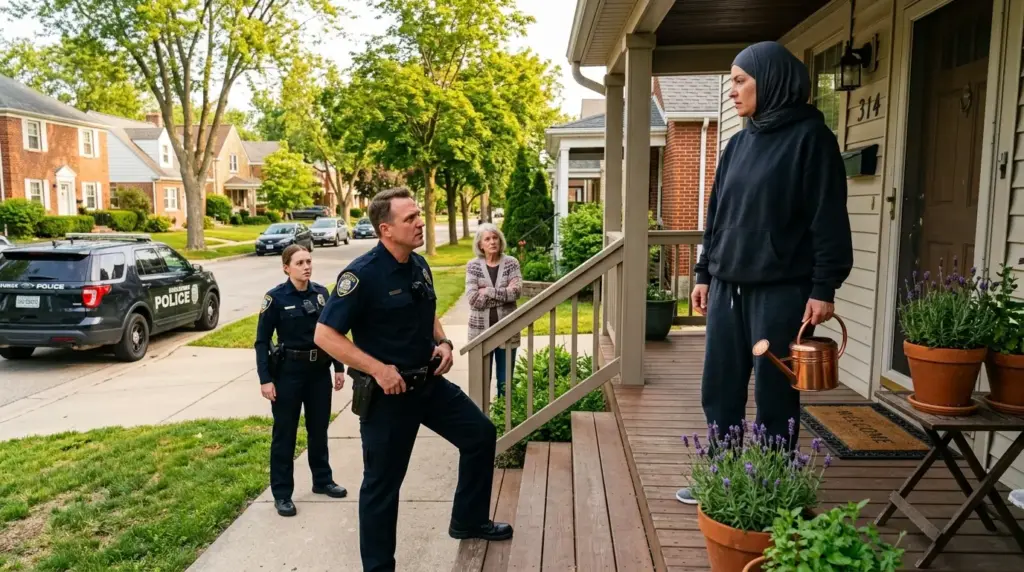
Rachel looked at Cole, and the part of her brain that functioned as a federal prosecutor, regardless of what she was wearing, ran the analysis in under two seconds: Stop-and-identify statutes in this state apply only to Terry stops—investigative detentions based on reasonable articulable suspicion of criminal activity. Standing on one’s own porch watering plants does not meet that threshold. A neighbor’s 911 call without corroborating evidence of criminal conduct does not establish reasonable suspicion under Terry v. Ohio. This demand is unlawful.
She knew all of it. She also knew that she could produce identification and end this in moments. Part of her—the part that had grown up knowing exactly what these decisions cost—suggested exactly that.
She looked at Cole’s face. She looked at the unsnapped holster. She thought about everyone who had stood in this exact position without federal credentials to produce, without years of case law filed in accessible memory, without the specific safety net of a job that made her legally formidable.
“No,” Rachel said.
Cole blinked. His processing system had not prepared a response for that word from this person in this situation, and the gap was visible.
“Excuse me?”
“I said no.”
Her voice had not moved a single register. It projected with the clarity of someone who has spent years ensuring back-row juries could hear her without assistance. “I’m not going to show you my identification.”
Cole climbed to the top of her porch steps. He was in her space now, and he intended that to be felt.
“Listen to me very carefully,” he said, dropping into the register men use when they want deniability later. “This is not a request. We are conducting an active investigation into a reported burglary. You are a suspect. Hand me your identification right now, or things will get very difficult for you very quickly.”
“Then let me be precise about the law,” Rachel said. She didn’t move back. She spoke in the cadence she used for opening arguments, each word placed with the deliberateness of foundation work. “We are in a state without a stop-and-identify statute applicable to consensual encounters on private property. To lawfully demand my identification, you need reasonable articulable suspicion that I have committed, am committing, or am about to commit a criminal offense. That is the standard from Terry v. Ohio, and it has not moved in more than fifty years. A neighbor’s phone call while I stand openly on my own porch watering plants in daylight does not meet that threshold. You have no legal basis to demand my identification.”
At the base of the steps, Lawson had stopped moving. She was holding her radio in both hands and looking at Cole with an expression that had crossed from uncertain into something more specific: the expression of someone who has heard something true and understood it, and does not know yet what to do with that understanding.
“Cole,” she said quietly. Just his name. Just enough.
He cut her off without turning. His ego had taken the hit—the legal language, the case citation, the composure of the woman in the sweatpants who was not behaving the way suspects in sweatpants were supposed to behave—and it was now responding with everything it had available.
“I don’t need a law lecture from someone prowling on a porch,” he said. His hand moved slowly and deliberately down to his holster, not drawing, just reminding her it was there. “You are interfering with a police investigation. Provide your name and date of birth right now, or I will place you under arrest for obstruction. Last chance.”
“You cannot arrest someone for obstruction solely for declining an unlawful ID demand,” Rachel said. Her voice had acquired an edge not of emotion, but of absolute certainty—the certainty of someone who has written this argument in federal briefs. “I am on my own private property. I have broken no law. You have no warrant, no probable cause, and no authority to detain me. I am formally asking you to step off my porch.”
She was still in frame. Both cameras were still recording. She knew it, and she was making sure every word was audible enough to be captured without ambiguity.
Cole moved. There was no additional warning.
One moment he was standing inches from her, and the next his hand had closed around her left wrist with a force that was not about procedure, was not about de-escalation, and was entirely about the specific intolerance of a man who has never been told no by someone he had already classified.
Rachel gasped—not from fear, but from the involuntary shock of physical contact applied without invitation or cause. And then he had spun her around toward the brick facade beside the front door, her left arm bent behind her back, his body weight pressing her forward until her right cheek made contact with the rough masonry.
The brick was cold. It scraped.
“Get your hands off me,” she said. And this time the composure cracked—not broke, cracked. Because the physical reality of it, after everything she had precisely and correctly articulated, was something that years of federal litigation had not fully prepared her for. “This is an unlawful arrest! You are violating my Fourth Amendment rights! This is an unlawful arrest!”
“Stop resisting,” Cole said.
She was not resisting. She was rigid with shock, pressed against her own house, her cheek against its masonry. The instruction was a verbal record, documentation for a version of events he was constructing in real time.
“Lawson, get up here! Secure her right arm.”
Lawson came up the steps. She was pale. She took Rachel’s right arm with a pressure that was, in its reluctance, something close to an apology before any apology was possible.
“Ma’am, please just cooperate,” Lawson said, and her voice was unsteady in a way she couldn’t control.





