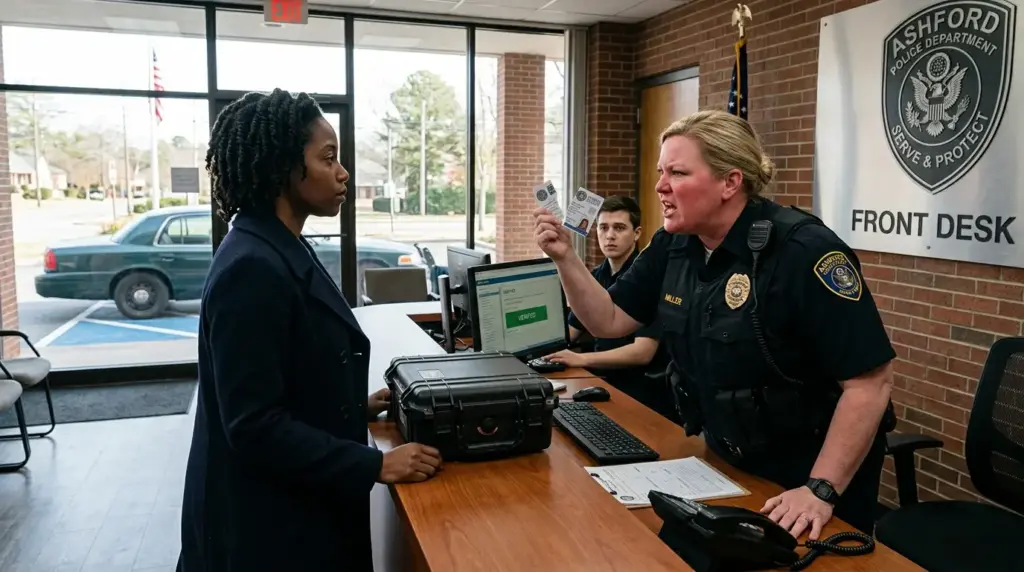
Maya looked at him. “Correct.”
Rebecca seemed surprised again by Maya’s refusal to go further than the evidence.
Maya continued, “What it establishes is that the record used to support the detention was not the original recording.”
The technician compared timestamps, export logs, and file signatures. “The official version was assembled after the fact. Whoever created it kept the visible case timestamp, but the compression signature changed.”
Mercer asked, “Could software maintenance account for that?”
“Not selectively on one segment.”
Rebecca looked at Lena. “Who had permission to modify body camera evidence?”
“Normal users couldn’t change source files,” Lena said. “It required elevated access.”
“How many people had that?”
“Very few.”
Maya asked for the list. Lena opened the administrator permissions table: her own evidence administrator account appeared first; Rebecca had security privileges with limited evidence management functions; Chief Mercer held executive-level administrative authority; Sloan Integrated Systems had several contractor certificates, including one with broader permissions than the written maintenance agreement described.
Maya asked, “Could the Sloan certificate alter file metadata?”
The federal technician checked the permission set: “Yes.”
“Could it replace a visible file while keeping the case entry intact?”
“Yes.”
Rebecca stepped forward. “That does not mean Calvin did it.”
“No,” Maya said. “It means the account could.”
Mercer looked at the hidden server. “And the original file stayed here.”
“Which raises another question,” Maya replied. “Why preserve the real recording on an undocumented server while placing a different version in the official archive?”
No one answered.
Maya asked the technician to build a complete timeline for Nathan’s case, starting with the body camera upload and ending with the final evidence entry.
The sequence took several minutes to reconstruct: the original body camera file reached the hidden server shortly after the encounter with Nathan; a different file appeared in the official evidence archive later; Nathan’s detention report was finalized after that second file existed.
Lena checked her handwritten notes. “I remember his complaint coming in the next day. He said the card had never been in his belongings.”
Maya asked, “What happened to the complaint?”
“It was logged and sent to command review.”
“Who received it?”
Lena searched the departmental records: the complaint had been routed through internal administration, but the final disposition field contained only a short entry stating that the video evidence supported the officer’s account.
Maya read it. “Who closed the complaint?”
Lena opened the authorization history: the entry had been approved using a command-level account.
Mercer looked at the screen. “Those approvals can be processed by staff under delegated authority.”
“Then we identify the person who used it,” Maya said.
Mercer did not respond.
Maya asked Lena for Nathan’s contact information.
“He has an attorney now,” Lena said.
“Good. Contact counsel first.”
A federal agent placed the call from the evidence office. Maya waited while Nathan’s attorney confirmed that Nathan was willing to speak with federal investigators. Several minutes later, Maya took the secure line.
“Nathan, this is Special Agent Maya Williams with the FBI.”
There was a pause. “I’ve already told Asheford what happened. I know they didn’t believe me.”
“I’m not calling to ask you to repeat everything right now.”
“Then why are you calling?”
“We recovered a source body camera file connected to your detention.”
Nathan was silent.
Maya continued, “I need you to understand that the file is being preserved under federal custody.”
“Does it show the search?”
“Yes.”
“And the card?”
“It does not appear during the original search.”
Nathan did not answer immediately. When he spoke again, his voice was quieter: “So somebody finally found it.”
“We found a record. The investigation still has to determine who changed the official evidence and why.”
“You believe me now?”
Maya chose her words carefully: “I believe the original recording does not match the version used to support your detention.”
“That’s not the same thing.”
“No, it isn’t. And I’m not going to tell you more than the evidence proves.”
Nathan let out a slow breath. “At least that’s more than they gave me.”
Maya asked whether he would come to a federal interview location later that day—not the Asheford station.
“No.”
“Why?”
“Because the systems connected to your case are under investigation.”
Nathan agreed to meet federal personnel.
Before ending the call, he said, “Agent Williams, when they found that card, everybody stopped listening to anything I said.”
Maya looked at the original video frozen on the workstation: “A false file can hold a man just as effectively as a locked door.”
Nathan was quiet.
Maya continued, “Your original record is preserved now. Nobody alters it again.”
After the call, Lena returned to the server index. “There’s something else.”
She opened a network activity panel associated with the hidden system. At first, the entries looked like ordinary backup traffic, but the destination addresses did not match any municipal or contracted disaster recovery service.
The federal technician moved closer. “These are outbound transfers.”
Mercer said, “Sloan handled remote backup.”
The technician shook his head. “These aren’t backup packages.”
“What are they?”
He opened one transfer manifest. The file categories included license plate histories, traffic camera locations, municipal access events, and vehicle location records.
Maya looked at the destination field. “Who owns that endpoint?”
“I don’t know yet.”
“Find out.”
A second transfer showed the same pattern. Then a third. These were organized exports, not accidental transmissions.
Rebecca looked at the screen. “Calvin’s company supported analytic systems for the city. There could be a legitimate reason.”
Maya asked, “Is there a contract authorizing external distribution of this data?”
Lena answered, “Not one I’ve ever seen.”
Maya turned back to the technician: “Preserve every transfer record before the retention cycle reaches it.”
He began copying the logs. Nathan Cole’s case had already established that Asheford’s official evidence could be changed. The hidden server now showed that the same undisclosed system was sending city surveillance data outside the department.
Maya looked at the growing list of destination addresses: “Trace where those files went.”





