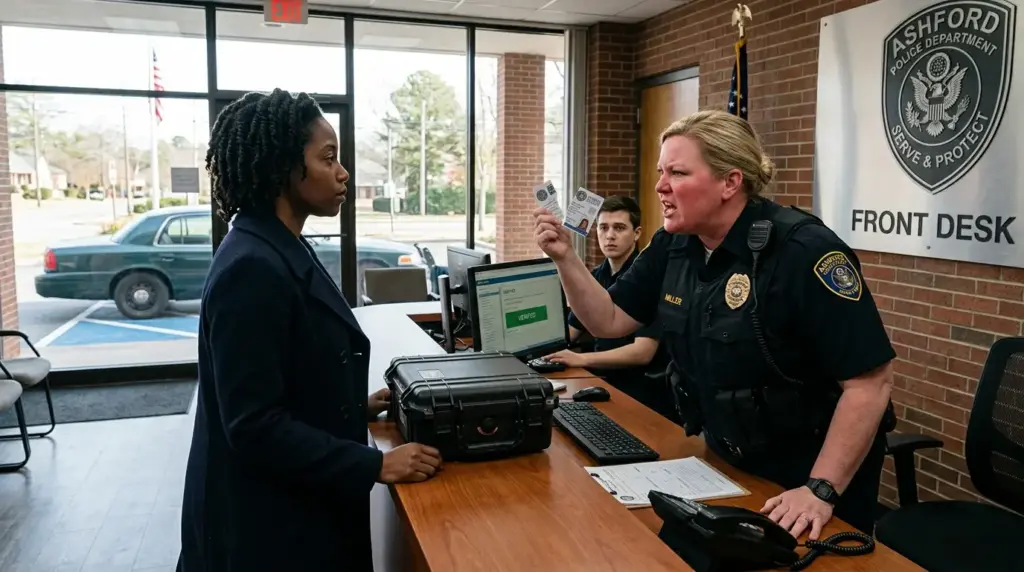
Rebecca crossed her arms. “You’re treating the entire department like a crime scene.”
“No, I’m treating the records like records.”
Lena led Maya toward the secured digital evidence office. Mercer followed, with Rebecca a few steps behind. Ben remained at the front desk under instructions not to touch the verification terminal or the torn credential.
The digital evidence room contained three workstations, two equipment cabinets, and a secured door leading to the main server area. Lena used her access card, then entered a personal code.
Maya stopped before crossing the threshold. “Who has administrator privileges?”
“Chief Mercer has executive-level access. I have evidence administration. Lieutenant Sloan has security and limited evidence permissions. Sloan Integrated Systems has contractor-level certificates for maintenance.”
Maya looked at Rebecca. “Sloan Integrated Systems?”
“My brother owns the company,” Rebecca said. “That isn’t a secret.”
“Was the relationship disclosed?”
“Yes,” Mercer answered before Rebecca could add anything. “The contract went through city procurement. It was reviewed and approved.”
Maya did not challenge him. “Then the records should confirm that.”
Lena sat at the nearest workstation and opened the audit console. “This is what I was trying to explain.”
A series of administrator events appeared on the screen. The newest records were detailed, showing account names, access levels, system changes, and timestamps. Older entries became noticeably less complete.
Maya leaned closer. “How long did the system retain administrative history before the change?”
“Six months in the primary audit layer, with archived copies beyond that.”
“And now?”
Lena opened the current configuration. “It cycles much faster. New events overwrite older ones.”
Mercer said, “That could be part of a storage optimization.”
Lena looked at him. “Not one I approved.”
“Could the vendor have done it during maintenance?”
“They could have. But changes at that level should create an administrator record.”
Maya asked, “And that record?”
“Gone,” Rebecca said. “If the log was overwritten automatically, you can’t claim someone deliberately deleted it.”
“I didn’t,” Maya replied.
Rebecca paused.
Maya continued, “I asked what changed.”
The distinction ended the argument.
A knock came from the outer door. Two FBI technical specialists had arrived, followed by another agent carrying sealed evidence containers. Maya met them in the hallway and gave brief instructions: “No shutdown unless I authorize it. Preserve live configuration first. Mirror active logs. Document every administrator certificate. Normal police operations stay online.”
One of the technicians nodded. “Understood.”
Mercer followed them back inside. “Agent Williams, this department handles active calls through systems connected to this network. I won’t have emergency operations disrupted.”
“Neither will I.”
“You’re bringing federal technicians into an operational police network.”
“To preserve specific systems.”
Mercer lowered his voice. “You arrived here under restricted notification. Your presence triggered a confrontation. And now you’re expanding into our internal infrastructure. I need something more specific than general concerns about a grant.”
Maya held his gaze. “Then give us a system that matches the grant records.”
Mercer did not answer.
Lena opened a storage report and turned the monitor toward Maya. “This is another problem.”
The report listed the department’s contracted capacity and redundancy status. The numbers did not match the physical storage visible on the network.
Maya asked, “How large is the difference?”
“Large enough that the equipment we have online cannot provide what the city certified.”
Rebecca moved closer. “You’re sure?”
“I’ve been sure for months.”
“Then why didn’t you report it?”
“I did.”
“To whom?”
Lena looked toward Mercer. He responded immediately: “You reported storage irregularities, not missing infrastructure.”
“I reported that the backup architecture didn’t match the contract.”
Mercer’s expression remained controlled. “And IT told us the vendor was completing remote configuration.”
Lena opened another page. “Remote configuration doesn’t create physical storage that isn’t here.”
No one spoke for a moment. Maya asked the federal technician to record the screen, capture the contract capacity, active capacity, backup status, and current certificates. The technician began imaging the configuration.
Rebecca looked at Maya. “You came here because of the storage system?”
“Partly.”
“What else?”
Maya did not answer.
Lena pulled a yellow legal pad from beside her keyboard. Several pages were filled with handwritten dates, account names, and brief notes.
Maya looked at it. “What’s that?”
“My own record.”
“You kept separate notes?”
“After the system started losing history.”
Mercer looked irritated. “Lena, you maintained unofficial audit records?”
“I wrote down what I saw on the department’s own system.”
“That isn’t the same thing as an official record.”
“No,” Lena said, “but it still exists.”
Maya took the point without commenting on the dispute. “Show me the first event that made you start writing things down.”
Lena turned back several pages. “There were small inconsistencies before this—storage errors, contractor sessions at strange hours, files appearing in indexes after they had supposedly been removed. But this was the first one I couldn’t explain.”
She entered a case number into the evidence database. A file opened. The name at the top read Nathan Cole.
Maya studied the screen. “Age 25. What happened?”
“He was detained after officers said they found a restricted municipal access card in his belongings.”
Rebecca said, “I remember the case. He had temporary access to a city facility.”
Lena nodded. “He also said the card wasn’t his.”
“That’s what people say when they’re caught with restricted property.”
Maya turned to Rebecca. “Was the search recorded?”
“Yes.”
Lena answered at the same time: “Not all of it.”
Rebecca looked at her. Lena opened the body camera entry. The file showed a recorded search, but the source information was incomplete. One segment ended, another began later. A third had been exported separately and labeled as original evidence.
Maya asked, “Where is the uninterrupted source file?”
Lena shook her head. “It should be there. It isn’t.”
Mercer stepped closer to the monitor. “A missing file doesn’t mean evidence was altered.”
Maya nodded. “Correct.”
His expression showed brief surprise.
She continued, “Which means we don’t assume anything. We find the original record.”





