Lena looked at her notes. “That’s why I contacted the federal office.”
Rebecca turned sharply. “You did what?”
Lena did not look away. “I reported what the system was doing.”
Maya closed the case window and addressed the technicians: “Preserve Nathan Cole’s entire evidence chain: every version, every export, every administrator event tied to it.”
One technician asked, “Priority over the procurement files?”
“Same priority.”
Maya looked at the screen again. The investigation had begun with missing money and a system that could not account for its own history. Now there was a 25-year-old man whose detention depended on a video record that no longer existed in its original form.
She turned to Lena: “Show me what Asheford paid for.”
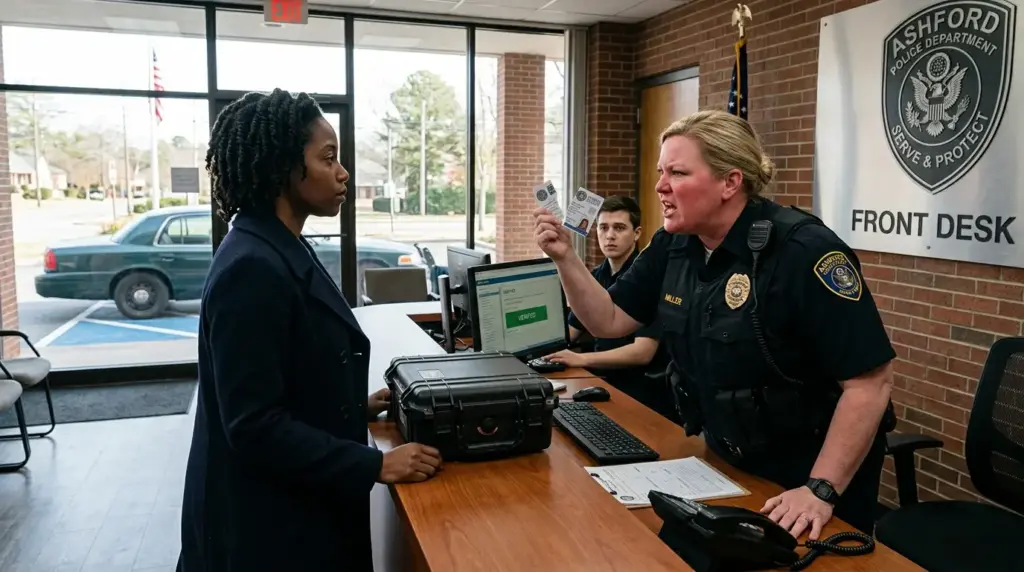
The red indicator on Maya’s coded case changed to green after the FBI technical team completed remote authentication. One of the internal locks released with a quiet click. Rebecca watched from the doorway as Maya opened the case for the first time. Inside were sealed preservation orders, clean storage drives, tamper-evident bags, chain of custody forms, and several authorization packets. There was no equipment that could be used to enter Asheford’s network.
Maya removed one preservation order and handed it to Chief Mercer. “This covers the systems and records identified in the federal review. Your department remains operational. We are preserving evidence, not taking over police functions.”
Mercer read the first page carefully. “And the case?”
“Federal evidence material.”
Rebecca looked at its contents and said nothing. Maya closed the case and turned back to Lena.
“You said the installed system doesn’t match what the city paid for.”
Lena returned to her workstation and opened the procurement database. “The project was approved in phases: body cameras first, then encrypted evidence storage, off-site backup, and dispatch redundancy.”
“How much was paid?”
Lena entered another menu. The total appeared on the monitor. The project had cost several million dollars, combining city funds with federal grant money.
Mercer stepped closer. “That figure covers equipment, software, licensing, installation, support, and long-term maintenance. It isn’t just hardware.”
Maya nodded. “I understand.” She looked at Lena. “What was certified as complete?”
“Everything.” Lena opened the final acceptance document.
The file stated that the new equipment had been installed, tested, integrated with the department’s evidence platform, and placed into active service. The acceptance line carried Daniel Mercer’s electronic signature. A second certification confirmed that the restricted work areas had been secured during installation. That document carried Rebecca Sloan’s name.
Rebecca read it over Lena’s shoulder. “My signature confirms contractor access and site security. I didn’t certify the technical work.”
Maya looked at the wording. “That’s what the document says.”
Rebecca seemed prepared to argue, but Maya had already moved on.
“Who certified the installation itself?”
Lena opened the contractor file: Sloan Integrated Systems. The company president was listed as Calvin Sloan.
Maya looked at Rebecca.
“My brother,” Rebecca said. “The city knew that when the contract was awarded.”
“Was the relationship disclosed in writing?”
“Yes,” Mercer added. “City procurement reviewed the conflict disclosure before the bid was approved.”
Maya said, “Then we’ll preserve that file with the rest.”
Again, she made no accusation. Rebecca appeared more unsettled by the lack of one.
A federal technician working at the second station turned around. “Agent Williams, the active storage environment is significantly smaller than the accepted configuration.”
“How significant?”
“The contract describes three separate retention layers. I can confirm the local layer and part of the redundant storage. I don’t see evidence that the full off-site architecture was ever brought online.”
Mercer said, “Some services are vendor-hosted.”
“Then there should be service endpoints, authentication records, and transfer history,” the technician replied. “I’m not seeing enough of that to support the certification.”
Maya asked Lena, “Where are the installation inventories?”
“In the procurement archive. Original receiving records, too.”
“Yes, open them.”
Lena brought up a list of equipment delivered to the city several months earlier. The quantities matched the federal invoices: body camera units, storage appliances, encryption modules, backup systems, network hardware, and replacement components.
Maya compared the delivery records with the active equipment list. “Where is the hardware that isn’t installed?”
Lena hesitated. “I don’t know.”
Rebecca looked at her. “You manage digital evidence. How do you not know where department equipment is?”
“Because I don’t control municipal receiving.”
Mercer said, “Large technology deliveries often go through central storage before installation.”
Maya turned to him. “Then central storage should have transfer records.”
“It should.”
“Let’s see them.”
Lena searched the city inventory system. Several entries showed that equipment had been received at the municipal storage annex behind the police complex. According to the next set of records, most of it had later been transferred to Sloan Integrated Systems for installation, but the transfer documentation was incomplete. Some entries listed quantities without serial numbers. Others showed equipment moved into service without naming the employee who accepted it.
One line caught Maya’s attention. “Open that.”
Lena selected a storage record from three months earlier. The equipment status read: Project complete. Remaining inventory closed.
Maya asked, “What does ‘inventory closed’ mean?”
Lena shook her head. “It usually means everything assigned to the project has either been installed, returned, or formally disposed of.”
“Do you have disposal records?”
“No.”
“Return records?”
“Not that I can see.”
Rebecca said, “That still doesn’t prove anything is missing. The vendor may have completed the transfer under a different work order.”
Maya looked at her. “Then we’ll find the work order.”
Mercer checked the time on the wall clock, but made no comment about it. “Agent Williams, I have command staff waiting for direction. If your team is going to begin searching city storage facilities, I need to know whether you have specific cause.”





