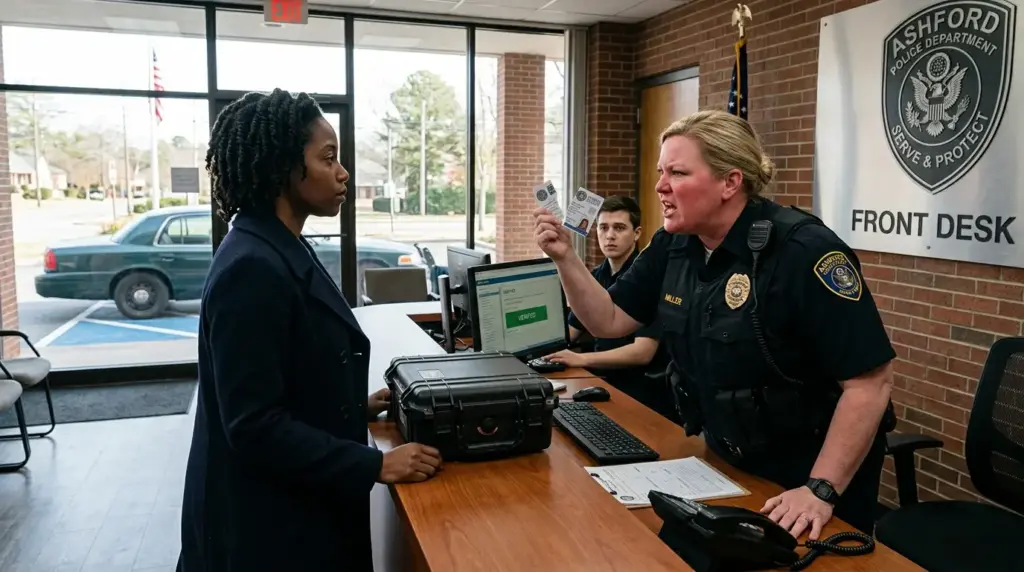
She handed the sheet to Mercer. “This unit is listed as active.”
Mercer examined the number twice. “That may be a clerical error.”
“One could be.” Maya pointed toward the rest of the pallet. “We’re going to find out whether all of them are.”
No one answered.
By the time the federal team finished the preliminary inventory, enough serial numbers had been matched to establish that the discrepancy was not limited to one box or one shipment. Maya did not announce fraud. She ordered the annex sealed for controlled access, assigned an agent to remain with the inventory, and returned to the police building with Mercer and Rebecca.
Lena was waiting in the digital evidence office. “You need to see something from the Cole file.”
Maya removed her coat and placed it over the back of a chair. “What did you find?”
Lena opened Nathan Cole’s case and placed two video records side by side. “The official evidence archive treats this one as the original body camera sequence.”
A video showed Nathan standing near a municipal service entrance while an Asheford officer checked his identification and belongings. Nathan appeared frustrated but cooperative. The video stopped. A second segment began later: an officer held up a restricted municipal access card and identified it as having been found among Nathan’s possessions.
Maya watched both clips without interrupting. “What’s missing?”
“The source continuity.” Lena enlarged the file information. “A body camera generates identifiers through the entire recording session. This first section has the correct source information. The second one doesn’t.”
Rebecca stood behind them. “That doesn’t mean the evidence was planted.”
Maya answered without turning around: “No, it doesn’t.”
Rebecca seemed surprised by the agreement.
Lena continued: “The second clip was exported later, then placed back into the case archive. The system labels it as original, but the file history doesn’t support that.”
Mercer moved closer to the screen. “Could normal processing cause that?”
“Not this way.”
“Could a software migration?”
“We didn’t migrate the system during that period.”
Maya asked, “Where is the uninterrupted source recording?”
Lena shook her head. “Not in the visible archive.”
“Was it ever there?”
“Yes.”
“How do you know?”
“I saw the original entry before it disappeared.”
Maya looked at her. “When?”
“Shortly after Nathan was detained.”
“And what did the original show?”
Lena chose her words carefully. “I didn’t watch the entire recording. I checked it because Nathan filed a complaint about the missing section. At that point, the continuous file existed.”
Rebecca said, “A complaint doesn’t make him right.”
“No,” Maya replied. “But an original file disappearing after the complaint makes the file important.”
She asked Lena to open Nathan’s detention report. Nathan Cole was 25 years old and had worked temporarily for a subcontractor servicing a municipal building. According to the report, he had been questioned after a restricted city access card was found among his belongings. He was held for several hours while officers investigated possible unauthorized access. No physical injury was reported. No violent confrontation was recorded. The entire detention depended on the access card.
Maya read Nathan’s statement: he had denied possessing it from the beginning. He also claimed that several days before his detention, he had noticed repeated searches of city surveillance records that had nothing to do with his assigned work—vehicle locations, traffic cameras, municipal access histories.
Maya looked at Lena. “Is this why you contacted the federal office?”
Lena nodded. “It was the first time I realized the storage problem might be affecting people, not just invoices.”
Maya returned to the video. If the access card had been planted and the body camera record altered afterward, Asheford was no longer dealing only with missing equipment or questionable grant money: a citizen had lost his freedom, even temporarily, because a digital record said something happened.
Maya closed the report. “A false file can hold a man just as effectively as a locked door.”
Mercer said, “We still don’t know that the file is false.”
“You’re right.” Maya turned to Lena. “Preserve every version of Nathan Cole’s body camera evidence, every export, every administrator session, and every access record tied to his case.”
“Already started.”
“Good. Now find me the original source.”
Lena looked at the monitor. “If it still exists, it isn’t where the department says it should be.”
Maya glanced toward the equipment list from the storage annex. Millions of dollars had been paid for a system that did not physically exist as certified. Nathan Cole’s original recording had disappeared from the system that was supposed to protect it. Those two facts were now part of the same investigation.
Maya looked at the federal technician: “Map the actual storage architecture. I want to know where Asheford’s evidence is really going.”
The federal technician began by comparing Asheford’s active network inventory with the equipment records recovered from the storage annex. Within twenty minutes, he had identified enough matching serial numbers to confirm that the discrepancy extended well beyond Nathan Cole’s case.
Maya stood beside Lena’s workstation while the technician entered each serial number into the procurement database.
“This storage module is listed as installed in the primary evidence array,” he said.
“Where is it physically?” Maya asked.
“In the annex.” He entered another number. “This encryption appliance is listed as active in the redundant backup system.”
“Also in storage?”
“Yes.”
A third device produced the same result.
Chief Mercer remained near the doorway. “If equipment was reassigned or replaced, the inventory system may not have been updated correctly.”
Maya turned to him. “Then we need the replacement records.”
“I already told you: the vendor handled installation, and the department accepted the work.”





