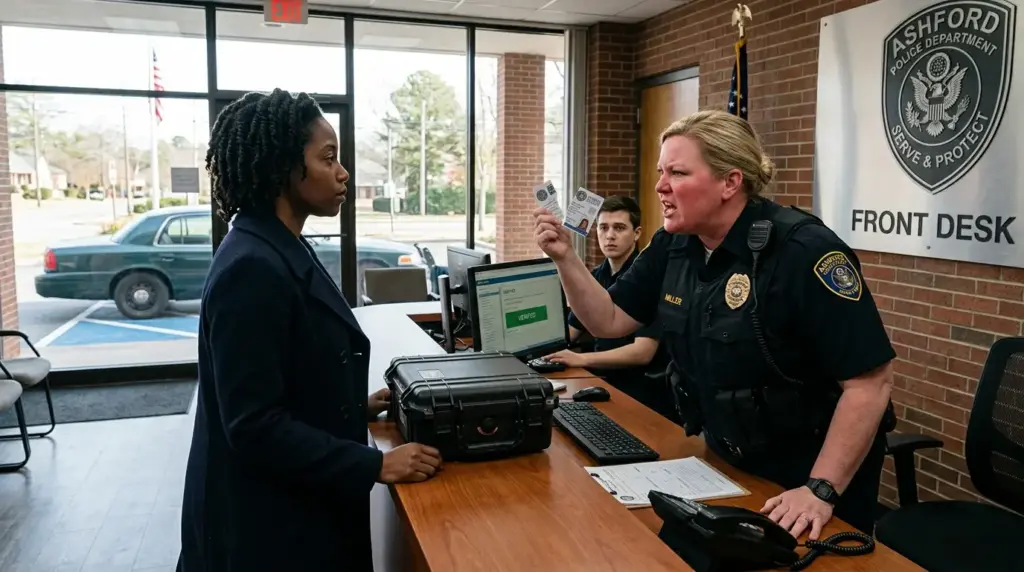
Maya handed him the acceptance record. “Your department certified millions of dollars in technology as installed and operational. Your active network does not show that capacity, and your inventory system cannot account for the difference. That is specific enough to inspect equipment purchased under the grant.”
Mercer read the document again. He did not object further.
Maya turned to one of the federal agents. “Get a city representative and a camera. Nothing moves until it’s photographed where it sits.”
The agent nodded and left.
Lena remained at the computer. Maya noticed her looking at the Nathan Cole file, still open in a minimized window. “You think this is connected?”
Lena answered carefully. “I think the problems started around the same period.”
“What problems?”
“The storage inconsistencies, contractor access after hours, Nathan’s missing source footage… They all began after the new system was supposed to be fully active.”
Maya asked, “Did you ever see Calvin Sloan working here personally?”
“A few times during normal maintenance hours.”
“And the other times?”
Lena looked toward Rebecca before answering: “Late evenings, usually after most administrative staff had gone home.”
Rebecca immediately said, “Contractors were approved for off-hours work because the system couldn’t be interrupted during normal operations.”
Maya nodded. “Who approved that access?”
“I did, when it was on the authorized schedule.”
Maya turned back to Lena. “Preserve every contractor entry record you still have.”
The federal technician raised a hand from the second workstation. “Agent Williams, one more thing.” He pointed to the certificate list. “Sloan Integrated Systems still has active administrator credentials.”
Mercer frowned. “That contract includes maintenance.”
The technician replied, “These aren’t limited maintenance credentials. At least one certificate has broader privileges than the documentation describes.”
Maya looked at the screen. “Can it alter retention settings?”
“Yes.”
“Can it modify evidence metadata?”
“With the permissions I’m seeing? Potentially.”
Maya gave the technician a clear instruction: “Do not revoke it yet. Mirror every action and every connection it makes.”
Rebecca stared at her. “If you think the credential is dangerous, why leave it active?”
“Because I want to know who is using it.”
A city facilities employee arrived a few minutes later with keys to the municipal storage annex. Maya picked up her coded case, and the federal photographer followed her toward the rear exit. The paperwork said Asheford had already installed everything it bought. Now they were going to see what was still sitting in the boxes.
The municipal storage annex stood behind the police complex, beside the vehicle maintenance building. A city facility supervisor named Frank Holloway unlocked the side entrance and signed the federal entry sheet before Maya allowed anyone inside.
“Nothing gets moved until it’s photographed,” Maya said.
Frank nodded. “Understood, Agent Williams.”
The overhead lights came on one row at a time. Stacks of equipment filled the rear half of the building. The federal photographer began documenting the room from the doorway while another agent compared serial numbers against the procurement list Lena had printed.
Maya stopped beside the first pallet. The boxes were marked with the same manufacturer listed in Asheford’s technology contract: body cameras, charging stations, encrypted storage modules, network appliances. Most of the manufacturer seals were still intact.
Frank looked at the paperwork in his hand. “These have been here for months.”
Chief Mercer turned toward him. “Why weren’t they released to the contractor?”
“They were.”
Mercer frowned. “Then why are they still here?”
Frank pointed to a receiving sticker on one of the boxes. “Sloan Integrated Systems signed them out for installation, then returned them to this bay under temporary storage. Nobody ever submitted another release request.”
Rebecca stepped closer. “Who signed the return?”
Frank checked the inventory sheet. “There’s no individual signature, just the contractor account.”
Maya asked, “How many pallets?”
“Seven in this section. There may be more in the locked cage.”
“Open it.”
Frank unlocked a wire mesh storage enclosure at the back of the annex. More equipment sat inside. One federal agent began reading serial numbers while another checked them against the invoices.
After several minutes, the pattern became clear: the city had paid for equipment that its own records described as installed and operational, but a substantial portion of that equipment had never left storage long enough to enter service.
Mercer studied the sealed boxes. “There could be a legitimate explanation. The vendor may have replaced units with equivalent equipment.”
Maya looked at him. “Then there will be substitution records.”
“And if there aren’t?”
“Then we document that, too.”
Rebecca folded her arms. “You keep saying ‘document.’ At some point, you’re going to have to tell us what you think happened.”
“No,” Maya said. “At some point, the evidence will tell us.”
A federal agent opened the procurement folder. “Agent Williams, the final payment was released after the completion certification signed by Chief Mercer for departmental acceptance. Vendor certification by Calvin Sloan.”
Rebecca spoke before Mercer could respond: “My brother handled the company. I didn’t handle billing.”
Maya looked at the security certification attached to the project. “You signed that contractor access to the restricted installation areas was completed according to schedule.”
“That’s right.”
“Were you present for every installation period?”
“No. My staff handled some of them.”
“Then we’ll need the duty roster.”
Rebecca’s jaw tightened, but she nodded.
Maya turned to Frank. “Was any of this equipment ever taken out of its packaging here?”
“Not that I saw.”
“How long have you worked municipal facilities?”
“Twenty-two years.”
“And you’re certain?”
Frank looked at the sealed pallets again. “I know what opened shipping bands look like. Those haven’t been cut.”
Maya asked the photographer to capture the seals in close detail. A single body camera was visible through clear packaging near the top of one carton. The contract said hundreds of similar units had already been placed in service. Maya checked the serial number against the delivery list; it appeared on the city’s completed installation inventory.





